Interpretation of Bi-207 decay spectrum

Click For Summary
SUMMARY

The discussion focuses on the interpretation of the Bi-207 decay spectrum measured using a scintillation detector. The Bi-207 nuclei primarily decay to excited states of Pb-207 through electron capture (EC) and a minor beta+ branch, emitting beta particles with a maximum energy of 806 keV and an average energy of 383 keV. The decay also produces gamma rays at 570 keV (98%), 1064 keV (74.6%), and 1770 keV (6.87%). Participants clarified that the observed peaks in the spectrum were Compton edges from the Pb-207 gamma emissions, rather than photo peaks, indicating a need for proper calibration and understanding of the detector response.

PREREQUISITES
  • Understanding of beta decay and electron capture processes
  • Familiarity with gamma spectroscopy and scintillation detectors
  • Knowledge of Compton scattering and energy calibration techniques
  • Awareness of nuclear decay schemes, particularly for Bi-207 and Pb-207
NEXT STEPS
  • Research the decay schemes of Bi-207 and Pb-207 to understand their energy levels
  • Learn about Compton scattering and how it affects gamma spectroscopy results
  • Study calibration methods for scintillation detectors to improve measurement accuracy
  • Explore the significance of photo peaks versus Compton edges in gamma spectra analysis
USEFUL FOR

Researchers in nuclear physics, experimental physicists, and anyone involved in gamma spectroscopy or decay analysis of isotopes like Bi-207 and Pb-207.

XLAYZ
Messages
7
Reaction score
0
TL;DR
Please help me interpret the Bi-207 decay spectrum, e.g. origin of the peaks, whether beta particles or gammas.
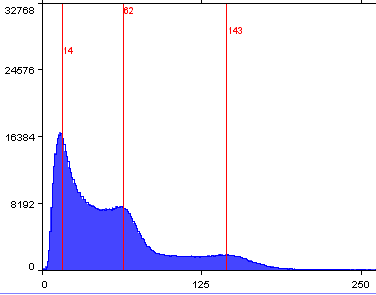
I measured the decay spectrum of Bi-207 as a beta source with scintillation detector and now I am trying to interpret the information given by the spectrum. As far as I know, the Bi-207 nuclei decay to the excited states of Pb-207 primarily via EC and a small beta+ branch, emitting beta particles of E_max=806keV, E_ave=383 keV, and the excited states of Pb-207 decays via IC, emitting conversion electrons of ~ 1 MeV. In addition, the Bi-207 decay was accompanied by emission of gamma rays of 570 keV (98%), 1064 keV(74.6%), and 1770 keV (6.87%).

In this measurement Bi-207 was used as the beta source to test the detector response to beta particles, however, in similar measured spectrum of Bi-207 made by others, it was described as the gamma spectrum with peaks at 570 and 1064 keV.
ask.png

Now I am quite confused of the measured spectrum, e.g. the origin of the two peaks, and what else information can be drawn from the spectrum.
Any helps would be very appreciated. Thank you in advance!
 
Physics news on Phys.org
Gammas from the decay of the 207Pb excited states. Look up the level schemes.
 
I am assuming the abscissa for your spectrum is channel number is that correct? If so what are the energies that the peaks represent? I also assume that at some point you calibrated the detector.
 
I would have expected to see a few sharper peaks also.
 
bobob said:
Gammas from the decay of the 207Pb excited states. Look up the level schemes.
Thanks, now I have figured it out. Those "peaks" were the Compton edges of the Pb-207 gammas.
 
gleem said:
I am assuming the abscissa for your spectrum is channel number is that correct? If so what are the energies that the peaks represent? I also assume that at some point you calibrated the detector.
Yes, they were the Compton edges of gammas. Thanks.
 
XLAYZ said:
es, they were the Compton edges of gammas. Thanks.

So where are the photo peaks? You should also describe your experimental setup. Your spectrum is not showing a typical response to gammas of the energy emitted by Pb207.
 

Similar threads

  • · Replies 2 ·
Replies
2
Views
2K
  • · Replies 1 ·
Replies
1
Views
7K
  • · Replies 4 ·
Replies
4
Views
2K
  • · Replies 3 ·
Replies
3
Views
5K
  • · Replies 2 ·
Replies
2
Views
21K
  • · Replies 2 ·
Replies
2
Views
9K
  • · Replies 50 ·
2
Replies
50
Views
10K