Interpreting Energy diagrams for polyatomic molecules

Click For Summary
SUMMARY

This discussion focuses on interpreting energy diagrams for polyatomic molecules, specifically the relationships between electronic, vibrational, rotational, and translational energy levels. It establishes that electronic energy levels are electrostatic potential energy levels associated with electrons and nuclei, while vibrational and rotational states can be excited by absorbing external energy. The conversation highlights that transitions between these states can occur simultaneously, adhering to selection rules, and emphasizes the concept of vibrational energy being coupled into vibrational bands, particularly in the context of infrared energy absorption.

PREREQUISITES
  • Understanding of polyatomic molecular structure
  • Familiarity with energy quantization in molecular systems
  • Knowledge of vibrational and rotational energy states
  • Basic principles of electronic transitions and selection rules
NEXT STEPS
  • Research the concept of "vibronically allowed" transitions in molecular spectroscopy
  • Study the role of infrared spectroscopy in identifying vibrational energy levels
  • Explore the effects of temperature on vibrational energy states in molecules
  • Learn about the quantization of energy levels in polyatomic molecules
USEFUL FOR

Chemists, physicists, and students studying molecular spectroscopy, particularly those interested in the interactions of energy levels in polyatomic molecules and the implications for vibrational and rotational transitions.

fog37
Messages
1,566
Reaction score
108
TL;DR
understand energy levels in energy diagram for compounds
Hello,
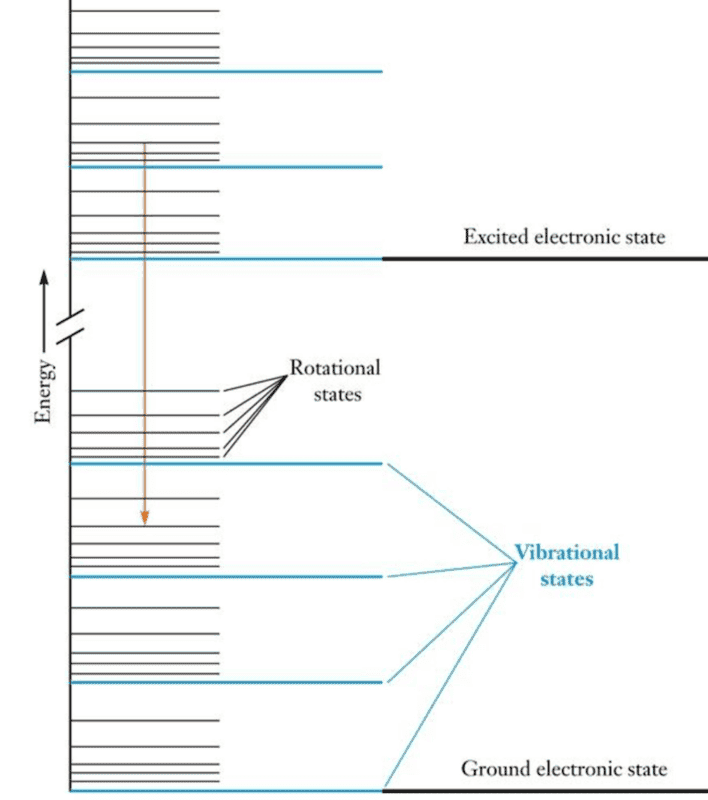
I am trying to correctly interpret the energy diagram below.

For example, a diatomic molecule can translate (kinetic energy), rotate (rotational energy), vibrate (vibrational energy). Each different type of energy is quantized and has associated modes (also called states). The rotational, vibrational, translational energy states/levels/modes pertain to the molecule as a whole. On the other hand, electronic energy levels are electrostatic potential energy levels (not kinetic energy) and pertain to the electrons and nuclei.

The vertical axis in the diagram, labelled Energy, therefore indicates energy in general, correct?
1610037115432.png
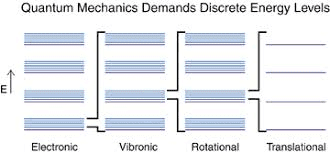
Based on the next figure below, what does it mean that an electronic energy level is comprised by several vibrational energy levels which are, in turn, comprised by many rotational energy levels? I know that when multiple molecules connect together, energy bands are formed instead of discrete and sharp energy levels. A band is formed by many discrete energy levels slightly separated from each other.

Do rotational/vibrational states get excited when a molecules absorbs external energy that does not match the difference between electronic energy levels?
1610037367708.png
 
Last edited:
Chemistry news on Phys.org
At each electronic energy level, the total energy is still a sum of the electronic, rotational, vibrational and translational. Those fine energy levels superimposed on the electronic states reflect those states as well. You may need to adjust your understanding of “where” the energy resides. Electronic energy levels are for the bond within the whole molecule and the vibrational, rotational and translational energies go along for that ride as well within each bond.
fog37 said:
Do rotational/vibrational states get excited when a molecules absorbs external energy that does not match the difference between electronic energy levels?
. Those types of energy that molecules absorb relate to that fine structure you see described. Vibrational energy is coupled into the vibrational bands (infrared energy), translational energy into the translational bands (temperature) and rotational energy by the rotational bands ( microwave energy).
 
Last edited:
  • Like
Likes   Reactions: fog37
Thank you chemisttree.

What do you mean that "Vibrational energy is coupled into the vibrational bands (infrared energy)..."

Coupled in what sense? I know that if the diatomic molecules absorbs energy equal to the the difference from ground state to first excited electronic energy state (thick blue lines), the molecule will move to that excited electronics state...Will the molecule be automatically excited into vibrational (red/green lines) and rotational states during that transition? I don't believe so.

From the figure below, if the absorbed energy is not equal to jump from blue line to blue line (longer red transition), then the molecule may be excited into vibrational or rotational states...How could it get excited into both types of states if it needs to land on a specific horizontal energy line?

1610109738251.png
 

Attachments

  • 1610109568365.png
    1610109568365.png
    40.4 KB · Views: 235
How could it get excited? By absorbing a photon of the right energy. It is perfectly possible to change rotational, vibrational and electronic states at the same time (though not without limit - there are selection rules). For example, in the diagram in your initial post, there is a red arrow (going downwards, so the molecule will emit a photon and lose energy) from a level in the upper electronic state with vibrational and rotational quantum numbers v' = 1 and J' = 3 to a level in the lower electronic state with v'' = 2 and J'' = 4. (Δv = ± 1 and ΔJ = ±1 are allowed.) Indeed, sometimes an electronic transition (between the ground vibrational states of two electronic states) which is forbidden by symmetry can be allowed if a vibrational mode of appropriate symmetry is simultaneously excited (i.e. between v'' = 0 and v' = 1); then we say that the transition is "vibronically allowed".
 
  • Like
Likes   Reactions: chemisttree and BvU
Wow, that was a quick "like"!
 
Had some 1972 lecture notes at hand ... :-p
 
fog37 said:
Thank you chemisttree.

What do you mean that "Vibrational energy is coupled into the vibrational bands (infrared energy)..."

Coupled in what sense? I know that if the diatomic molecules absorbs energy equal to the the difference from ground state to first excited electronic energy state (thick blue lines), the molecule will move to that excited electronics state...Will the molecule be automatically excited into vibrational (red/green lines) and rotational states during that transition? I don't believe so.
Molecules above absolute zero in temperature already have vibrational energy. The “ground state” is actually a manifold of states. If energy of the appropriate magnitude is absorbed to jump into an excited electronic state (UV or visible energy), the manifold of states ( the fine structure you see around the various electronic states) around the electronically excited molecule can be populated directly. The excited state can itself both absorb and emit vibrational and rotational energy from that state as well.
 

Similar threads

  • · Replies 12 ·
Replies
12
Views
3K
  • · Replies 8 ·
Replies
8
Views
2K
  • · Replies 12 ·
Replies
12
Views
3K
  • · Replies 2 ·
Replies
2
Views
2K
  • · Replies 83 ·
3
Replies
83
Views
8K
  • · Replies 1 ·
Replies
1
Views
2K
  • · Replies 3 ·
Replies
3
Views
2K
  • · Replies 8 ·
Replies
8
Views
5K
  • · Replies 156 ·
6
Replies
156
Views
11K
  • · Replies 4 ·
Replies
4
Views
1K