What are phasor and sinor diagrams and how do you interpret them?
- Thread starter Lord Loh.
- Start date
-
- Tags
- Phasor
Join the discussion
Registration is free. Ask a follow-up in this thread, or start your own.
5 replies · 5K views

Discussion
Physics news on Phys.org
Homework Helper
- 652
- 0
Phasors and sinors are mathematical concepts, and very important ones for many different problems. Firstly you must be somewhat familiar with complex numbers and plotting complex numbers. They basically replot a sinusodial onto the complex plane with the y-axis being imaginary and the x-axis being real. They do this by relating [tex]A cos (\omega t + \phi) = Re(Ae^{\phi}e^{\omega t})[/tex] from Euler's formula. The phasor is a vector in this domain with origin at 0,0. The phasor is stripped of the time component. The sinor is a rotating phasor (i.e. time component added).
To understand how they represent the time dependent function [tex]sin (\omega t + \phi)[/tex], drop down a shadow from the sinor vector onto the real plane. That is the magnitude of the signal in the real plane at any time t. You see that as the sinor rotates, the shadow on the x-axis shrinks and grows, just as you do with the time-dependent sinusodial. The component in the imaginary axis is like a 'conserved' portion of the signal.
Subsequently, to truly appreciate phasors, you have to start solving some problems. You'll see that the elimination of the time dependent term helps simplifies calculations tremendously.
To understand how they represent the time dependent function [tex]sin (\omega t + \phi)[/tex], drop down a shadow from the sinor vector onto the real plane. That is the magnitude of the signal in the real plane at any time t. You see that as the sinor rotates, the shadow on the x-axis shrinks and grows, just as you do with the time-dependent sinusodial. The component in the imaginary axis is like a 'conserved' portion of the signal.
Subsequently, to truly appreciate phasors, you have to start solving some problems. You'll see that the elimination of the time dependent term helps simplifies calculations tremendously.
Last edited:
Lord Loh.
- 7
- 0
Thanks a lot mezarashi for the lucid explanation. It dispelled some doubts but a few more still remain.
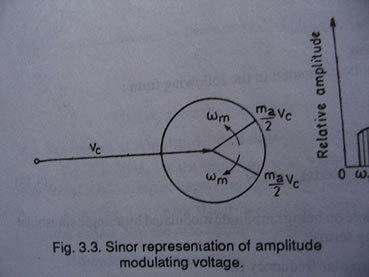
Okay, So in the attached diagram, the Vc is totally real therefore it is on the X axis. And the length of vector Vc is it's amplitude. And it has no time component. (This is the phasor part of the diagram). Am I right so far?
--------------------------
The plot is that of an amplitude modulated signal.
V={Vc + Ka Vm Cos(Wm t)} Cos (Wc t)
Where
Vc = Amplitude of the carrier frequency
Vm = Amplitude of the modulating frequency
Wc = Carrier frequency
Wm = Modulating frequency
Ka = A constant of amplification or attenuation.
The same equation may also be written as
V=Vc {1 + [(Ka Vm)/Vc] Cos (Wm t)} Cos (Wc t)
and (Ka Vm)/Vc is designated Ma, the modulating index and thus,
V=Vc {1 + Ma Cos (Wm t)} Cos (Wc t)
------------------------------------------
Now I do not understand the two Wm near the curved arrows in the complex plane and the (Ma Vc)/2
Okay, So in the attached diagram, the Vc is totally real therefore it is on the X axis. And the length of vector Vc is it's amplitude. And it has no time component. (This is the phasor part of the diagram). Am I right so far?
--------------------------
The plot is that of an amplitude modulated signal.
V={Vc + Ka Vm Cos(Wm t)} Cos (Wc t)
Where
Vc = Amplitude of the carrier frequency
Vm = Amplitude of the modulating frequency
Wc = Carrier frequency
Wm = Modulating frequency
Ka = A constant of amplification or attenuation.
The same equation may also be written as
V=Vc {1 + [(Ka Vm)/Vc] Cos (Wm t)} Cos (Wc t)
and (Ka Vm)/Vc is designated Ma, the modulating index and thus,
V=Vc {1 + Ma Cos (Wm t)} Cos (Wc t)
------------------------------------------
Now I do not understand the two Wm near the curved arrows in the complex plane and the (Ma Vc)/2
Homework Helper
- 652
- 0
Sorry I didn't reply earlier, because your attachment was not approved, so I couldn't see what you were talking about. Are you learning radio angle modulation already while learning circuit fundamentals like phasors? It's a relatively advanced topic. Your college must have a really weird cirriculum. I remember struggling in communications even in my junior year. Anyway.
The Vc is real, because this is the reference. We denote the carrier signal to be in phase, or phase = 0. This is just for simplicity. Angle modulation means that we encode our signal in the angle of the carrier signal. In the time domain, this looks like:
[tex]V = V_c cos(\omega t + \Phi)[/tex]
[tex]V = V_c cos(\omega t + Kcos(\omega_{message}t))[/tex]
But, as you can see the simplicity which comes from a time domain to frequency domain analysis. With phasors, we look only at the angle. So you see that the message signal causes the Vc+Vm to move up and down by a bit. As Vc+Vm moves up, it will no longer be completely real. There will be a phase. Thus why it is called phase modulation. I hope that's what you were looking for.
The Vc is real, because this is the reference. We denote the carrier signal to be in phase, or phase = 0. This is just for simplicity. Angle modulation means that we encode our signal in the angle of the carrier signal. In the time domain, this looks like:
[tex]V = V_c cos(\omega t + \Phi)[/tex]
[tex]V = V_c cos(\omega t + Kcos(\omega_{message}t))[/tex]
But, as you can see the simplicity which comes from a time domain to frequency domain analysis. With phasors, we look only at the angle. So you see that the message signal causes the Vc+Vm to move up and down by a bit. As Vc+Vm moves up, it will no longer be completely real. There will be a phase. Thus why it is called phase modulation. I hope that's what you were looking for.
Lord Loh.
- 7
- 0
The diagram I posted was meant for amplitude modulation and not phase angle modulation.
In case of AM, the carrier is supposed to be changed in accordance to the instantaneous value of the modulating voltage. So Vc should be changing on the X axis.
So should I understand that the sinor is the vector sum of Vc+Wm?
I am still confused... We were being taught AM before being taught amplifiers and transistors... We had to fit it all like a jigsaw puzzle rather than like a building from foundation to apex.
In case of AM, the carrier is supposed to be changed in accordance to the instantaneous value of the modulating voltage. So Vc should be changing on the X axis.
So should I understand that the sinor is the vector sum of Vc+Wm?
I am still confused... We were being taught AM before being taught amplifiers and transistors... We had to fit it all like a jigsaw puzzle rather than like a building from foundation to apex.
Homework Helper
- 1,249
- 30
The amplitude of the (high frequency!) carrier wave is changing -
but slowly, taking 100 carrier cycles for 1 modulation cycle.
The diagrams want to avoid having the big fast carrier wave rotation
ovwerwhelm the small slow modulation rotation.
To keep the V totally Real, (the traditional approach) is to
add TWO modulation sources: one positive frequency + one negative,
each with half the (total) modulation Voltage.
I would've drawn the two of them tail-to-tip so you'd see a Real sum.
Only EVER add Voltages to Voltages (never add Voltage to frequency!)
(but I'm sure you know frequencies add and sutract from frequencies
to make sideband , single or double ... ).
but slowly, taking 100 carrier cycles for 1 modulation cycle.
The diagrams want to avoid having the big fast carrier wave rotation
ovwerwhelm the small slow modulation rotation.
To keep the V totally Real, (the traditional approach) is to
add TWO modulation sources: one positive frequency + one negative,
each with half the (total) modulation Voltage.
I would've drawn the two of them tail-to-tip so you'd see a Real sum.
Only EVER add Voltages to Voltages (never add Voltage to frequency!)
(but I'm sure you know frequencies add and sutract from frequencies
to make sideband , single or double ... ).