Bolter
- 262
- 31
- Homework Statement
- See full question below
- Relevant Equations
- None
This is a quick multiple choice question in which I need to interpret the graph and see which statement is true
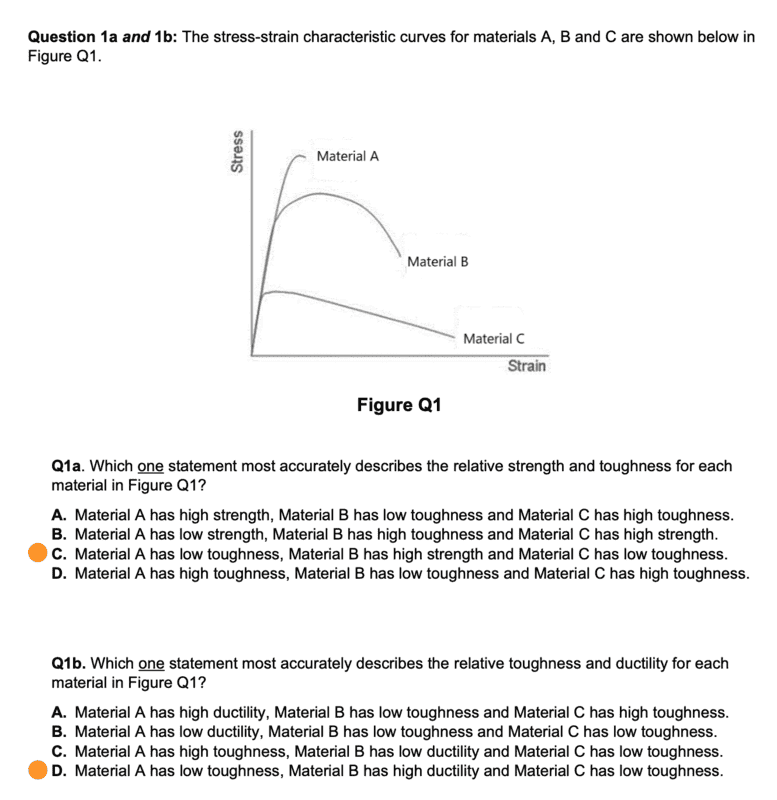
This is what I have found from looking at the graph
I know that strength is determined by the maximum stress a material can withstand in its elastic region.
And toughness is the ability of a material to absorb a certain energy before complete rupture, I know this property can be relatively measured by the area under the whole curve.
In 1a, option a) Material A does have high strength but clearly material B is more tougher than material C as material B occupies a larger area beneath its curve than material C before rupture.
Hence cannot be option a
Also cannot be option b either as material A is NOT low in strength
Again not option d too as material B is certainly not low in toughness, in fact it is the toughest material there?
So my answer for 1a) leaves with option c to be the one. That is my reasoningMoving to 1b now, it now brings in ductility. From what I understand about ductility is that it is defined as the degree of elongation before complete rupture.
So looking at the graph again, I can conclude that material C has high ductility?
Material A is most likely brittle or in other words less ductile.
Can't be option a, as material A is not high ductility
Can't be option b, as material B is not low toughness
And finally can't be option c too as material B does not have low ductility, material A does
So this leaves me with option d as the answer.
I'm feeling very confused with these mcq's as I don't believe my reasoning is right.
Thanks for any help!
This is what I have found from looking at the graph
I know that strength is determined by the maximum stress a material can withstand in its elastic region.
And toughness is the ability of a material to absorb a certain energy before complete rupture, I know this property can be relatively measured by the area under the whole curve.
In 1a, option a) Material A does have high strength but clearly material B is more tougher than material C as material B occupies a larger area beneath its curve than material C before rupture.
Hence cannot be option a
Also cannot be option b either as material A is NOT low in strength
Again not option d too as material B is certainly not low in toughness, in fact it is the toughest material there?
So my answer for 1a) leaves with option c to be the one. That is my reasoningMoving to 1b now, it now brings in ductility. From what I understand about ductility is that it is defined as the degree of elongation before complete rupture.
So looking at the graph again, I can conclude that material C has high ductility?
Material A is most likely brittle or in other words less ductile.
Can't be option a, as material A is not high ductility
Can't be option b, as material B is not low toughness
And finally can't be option c too as material B does not have low ductility, material A does
So this leaves me with option d as the answer.
I'm feeling very confused with these mcq's as I don't believe my reasoning is right.
Thanks for any help!