Estimating Mass of Central Object Using S2's Orbit Motion and Kepler's 3rd Law

  • Context: Undergrad 
  • Thread starter Thread starter doopa
  • Start date Start date
  • Tags Tags
    Orbit
Click For Summary
SUMMARY

The discussion focuses on estimating the mass of a central object using the orbit motion of star S2 and Kepler's 3rd Law. Participants clarify that the radius used in calculations is half the semi-major axis of the elliptical orbit, with an estimated value of 0.1 arcseconds for S2's orbit. The importance of correcting for orbital tilt is emphasized, as it affects the accuracy of mass estimation. The discussion references specific tools and concepts, including the arcsec relation and the need to analyze the tilt of the orbit.

PREREQUISITES
  • Understanding of Kepler's 3rd Law
  • Familiarity with orbital mechanics and elliptical orbits
  • Knowledge of angular measurements in arcseconds
  • Ability to interpret astronomical graphs and diagrams
NEXT STEPS
  • Research the application of Kepler's 3rd Law in mass estimation
  • Learn about the arcsec relation in astronomy
  • Investigate methods for correcting orbital tilt in mass calculations
  • Explore the significance of semi-major axes in elliptical orbits
USEFUL FOR

Astronomy students, astrophysicists, and anyone interested in celestial mechanics and mass estimation of astronomical objects.

doopa
Messages
6
Reaction score
1
TL;DR
I want to understand how one can go about estimating the mass of a central object given the a graph the orbital motion of S2, or any given star for that matter.
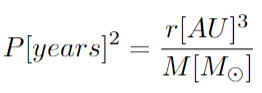
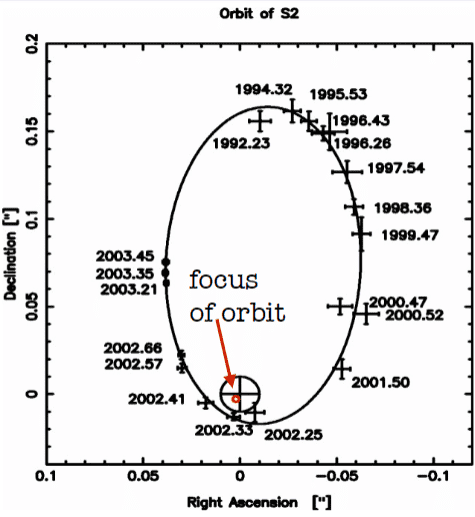
During one of my class lectures, we were shown a graph of star S2's orbit motion (shown at the bottom of this post) and was told to try and figure out how to find the mass of the central object using Kepler’s 3rd law in solar units, as shown below:
1678026251763.png


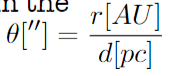
We were also given a hint to use the arcsec relation and read the radius of the orbit from the image, as shown below:
1678026338495.png


From my notes, it looks like we had to use the declination value of 0.1, but I still don't understand how exactly we got to that point. Does anyone happen to know why this is and how to generally use these types of graphs to estimate the mass of a central object?
1678026170065.png
 
Astronomy news on Phys.org
The "radius" in the formula is actually half the semi-major axis of the ellipse (which obviously doesn't have a constant radius). Based on the diagram, 0.1'' might be a good estimate for the semi-major axis.
 
As @pasmith said, reading from the diagram, the semimajor axis is about 0.1". This is the θ in your second formula. It is not a declination, it is the angular size of the orbit.
 

Similar threads

  • · Replies 2 ·
Replies
2
Views
1K
  • · Replies 1 ·
Replies
1
Views
2K
  • · Replies 1 ·
Replies
1
Views
2K
  • · Replies 8 ·
Replies
8
Views
4K
  • · Replies 86 ·
3
Replies
86
Views
8K
  • · Replies 8 ·
Replies
8
Views
2K
  • · Replies 7 ·
Replies
7
Views
1K
  • · Replies 4 ·
Replies
4
Views
5K
  • · Replies 12 ·
Replies
12
Views
3K
  • · Replies 3 ·
Replies
3
Views
3K