SUMMARY
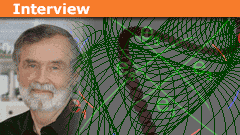
The forum discussion centers on the contributions of David Hestenes to physics, particularly his work on geometric algebra and its implications for understanding complex numbers in physics. Hestenes, a Professor Emeritus at Arizona State University, emphasizes that geometric algebra serves as a compact notation for tensors and spinors, facilitating a new interpretation of mathematical constructs in physics. The discussion highlights the potential of geometric algebra to unify various mathematical objects and its relevance in deriving equations such as the Pauli equation from the Schrödinger equation.
PREREQUISITES
- Understanding of geometric algebra concepts
- Familiarity with tensor and spinor mathematics
- Knowledge of the Schrödinger and Pauli equations
- Basic principles of quantum mechanics and relativistic physics
NEXT STEPS
- Explore the implications of geometric algebra in quantum mechanics
- Study the Force-Concept Inventory and Modeling Instruction in physics education
- Investigate the role of complex numbers in the mathematics of physics
- Learn about the historical context and applications of spinors in theoretical physics
USEFUL FOR
Physicists, mathematics educators, and students interested in advanced theoretical physics, particularly those focusing on the intersection of geometry and quantum mechanics.