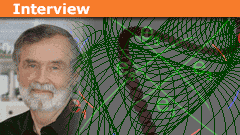
Interview with a Physicist: David Hestenes - Comments

Click For Summary

Discussion Overview

The discussion revolves around the contributions and interpretations of David Hestenes' work, particularly in relation to geometric algebra and its implications in physics. Participants explore the nature of geometric algebra, its comparison to traditional tensor and spinor notation, and its potential insights into complex numbers and the Dirac equation.

Discussion Character

  • Exploratory
  • Technical explanation
  • Debate/contested

Main Points Raised

  • Some participants argue that referring to Hestenes solely as a mathematician overlooks his contributions to physics, noting his background and current role in the Physics Department at ASU.
  • There are differing views on whether geometric algebra is merely a compact notation or if it provides new insights, with some suggesting it leads to a new interpretation of complex numbers in physics.
  • One participant compares geometric algebra to the introduction of 4-vector notation in non-relativistic physics, suggesting that while it simplifies notation, it may not add deeper physical content.
  • Another participant posits that the geometric algebra approach offers a distinct interpretation of the Dirac gamma matrices, viewing them as basis vectors rather than components of a matrix-valued vector.
  • Concerns are raised about the implications of treating gamma matrices solely as basis vectors, questioning whether this limits the ability to extract relevant physical information from the Dirac equation.
  • Some participants note that the occurrence of mixed objects in geometric algebra may not align with traditional approaches, while others argue that linear combinations of scalars, vectors, and tensors have been utilized in traditional vector spaces since the 1930s.
  • There is a reference to historical works, such as E. Cartan's "Theory of Spinors," suggesting that the treatment of gamma matrices as basis vectors is not a novel idea.

Areas of Agreement / Disagreement

Participants express a range of opinions on the significance and interpretation of geometric algebra, with no clear consensus on whether it offers new insights or is simply a matter of notation. The discussion remains unresolved regarding the implications of treating gamma matrices as basis vectors.

Contextual Notes

Some claims about the nature of geometric algebra and its relationship to traditional physics concepts are presented without consensus, and there are unresolved questions about the representation of gamma matrices and their physical implications.

micromass
Staff Emeritus
Science Advisor
Homework Helper
Insights Author
Messages
22,170
Reaction score
3,326
micromass submitted a new PF Insights post

Interview with a physicist: David Hestenes

DavidHestenes.png


Continue reading the Original PF Insights Post.
 
Last edited by a moderator:
  • Like
Likes   Reactions: Charles Link, MexChemE, FactChecker and 2 others
Physics news on Phys.org
I think it is more correct to refer to David Hestenes as a physicist...
maybe mathematical physicist (although he is also involved in physics education research [Force-Concept Inventory and Modeling Instruction]).
But "mathematician" alone neglects the "Physics" side.

His PhD is in Physics http://adsabs.harvard.edu/abs/1963PhDT...27H
His mailing address is in the Physics Department at ASU.
His title is "Professor Emeritus" in the Physics department http://physics-dev.asu.edu/home/people/emeritus-faculty/david-hestenes
 
  • Like
Likes   Reactions: Greg Bernhardt
My impression is that geometric algebra is just a more compact notation for objects which are usually written in terms of tensors or spinors. A compact notation may be useful, but it's rarely essential.
 
  • Like
Likes   Reactions: Zypheros_Knight
Demystifier said:
My impression is that geometric algebra is just a more compact notation for objects which are usually written in terms of tensors or spinors. A compact notation may be useful, but it's rarely essential.

It's hard to say whether it provides new insight, or is just a matter of notation. The interesting thing about geometric algebra, compared to the usual mathematics of tensors, is the occurrence of mixed objects that are linear combinations of scalars, vectors, and tensors. That's not something that makes much sense from the point of view of the traditional approach.

Geometric algebra also is a research program leading toward a new interpretation of complex numbers in physics. I don't actually think anything much has come of this research program, but it's kind of interesting. The geometric algebra approach tends to look for geometric reasons for the appearance of complex numbers in the mathematics of physics. Often when the imaginary number i appears, it can be reinterpreted as a geometric object whose square is negative: pseudo-scalars or bi-vectors. After-the-fact, the Pauli equation can be derived from the Schrödinger equation by interpreting the i as a bivector.
 
  • Like
Likes   Reactions: Zypheros_Knight
stevendaryl said:
It's hard to say whether it provides new insight, or is just a matter of notation. The interesting thing about geometric algebra, compared to the usual mathematics of tensors, is the occurrence of mixed objects that are linear combinations of scalars, vectors, and tensors. That's not something that makes much sense from the point of view of the traditional approach.
I would compare it with introducing a 4-vector notation in non-relativistic physics. E.g. a plane-wave solution of the non-relativistic Schrödinger equation can be written as ##exp(ik_{\mu}x^{\mu})## where ##\mu=0,1,2,3##, ##x^0=t## is time and ##k_0=\omega## is frequency. It simplifies the notation, but does not have a deeper physical content in non-relativistic physics.
 
Demystifier said:
I would compare it with introducing a 4-vector notation in non-relativistic physics. E.g. a plane-wave solution of the non-relativistic Schrödinger equation can be written as ##exp(ik_{\mu}x^{\mu})## where ##\mu=0,1,2,3##, ##x^0=t## is time and ##k_0=\omega## is frequency. It simplifies the notation, but does not have a deeper physical content in non-relativistic physics.

I would argue that a 4-vector notation would provide a clearer link showing how non-relativistic physics is a limiting case of relativistic physics. That was the motivation for formulating Newtonian gravity from a space time viewpoint (Cartan, Trautman, Ehlers, ...).
One could imagine that if one had somehow formulated non-relativistic physics in this way... the leap to relativistic physics may have been simpler.I think things like vectors, tensors, differential forms, spinors, geometric-algebra, etc... provide more than a compact notation. They seem to display symmetries that may not be evident in (say) component form. One can think of a geometrical object, rather than merely a collection of components that transform in certain ways.
 
It seems to me that the geometric algebra approach provides a very different interpretation of the Dirac gamma matrices. Most people treat the gamma matrices \gamma^\nu as either (1) 4 components of a matrix-valued 4-vector, or (2) four constant matrices. The geometric algebra views the gamma matrices as 4 basis vectors. So it's 4 vectors, rather than 4 components of one (matrix-valued) vector. That doesn't seem to me to just be a matter of notation.
 
  • Like
Likes   Reactions: Demystifier
stevendaryl said:
It seems to me that the geometric algebra approach provides a very different interpretation of the Dirac gamma matrices. Most people treat the gamma matrices \gamma^\nu as either (1) 4 components of a matrix-valued 4-vector, or (2) four constant matrices. The geometric algebra views the gamma matrices as 4 basis vectors. So it's 4 vectors, rather than 4 components of one (matrix-valued) vector. That doesn't seem to me to just be a matter of notation.
That leads me to a question. Suppose that \gamma^{\mu} are only basis vectors, and nothing more. Then all what matters is their algebra
$$\gamma^{\mu}\gamma^{\nu}+\gamma^{\nu}\gamma^{\mu}=2g^{\mu\nu}$$
while the the representation in terms of matrices, or even the dimension ##d## of the representation (which, in 4 spacetime dimensions, must be ##d\geq 4##) should be irrelevant. But without any information about the representation (including ##d##) it seems impossible to extract all the relevant physical information from the Dirac equation. For instance, it seems impossible to find the spectrum of the relativistic hydrogen atom. Doesn't it suggest that physics requires a representation, and consequently, that \gamma^{\mu} are more than basis vectors?
 
  • #10
@Demystifier, Hestenes's spacetime algebra G_{1,3} is generated from the Minkowski space \mathbb{R}_{1,3}. To say that the \gamma^\mu are only basis vectors is usually meant to clarify that, in G_{1,3}, they are simply a basis for \mathbb{R}_{1,3} and that they are meant to be thought of as such.
 
  • #11
stevendaryl said:
he occurrence of mixed objects that are linear combinations of scalars, vectors, and tensors. That's not something that makes much sense from the point of view of the traditional approach.
Well, one can consider $R\times R^2\times R^{2\times 2}$ and has linear combinations of them all, in a traditional vector space. Continuing with tensors of higher order and restricting to the symmetric or alternating case, one ends up with traditional Fock spaces. Thus linear combinations of scalars, vectors and tensors (and even spinors) are known and used since 1930.
 
  • #12
stevendaryl said:
It seems to me that the geometric algebra approach provides a very different interpretation of the Dirac gamma matrices. Most people treat the gamma matrices \gamma^\nu as either (1) 4 components of a matrix-valued 4-vector, or (2) four constant matrices. The geometric algebra views the gamma matrices as 4 basis vectors. So it's 4 vectors, rather than 4 components of one (matrix-valued) vector. That doesn't seem to me to just be a matter of notation.
I think treating gamma-matrices as basis vectors is useful and important. However, such treatment was heavily used already in the book "Theory of spinors" by E. Cartan, the discoverer of spinors. This book was first published in 1938. Cartan also treats products of 2 gamma-matrices as so called bivectors (2-dimensional planes) etc.
 
  • #13
Demystifier said:
That leads me to a question. Suppose that \gamma^{\mu} are only basis vectors, and nothing more. Then all what matters is their algebra
$$\gamma^{\mu}\gamma^{\nu}+\gamma^{\nu}\gamma^{\mu}=2g^{\mu\nu}$$
while the the representation in terms of matrices, or even the dimension ##d## of the representation (which, in 4 spacetime dimensions, must be ##d\geq 4##) should be irrelevant. But without any information about the representation (including ##d##) it seems impossible to extract all the relevant physical information from the Dirac equation. For instance, it seems impossible to find the spectrum of the relativistic hydrogen atom. Doesn't it suggest that physics requires a representation, and consequently, that \gamma^{\mu} are more than basis vectors?
Well, the anti-commutation relations for gamma-matrices contain the metric tensor, which provides information on the dimension of the spacetime:-). But I certainly agree that the Dirac equation contains more than just gamma-matrices. For one, it contains a 4-spinor. According to Cartan, 4-spinors are pretty much equivalent to pairs of isotropic bivectors (an isotropic bivector in the Minkowski space is like an electromagnetic field with zero invariants E^2-H^2 and EH). I would also like to add that Cartan treats gamma-matrices both as vectors and reflections represented by the vectors. So, for example, the product of a gamma-matrix and a spinor (in this order) is a spinor which is a reflection of the original spinor.
 
  • #14
stevendaryl said:
Geometric algebra also is a research program leading toward a new interpretation of complex numbers in physics. I don't actually think anything much has come of this research program, but it's kind of interesting. The geometric algebra approach tends to look for geometric reasons for the appearance of complex numbers in the mathematics of physics. Often when the imaginary number i appears, it can be reinterpreted as a geometric object whose square is negative: pseudo-scalars or bi-vectors. After-the-fact, the Pauli equation can be derived from the Schrödinger equation by interpreting the i as a bivector.
Of course, tastes differ, but I don't think this is a strong point of geometric algebra. I prefer the approach of Schroedinger (Nature, 169:538, 1952), who noted that, say, in the Klein-Gordon equation, the wave function can be made real by a gauge transform. After that, you just don't have any complex numbers (or pairs of real numbers), just real numbers. Using a similar, but a more complex trick, one can get rid of complex numbers in the Dirac equation (http://akhmeteli.org/wp-content/uploads/2011/08/JMAPAQ528082303_1.pdf, published in the Journal of Mathematical Physics).
 

Similar threads

  • · Replies 15 ·
Replies
15
Views
5K
  • · Replies 38 ·
2
Replies
38
Views
8K
  • · Replies 132 ·
5
Replies
132
Views
15K
  • · Replies 7 ·
Replies
7
Views
3K
  • · Replies 7 ·
Replies
7
Views
3K
  • · Replies 14 ·
Replies
14
Views
5K
  • · Replies 5 ·
Replies
5
Views
2K
  • · Replies 6 ·
Replies
6
Views
2K
  • · Replies 395 ·
14
Replies
395
Views
27K
  • · Replies 6 ·
Replies
6
Views
3K