mathbalarka
- 452
- 0
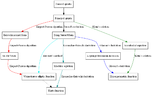
This is a graph containing the main Tschirnhausen transformations of a general quintic and the algorithms to solve them. The methods would be explicitly described most probably elsewhere in this forum
https://www.physicsforums.com/attachments/1786._xfImport
Any comment/question regarding this thread should be posted in http://mathhelpboards.com/commentary-threads-53/commentary-introduction-theory-quintics-8210.html
https://www.physicsforums.com/attachments/1786._xfImport
- The lower-most nodes are the elementariest functions to which the root of a general quintic can be extracted.
- In any sub-graph of the above, the lowermost elements are the form reduced from the topmost elements via Tschirnhausen transformations.
- Deeper colors indicates the effectiveness of the algorithm in computational research, as well as popularity.
- Dotted lines indicates a reduction that is non-obvious although not a part of the interest, in most cases.
- Black lines indicates a transformation that is not part of the algorithm.
- The red arrows indicate the Kiepert algorithm, which I like to call Kiepert-Perron algorithm.
- The green arrows indicate Glasser's derivation.
- The magenta-like colors indicate Hasner's method and Kronecker-Brioschi derivation respectively.
Any comment/question regarding this thread should be posted in http://mathhelpboards.com/commentary-threads-53/commentary-introduction-theory-quintics-8210.html
Attachments
Last edited: