Inversion of functions that aren't 1-1

  • Context: Undergrad 
  • Thread starter Thread starter Happiness
  • Start date Start date
  • Tags Tags
    Functions Inversion
Click For Summary
SUMMARY

The discussion centers on the inversion of functions that are not one-to-one (1-1), specifically in the context of classical physics and orbital mechanics. It highlights that while mathematically one can express ##r## as a function of ##t## (e.g., ##t = r^2## leading to ##r = \pm\sqrt{t}##), this does not yield a valid function due to the multiple values of ##r## for a single ##t##. The conversation emphasizes the necessity of selecting a principal branch for functions and limiting the analysis to half an orbit to avoid contradictions in values of ##r## and ##\theta##. The discussion concludes that ensuring a single value for ##r## at a given ##\theta## is critical for accurate physical modeling.

PREREQUISITES
  • Understanding of functions and their properties, particularly one-to-one functions.
  • Familiarity with classical physics concepts, especially orbital mechanics.
  • Knowledge of mathematical branches and their applications in function inversion.
  • Basic grasp of polar coordinates and their representation in physics.
NEXT STEPS
  • Study the concept of one-to-one functions in depth, focusing on their implications in mathematical modeling.
  • Learn about the principal branch of multi-valued functions and its significance in physics.
  • Explore the relationship between polar coordinates and Cartesian coordinates in the context of orbits.
  • Investigate the effects of discontinuities in angular measurements on physical systems.
USEFUL FOR

Students and professionals in physics, mathematicians dealing with function theory, and anyone interested in the mathematical foundations of orbital mechanics.

Happiness
Messages
686
Reaction score
30
If ##t## is a function of ##r##, then we may in theory find ##r## as a function of ##t##, as claimed in the last paragraph of the attachment below. My issue is this is only true if ##t## is a 1-1 function of ##r##. Otherwise, suppose ##t=r^2##. Then ##r=\pm\sqrt{t}##, which isn't a function.

I understand that physically it makes no sense for ##t## not to be a 1-1 function of ##r##, because we would then have two different values of ##r## at a particular time and an object can't be at two places at once. But mathematically, I don't see how (6.15) shows ##t## is a 1-1 function of ##r##.
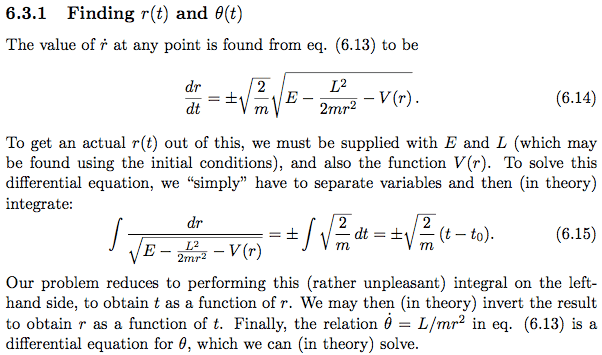
Screen Shot 2016-11-17 at 4.00.50 AM.png
 
Mathematics news on Phys.org
When you are dealing with multiple-valued functions, you can define different "branches" of the function in which it is 1-1. Then you can select one of the branches, called the "principle branch", and use it for a 1-1 function. In your case, you might start with the branch that makes r positive. Typically an (r,θ) designation has r>0. As you integrate r, it may smoothly become negative. That is a problem where you will have to decide whether you should keep r positive or not. If the integral goes negative, you might want to keep r positive and add 180° to θ. Those discontinuities of θ can cause problems, depending on how you are using it.
 
This is a classical physics problem - you can be sure the object won't be at two places at the same time (otherwise your solution is wrong), going from t(r) to r(t) is no problem.
 
mfb said:
This is a classical physics problem - you can be sure the object won't be at two places at the same time (otherwise your solution is wrong), going from t(r) to r(t) is no problem.

How about going from ##\theta(r)## to ##r(\theta)##? ##\theta(r)## may not be a 1-1 function since it is possible for an orbit to have 2 values of ##r## with the same ##\theta##.
Screen Shot 2016-11-17 at 4.31.06 PM.png
 
In nonrelativistic mechanics, there is no orbit with two values of r for the same value of θ. If you would have that, you could limit the inversion to a single orbit. The problem doesn't occur however, because there are two values of θ for the same r - you have to limit the analysis to half an orbit in an earlier step already.
 
mfb said:
In nonrelativistic mechanics, there is no orbit with two values of r for the same value of θ. If you would have that, you could limit the inversion to a single orbit. The problem doesn't occur however, because there are two values of θ for the same r - you have to limit the analysis to half an orbit in an earlier step already.

Below is an orbit with two values of ##r## for the same value of ##\theta##. Look at the dotted line just left of the arrow ##r_1##. The line cuts the orbit twice or more times, indicating there are two or more values of ##r##.
Screen Shot 2016-11-18 at 1.24.25 AM.png

How do you "limit the inversion to a single orbit"? What's the single orbit in this case?
 
Last edited:
The single orbit ends at the point where the line intersects itself: θ changed by 2 pi along one revolution.
If you allow θ values larger than 2 pi, you can fix this issue - the two points then differ by 2 pi in θ.

As this particular motion seems to have a shorter period in r-oscillations, you can study the trajectory for θ from 0 to 2pi/3 only if you want.
 

Similar threads

  • · Replies 24 ·
Replies
24
Views
3K
  • · Replies 4 ·
Replies
4
Views
4K
  • · Replies 2 ·
Replies
2
Views
2K
  • · Replies 4 ·
Replies
4
Views
2K
  • · Replies 1 ·
Replies
1
Views
3K
  • · Replies 33 ·
2
Replies
33
Views
3K
  • · Replies 4 ·
Replies
4
Views
3K
  • · Replies 2 ·
Replies
2
Views
4K
  • · Replies 7 ·
Replies
7
Views
1K
  • · Replies 2 ·
Replies
2
Views
3K