Sorry, that was mainly written for newjerseyrunner. I'll try to explain it in easier terms:
It is one of the theoretical issues of the standard model (which includes antiparticles, but no supersymmetry). Particle masses there depend on the existence of other particles because they interact with those particles. This effect is small for most particles, but it is important for the Higgs boson mass. If you try to calculate it, you get an integral that looks a bit like
$$\int_0^\infty 1 dx$$
Here x is an energy scale of the interaction. "Multiply 1 by infinity": The integral is not well-defined. We know that our theories break down where gravity gets relevant (this happens at the Planck mass m
P), so it does not really make sense to include energy scales above the Planck mass:
$$\int_0^{m_P} 1 dx = m_P$$
"Multiply 1 by a large number": That works mathematically, the result is a large number. The Higgs mass m
H is the sum of this contribution and a different mass source m
b: m
H = m
P + m
b. The value of this different mass source can be anything - it is a free parameter.
The Planck mass is about 10000000000000000000 GeV, the Higgs mass is 125 GeV. The units don't matter here, only the numbers are important. So we get an equation that looks like "add a number like 10000000000000000000 and a completely unrelated number, and the result is 125". That means m
b is something like -9999999999999999874 GeV, extremely close to the Planck mass but not exactly identical. Possible? Yes. But it doesn't look likely. The problem is the huge Planck mass which enters the equation.
With supersymmetry, we get additional particles (the superpartners of the known particles). They also influence the particle masses, and it turns out that their effect is exactly the opposite. The integral from above is now zero:
$$\int_0^{m_P} (1-1) dx = 0$$
With this approach, regular particles and their superpartners would have identical masses. In this case we would have found the superpartners already, so this cannot be true. Supersymmetry must be broken (it is not exactly symmetric), and the superpartners have different masses. So we have to modify the integral again, and it now looks a bit like this:
$$\int_1^{m_P} (1-1+\frac{1}{x}) dx = ln(m_P)$$
I cheated a bit here to avoid introducing too many technical details. The main point: Instead of a huge number, with supersymmetry we just get the logarithm of a huge number - which is much more reasonable.
hsdrop said:
I'm just not quite sure how we can make antimatter particles to study them
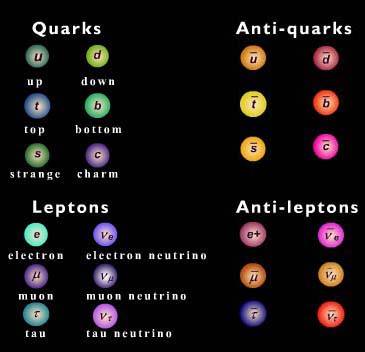
Collide particles at high energies. In the collisions, all types of particles get produced. Usually as pairs of matter plus antimatter particle, which then fly apart.

 thank you to anyone that takes the time to replay

