Is GR about fixed curved background or dynamical?
- Level: Undergrad
- Thread starter mieral
- Start date
-
- Tags
- Geometry
Join the discussion
Registration is free. Start your own thread to ask a follow-up.
65 replies · 11K views
Physics news on Phys.org
RockyMarciano
- 588
- 43
But how is a spherical surface an analogy to GR manifolds? In what sense is a sphere dynamical in the way GR metrics are?PeterDonis said:I think the issue here is over the word "manifold". If you restrict that word to just mean the mathematical model (not the geometric object being modeled), then yes, the hole argument means you can't individuate points in the manifold by geometric invariants, because you can always apply a diffeomorphism that "moves" a given geometric invariant to a different point in the manifold. But that doesn't "move" the geometric object itself.
To see the distinction, consider: the surface of the Earth is a geometric object.
Science Advisor
Gold Member
- 869
- 373
For those unaware of Einstein's hole argument, let me sketch it.
First of all let me get something out of the way. Say you have a metric tensor function that solves Einstein's equations in ##x-##coordinates, let us denote it ##g_{ab} (x)##. Given another coordinate system, denote it the ##y-##coordinates, there should exist a metric tensor function in the ##y-##coordinate system that imposes the same geometry that ##g_{ab} (x)## imposes in the ##x-##coordinates. We want this to also be a solution of the field equations. This is guaranteed if write the field equations in tensor form. Standard textbooks tell you about this.
However, standard textbooks often miss what about what I am about to explain (Einstein didn't miss this!). O.K. say we have the vacuum field equations in the ##x-##coordinates:
##
R_{ab} (x) = 0 \qquad Eq (1)
##
this is an horrendous differential equation where the independent variable is ##x##. Let us consider another coordinate system, call them the ##y-##coordinates. Einstein required that the laws of physics take the same form in all coordinate systems. Therefore the vacuum field equations in the ##y-##coordinates coordinates should be given by exactly the same differential equation but now the independent variable is ##y##:
##
R_{ab} (y) = 0 \qquad Eq (2)
##
So as soon as we find a metric tensor function, denote it ##g_{ab} (x)##, that solves the field equations in the ##x-##coordinates, simply write down exactly the same function but replace ##x## by ##y## and this will solve the field equations in the ##y-##coordinate system! Denote this new metric tensor function ##\tilde{g}_{ab} (y)##. Now, because it has the same functional form as ##g_{ab} (x)## but belongs to a different coordinate system, it imposes a different spacetime geometry! This may come as a shock to some people, but it is correct.
Now comes the problem - roughly the Hole argument. What if the ##x## and ##y-##coordinates coincide at first but differ after ##t=0##. You will have two geometrically distinct solutions after ##t=0## but which have the same initial boundary conditions at ##t=0##! EEk! The conclusion is that GR does not uniquely predict the spacetime geometry after ##t=0##! Einstein initially recoiled from this and dropped the principle of general covariance only to return to it. The resolution was to realize that we have a gauge transformation, and we have to understand what is then physically meaningfull given this gauge symmetry.
So what was this transformation taking ##g_{ab} (x)## to ##\tilde{g}_{ab} (y)##? Well, first observe that as they have the same functional form they satisfy:
##
g_{ab} (x^1 = u_1,x^2 =u_2, x^3=u_3, x^4=u_4) = \tilde{g}_{ab} (y^1 = u_1,y^2 =u_2, y^3=u_3, y^4=u_4)
##
where ##u_1,u_2,u_3,u_4## take values with the region of overlap between the two coordinate charts. If you think about this relation, you will realize that these two solutions are related by taking the metric tensor function ##g_{ab} (x)## and actively dragging it over the manifold while keeping the coordinate lines “attached” (see the figure I have provided - the value of ##\tilde{g}_{ab}## at ##P## coincides with the value of ##g_{ab}## at ##P_0##). I won't go into the details of it, but this corresponds precisely to a diffeomorphism as a mathematician would define it.
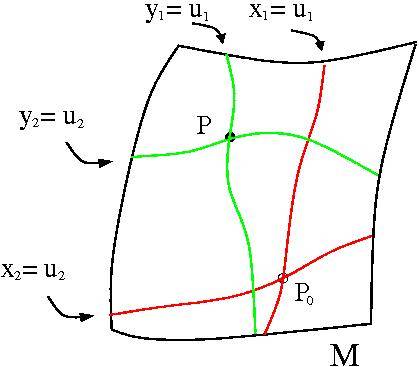
You can read more about the Hole argument and what is physically meanifull in Rovelli's book, a draft version available at
http://www.cpt.univ-mrs.fr/~rovelli/book.pdf
p.s. if you do a coordinate transformation on ##\tilde{g}_{ab} (y)## going from the ##y-##coordinate system to ##x-##coordinate system, the resulting metric tensor function in the ##x-##coordinates will have a different functional form to ##g_{ab} (x)##, as I alluded to in my previous post.
First of all let me get something out of the way. Say you have a metric tensor function that solves Einstein's equations in ##x-##coordinates, let us denote it ##g_{ab} (x)##. Given another coordinate system, denote it the ##y-##coordinates, there should exist a metric tensor function in the ##y-##coordinate system that imposes the same geometry that ##g_{ab} (x)## imposes in the ##x-##coordinates. We want this to also be a solution of the field equations. This is guaranteed if write the field equations in tensor form. Standard textbooks tell you about this.
However, standard textbooks often miss what about what I am about to explain (Einstein didn't miss this!). O.K. say we have the vacuum field equations in the ##x-##coordinates:
##
R_{ab} (x) = 0 \qquad Eq (1)
##
this is an horrendous differential equation where the independent variable is ##x##. Let us consider another coordinate system, call them the ##y-##coordinates. Einstein required that the laws of physics take the same form in all coordinate systems. Therefore the vacuum field equations in the ##y-##coordinates coordinates should be given by exactly the same differential equation but now the independent variable is ##y##:
##
R_{ab} (y) = 0 \qquad Eq (2)
##
So as soon as we find a metric tensor function, denote it ##g_{ab} (x)##, that solves the field equations in the ##x-##coordinates, simply write down exactly the same function but replace ##x## by ##y## and this will solve the field equations in the ##y-##coordinate system! Denote this new metric tensor function ##\tilde{g}_{ab} (y)##. Now, because it has the same functional form as ##g_{ab} (x)## but belongs to a different coordinate system, it imposes a different spacetime geometry! This may come as a shock to some people, but it is correct.
Now comes the problem - roughly the Hole argument. What if the ##x## and ##y-##coordinates coincide at first but differ after ##t=0##. You will have two geometrically distinct solutions after ##t=0## but which have the same initial boundary conditions at ##t=0##! EEk! The conclusion is that GR does not uniquely predict the spacetime geometry after ##t=0##! Einstein initially recoiled from this and dropped the principle of general covariance only to return to it. The resolution was to realize that we have a gauge transformation, and we have to understand what is then physically meaningfull given this gauge symmetry.
So what was this transformation taking ##g_{ab} (x)## to ##\tilde{g}_{ab} (y)##? Well, first observe that as they have the same functional form they satisfy:
##
g_{ab} (x^1 = u_1,x^2 =u_2, x^3=u_3, x^4=u_4) = \tilde{g}_{ab} (y^1 = u_1,y^2 =u_2, y^3=u_3, y^4=u_4)
##
where ##u_1,u_2,u_3,u_4## take values with the region of overlap between the two coordinate charts. If you think about this relation, you will realize that these two solutions are related by taking the metric tensor function ##g_{ab} (x)## and actively dragging it over the manifold while keeping the coordinate lines “attached” (see the figure I have provided - the value of ##\tilde{g}_{ab}## at ##P## coincides with the value of ##g_{ab}## at ##P_0##). I won't go into the details of it, but this corresponds precisely to a diffeomorphism as a mathematician would define it.
You can read more about the Hole argument and what is physically meanifull in Rovelli's book, a draft version available at
http://www.cpt.univ-mrs.fr/~rovelli/book.pdf
p.s. if you do a coordinate transformation on ##\tilde{g}_{ab} (y)## going from the ##y-##coordinate system to ##x-##coordinate system, the resulting metric tensor function in the ##x-##coordinates will have a different functional form to ##g_{ab} (x)##, as I alluded to in my previous post.
Last edited:
Mentor
- 50,926
- 26,966
RockyMarciano said:how is a spherical surface an analogy to GR manifolds?
It's a geometric object.
RockyMarciano said:In what sense is a sphere dynamical in the way GR metrics are?
A sphere is an unchanging 2-dimensional geometry. Spacetime is an unchanging 4-dimensional geometry. The only difference between them is that the sphere has a positive definite metric and spacetime does not.
It is true that we aren't considering the sphere as being produced by solving any field equations, whereas spacetime is. But that difference has nothing to do with how we individuate events in the manifold by geometric invariants. See below.
RockyMarciano said:I would say that when talking about dynamic gravitational fields one must think about what really changes in GR metrics with respect to SR, which is the curvature, different sources configurations give different curvatures from different metrics that are solutions of the EFE
This is all true, but, as above, it is irrelevant to the question of how we individuate events in a given 4-dimensional spacetime geometry. In order to have a given manifold, you must already have solved the EFE, so all the "dynamic" stuff you are talking about is already done. Once you have a given geometry, individuating points in it has nothing to do with how you derived it from a field equation. You just look at the invariants derived from the metric that you have already found. You don't change the metric in the course of doing that. So any talk about "changing" or "dynamic" metrics is irrelevant to that particular question, of how points in the geometry are to be individuated, which is the question at issue in the hole argument.
Mentor
- 50,926
- 26,966
julian said:you are meant to understand diffeomorphisms as a mathematician defines them. For example transforming a doughnut-shaped manifold into its coffe-cup-shaped copy
But doing that changes the geometric invariants, and therefore changes the physics (if we are talking about applying such an operation to a spacetime geometry). The doughnut and the coffee cup are different geometries. Similarly, two spacetimes which are related by a diffeomorphism of the kind you describe (an "active diffeomorphism", as opposed to a "passive" one) are different geometries. And different geometries in GR means different physical predictions, so there is no point in asking which points in the different geometries are "the same".
Mentor
- 50,926
- 26,966
julian said:because it has the same functional form as ##g_{ab} (x)## but belongs to a different coordinate system, it imposes a different spacetime geometry!
I don't see how this follows, because you have not said how the ##x## and ##y## coordinates are actually different. Changing from ##x## to ##y## is just changing a label. But that means that you cannot assume that the two metrics ##g_{ab}(x)## and ##g_{ab}(y)## are actually different geometries. It might turn out that the ##x## and ##y## labels actually label exactly the same points in exactly the same geometry--you just didn't realize it because you started out using two different labels.
Science Advisor
Gold Member
- 869
- 373
PeterDonis said:But doing that changes the geometric invariants, and therefore changes the physics (if we are talking about applying such an operation to a spacetime geometry). The doughnut and the coffee cup are different geometries. Similarly, two spacetimes which are related by a diffeomorphism of the kind you describe (an "active diffeomorphism", as opposed to a "passive" one) are different geometries. And different geometries in GR means different physical predictions, so there is no point in asking which points in the different geometries are "the same".
You may have to revise what is physical in light of this invariance under active diffeomorphisms. Radically change your view of the physical world.
Science Advisor
Gold Member
- 869
- 373
PeterDonis said:I don't see how this follows, because you have not said how the ##x## and ##y## coordinates are actually different. Changing from ##x## to ##y## is just changing a label. But that means that you cannot assume that the two metrics ##g_{ab}(x)## and ##g_{ab}(y)## are actually different geometries. It might turn out that the ##x## and ##y## labels actually label exactly the same points in exactly the same geometry--you just didn't realize it because you started out using two different labels.
I don't put any restrictions on the two coordinate systems (aside from the usual requirements pertaining to the differentiablilty of the manifold).
Mentor
- 50,926
- 26,966
julian said:You may have to revise what is physical in light of this invariance under active diffeomorphisms.
What invariance? The metric is not invariant under active diffeomorphisms; at least, that's what you are saying.
julian said:I don't put any restrictions on the two coordinate systems
Then I don't see how it follows that the two spacetime geometries, ##g_{ab}(x)## and ##g_{ab} (y)##, must be different. In fact, with the conditions as you give them, it seems to me that they must be the same.
First, observe that the equation ##R_{ab} = 0##, by itself, is not one differential equation (or even one per component ##ab##). It's more like a template for an infinite number of possible differential equations. Which actual differential equation among that infinite number you are talking about depends on the metric (meaning here the function ##g_{ab}(x)##), because ##R_{ab}## is an expression involving the metric and its derivatives with respect to the coordinates. So if two coordinate charts ##x## and ##y## end up giving you exactly the same differential equation, that means the two metrics must be the same.
So now we have the following: we have two coordinate charts, ##x##, and ##y##. We have two metrics, ##g_{ab} (x)## and ##g_{ab} (y)##, which have exactly the same functional form. That means, given any point ##x##, the geometric invariants for that point are identical to the geometric invariants for the point ##y## for which ##y = x##. That, to me, means the two metrics ##g_{ab} (x)## and ##g_{ab} (y)## describe the same spacetime geometry.
If you disagree with the above, I would really like to see a concrete counterexample. Is there one that you know of?
Science Advisor
Gold Member
- 869
- 373
Say you have two close points ##P## and ##Q##. Say ##P## is labelled by ##x^a## and ##Q## is labelled by ##x^a + dx^a## in the ##x-##coordinates. Say ##P## is labelled by ##y^a## and ##Q## is labelled by ##y^a + dy^a## in the ##x-##coordinates. In general ##dx^a## won't be equal to ##dy^a##. As such, given that ##g_{ab} (x)## and ##\tilde{g}_{ab} (y)## have the same functional form, we will have in general that
##
ds^2 := dx^adx^b g_{ab} (x) \not= d\tilde{s}^2 := dy^ady^b \tilde{g}_{ab} (y).
##
This initially alarmed Einstein, but then he came to understand that there is a resolution but it requires a radical revision of our understanding of the physical world (in fact this revision is what Einstein was referring to when he made his remark "beyond my wildest expectations"). To understand this revision I recommend you look at Rovelli's book.
Physical observations that are made all the time, these make definite unique predictions despite active diffeomorphisms because the reference systems are coupled to the gravitational field and are part of the physical system under consideration, they transform along with the gravitational field under active diffeomorphisms in such a way as to make the whole thing work.
##
ds^2 := dx^adx^b g_{ab} (x) \not= d\tilde{s}^2 := dy^ady^b \tilde{g}_{ab} (y).
##
This initially alarmed Einstein, but then he came to understand that there is a resolution but it requires a radical revision of our understanding of the physical world (in fact this revision is what Einstein was referring to when he made his remark "beyond my wildest expectations"). To understand this revision I recommend you look at Rovelli's book.
Physical observations that are made all the time, these make definite unique predictions despite active diffeomorphisms because the reference systems are coupled to the gravitational field and are part of the physical system under consideration, they transform along with the gravitational field under active diffeomorphisms in such a way as to make the whole thing work.
Last edited:
Science Advisor
Gold Member
- 869
- 373
There is nothing stopping you from considering the differential equation ##R_{ab} = 0## in its general form, that I can write down. I can then consider plugging in any metric I like to see if it solves it. You need to open up from this restrictive view that the differential equation depends on a particular solution.
Science Advisor
Gold Member
- 869
- 373
I see where you are coming from because I've had the same thoughts. It is like what came first ##g_{ab} (x)## or ##\tilde{g}_{ab} (y)##? It is like you are saying that ##g_{ab} (x)## is more privileged and from this point on the differential equation itself must abide to it. But if we are being democratic, which we should, neither is more privileged.
Mentor
- 50,926
- 26,966
julian said:In general ##dx^a## won't be equal to ##dy^a##.
Why not?
To put the question a different way: if ##dx^2 \neq dy^a##, then what is your basis for saying that ##y^a + dy^a## describes the "same" point Q as ##x^a + dx^a##? By your own hypothesis, the geometric invariants at the point ##y^a + dy^a## are different from those at the point ##x^a + dx^a##. And the coordinate values of the two are different. So what, exactly, "stays the same" that allows you to identify the points?
Science Advisor
Gold Member
- 869
- 373
PeterDonis said:Why not?
To put the question a different way: if ##dx^2 \neq dy^a##, then what is your basis for saying that ##y^a + dy^a## describes the "same" point Q as ##x^a + dx^a##? By your own hypothesis, the geometric invariants at the point ##y^a + dy^a## are different from those at the point ##x^a + dx^a##. And the coordinate values of the two are different. So what, exactly, "stays the same" that allows you to identify the points?
A differatiable manifold admits coordinates, in particular two overlapping coordinate systems, in the absence of a distance function.
Mentor
- 50,926
- 26,966
julian said:You need to open up from this restrictive view that the differential equation depends on a particular solution.
That's not the view I am taking.
julian said:It is like you are saying that gab(x)g_{ab} (x) is more privileged and from this point on the differential equation itself must abide to it.
That's not the view I'm taking either.
See my previous post for the view I'm taking. Basically, I see all this vague, general talk about two points being "the same" in two different metrics, when as far as I can see, there is nothing the same between them. The coordinates are different and all the geometric invariants are different. So what makes them "the same"? This question is critical to the whole argument, and yet I have seen no concrete answer to it. That is why I asked for a specific, concrete example.
To illustrate the issue another way, consider two possible diffeomorphisms, first a passive one and then an active one.
We start off with a flat 2-dimensional plane described in polar coordinates, so the coordinates are ##r, \theta## and the metric is ##g_{ab} (r, \theta) = dr^2 + r^2 d\theta^2## (I'm writing it as a line element for easier typing, the meaning should be clear).
An example of a passive diffeomorphism would be transforming to Cartesian coordinates: ##x = r \cos \theta## and ##y = r \sin \theta##. This gives a metric ##g_{ab} (x, y) = dx^2 + dy^2##. Points are "the same" in the two metrics if their coordinate values are related by the transformation formulas I just gave; so, for example, the point ##x = 1##, ##y = 1## is the same as the point ##r = \sqrt{2}, \theta = \pi / 4##. Here all of the geometric invariants are unchanged--points that are "the same" in the two metrics have the same invariants. That is why we call this a "passive" diffeomorphism.
An example of an active diffeomorphism would be using the same coordinates ##r, \theta## but changing the metric to, e.g., ##\tilde{g}_{ab} (r, \theta) = f(r) dr^2 + r^2 d\theta^2##. This changes the flat plane to a curved surface which is rotationally symmetric about the origin ##r = 0##. Points are "the same" in the two metrics if they have the same coordinate values ##r, \theta##. Here points that are "the same" in the two metrics do not have the same geometric invariants; that is why we call this an "active" diffeomorphism. But we still have to have the coordinate values in order to tell which points are "the same".
What you appear to be describing is a case where neither of the above are true: we have a point Q which is said to be "the same" in both metrics, but it has different coordinate values and different geometric invariants in the two metrics. So I don't see how it fits into either of the cases I described above.
Mentor
- 50,926
- 26,966
julian said:A differatiable manifold admits coordinates, in particular two overlapping coordinate systems, in the absence of a distance function.
But a metric is a distance function, and we are assuming we have a metric, so I don't see how this is relevant.
Mentor
- 50,926
- 26,966
julian said:To understand this revision I recommend you look at Rovelli's book.
What particular part of it best explains what you are referring to?
Science Advisor
Gold Member
- 869
- 373
PeterDonis said:What invariance? The metric is not invariant under active diffeomorphisms; at least, that's what you are saying.
The ##y-## coordinates are different from the ##x-##coordinates. We are considering a metric tensor function in the ##y-##coordinates, ##\tilde{g}_{ab} (y)##, that has the same functional form as ##g_{ab} (x)##. If you take ##\tilde{g}_{ab} (y)## and do a coordinate transformation on it taking it to the ##x-##coordinate system, then it won't have the same functional form as ##g_{ab} (x)##, and as such it won't impose the same geometry.
PeterDonis said:Then I don't see how it follows that the two spacetime geometries, ##g_{ab}(x)## and ##g_{ab} (y)##, must be different. In fact, with the conditions as you give them, it seems to me that they must be the same.
First, observe that the equation ##R_{ab} = 0##, by itself, is not one differential equation (or even one per component ##ab##). It's more like a template for an infinite number of possible differential equations. Which actual differential equation among that infinite number you are talking about depends on the metric (meaning here the function ##g_{ab}(x)##), because ##R_{ab}## is an expression involving the metric and its derivatives with respect to the coordinates. So if two coordinate charts ##x## and ##y## end up giving you exactly the same differential equation, that means the two metrics must be the same.
I think I see what you are saying. The metric tensor function is the dependent variable of the differential equation (well set of equations really to be solved for the metric tensor function). It is a function of the independent variable. A metric tensor function, the dependent variable, doesn't affect the general form of the differential equation. When I said it is the same differential equation in the ##y-##coordinates I actually meant the differential equation has the same general form in the ##y-##coordinates as it has in the ##x-##coordinate system.
Last edited:
Science Advisor
Gold Member
- 869
- 373
PeterDonis said:I don't see how this follows, because you have not said how the ##x## and ##y## coordinates are actually different. Changing from ##x## to ##y## is just changing a label. But that means that you cannot assume that the two metrics ##g_{ab}(x)## and ##g_{ab}(y)## are actually different geometries. It might turn out that the ##x## and ##y## labels actually label exactly the same points in exactly the same geometry--you just didn't realize it because you started out using two different labels.
I'm not considering a coordinate transformation. I am coming along and considering writing down the same function as ##g_{ab} (x)## but replacing ##x## with ##y##, which I denote ##\tilde{g}_{ab} (y)##, which I am free to do if I want.
This metric tensor function ##\tilde{g}_{ab} (y)## will solve the field equations in the ##y-##coordinates system because the field equations have the same general form in the ##y-##coordinates.
Last edited:
Science Advisor
Gold Member
- 869
- 373
PeterDonis said:But a metric is a distance function, and we are assuming we have a metric, so I don't see how this is relevant.
I'm saying that a bare manifold, a manifold without a metric, still admits coordinates. In particular two overlapping coordinate systems and points ##P## and ##Q##, which to start off with we consider abstarctly, can be labelled in the two coordinates systems and in general ##dx^a \not= dy^a##.
Last edited:
Mentor
- 50,926
- 26,966
julian said:I'm saying that a bare manifold, a manifold without a metric, still admits coordinates.
Yes, I agree with that.
julian said:In particular two overlapping coordinate systems and points ##P## and ##Q##, which to start off with we consider abstarctly, can be labelled in the two coordinates systems and in general ##dx^a \not= dy^a##.
But, once again, how do you know that the coordinate labels ##x^a + dx^a## and ##y^a + dy^a## label the same point ##Q##?
RockyMarciano
- 588
- 43
Because it is supposed to be the overlapping point between the two coordinate systems? It is a manifold differentiability requirement, no?PeterDonis said:But, once again, how do you know that the coordinate labels ##x^a + dx^a## and ##y^a + dy^a## label the same point ##Q##?
Science Advisor
Gold Member
- 869
- 373
PeterDonis said:Yes, I agree with that.
But, once again, how do you know that the coordinate labels ##x^a + dx^a## and ##y^a + dy^a## label the same point ##Q##?
O.K. so a bare manifold admits coordinates. Where two coordinate charts overlap, each point will be labelled by some value in the ##x-##coordinates and another value in the ##y-##coordinates.
Then it is quite simple. Say ##P## is labelled by ##x^a (P)## and ##Q## is labelled by ##x^a(Q) = x^a (P) + dx^a## in the ##x-##coordinates. Say ##P## is labelled by ##y^a (P)## and ##Q## is labelled by ##y^a(Q)##in the ##y-##coordinates. Then we just define ##dy^a## by ##dy^a := y^a(Q) - y^a (P)##.
Because ##x-##coordinates and ##y-##coordinates are different in general we will have ##dx^a \not= dy^a##.
Mentor
- 50,926
- 26,966
julian said:Where two coordinate charts overlap, each point will be labelled by some value in the x-coordinates and another value in the y-coordinates.
Yes, sure. But none of this answers the question I have been asking: how do you know that a given point ##Q## is "the same" point in the two coordinate charts?
Your answer is basically, "because I say so". But when you are constructing a model of some actual physical system, you can't just say so.
To clarify further, note that in the Rovelli paper you linked to, when he discusses the hole argument and Einstein's two switches of position (from for general covariance to against it, then back to for it), he describes two possible resolutions of the hole argument: (i) physical theories do not respect general covariance; or (ii) there is no physical meaning to a "point in the manifold". As Rovelli makes clear, Einstein first thought that (i) was the resolution (that was his first switch), but then realized that the correct resolution was (ii) (that was his second switch).
In other words, in the absence of some additional structure on the manifold, the answer to the question I have repeatedly asked you--how do you know that a point "Q" is "the same" in two different coordinate charts--is "you don't, because points in the manifold have no physical meaning". Rovelli then discusses the additional structure that is required in order to give "points" (i.e., events) physical meaning: it basically amounts to identifying events by the values of invariants--observable properties of the various fields in the theory, and their relationships.
Mathematically, of course, you can always say that a given point ##Q## is labeled by coordinate values ##x^a + dx^a## and ##y^a + dy^a##, which are unequal, just because; in mathematics you can construct any consistent model you wish. But this discussion is about physics, not mathematics.
mieral
- 203
- 5
Peterdonis. According to atyy: "There are two different things in GR both called diffeomorphism invariance. One is the ability to use arbitrary coordinates, also called "general covariance". This is not specific to GR, and is true of all theories, even special relativity and Newtonian physics. When Smolin says "This principle implies that, unlike theories prior to general relativity, one is free to choose any set of coordinates to map spacetime and express the equations.", he seems to be referring to general covariance. However, it is not true that general covariance applies only to general relativity.
The special thing about GR is that the 4D spacetime metric is modified by matter such that specifying the spacetime metric completely specifies the distribution of energy in spacetime. This is also called background independence, because there is no fixed background that is unmodified by matter."
Peterdonis. What you and Julian were discussing now. Is it the first or second case or combined? Anyway about General Covariance.. where it is about able to use any coordinate system we please. Can you please give an example of any system or scenario of what it means unable to use any coordinate system we please or Nongeneral covariance? Thank you.
The special thing about GR is that the 4D spacetime metric is modified by matter such that specifying the spacetime metric completely specifies the distribution of energy in spacetime. This is also called background independence, because there is no fixed background that is unmodified by matter."
Peterdonis. What you and Julian were discussing now. Is it the first or second case or combined? Anyway about General Covariance.. where it is about able to use any coordinate system we please. Can you please give an example of any system or scenario of what it means unable to use any coordinate system we please or Nongeneral covariance? Thank you.
Mentor
- 50,926
- 26,966
mieral said:According to atyy
Please give a reference to the actual post and the actual thread where @atyy said this. It is very bad manners (as well as technically against the PF rules) to quote someone without giving a reference, so we can see the context of the quote. You might be seriously misrepresenting what the person you are quoting was actually trying to say.
I'll respond further only after I see the reference.
mieral
- 203
- 5
PeterDonis said:Please give a reference to the actual post and the actual thread where @atyy said this. It is very bad manners (as well as technically against the PF rules) to quote someone without giving a reference, so we can see the context of the quote. You might be seriously misrepresenting what the person you are quoting was actually trying to say.
I'll respond further only after I see the reference.
Sorry,, here's the link.. i searched at pf the wildcards "diffeomorphism invariance" and found in message 7 atyy distinctions:
https://www.physicsforums.com/threads/diffeomorphism-invariance-in-gr.485023/
Science Advisor
- 1,956
- 233
The problem as I emphasized at the beginning is that the word background independence, is one of the most heavily equivocated words in modern physics, both on these forums and in the literature. Already in this thread you have 5 different senses of the word, just for the classical theory of gravitation. One for 'no prior geometry', another for the use of the background field method, one sense for the objects that are allowed to be dynamic (varied over) vs fixed in a Lagrangian formalism, another that links it to general covariance and yet another sense where it corresponds to active but not passive transformations(even though they are mathematically equivalent for Riemann metric theories)
Note, some of these senses are mutually contradictory. For instance the background field methods primary virtue is that it preserves manifest gauge invariance(diffeomorphism invariance in the case of GR).
That's why I hate the word and instead insist on focusing on real physical properties of the equations... something that can defined and measures in an experiment. Words get no where with this stuff, especially when people get into the game of (my theory is more BI than yours)..
Note, some of these senses are mutually contradictory. For instance the background field methods primary virtue is that it preserves manifest gauge invariance(diffeomorphism invariance in the case of GR).
That's why I hate the word and instead insist on focusing on real physical properties of the equations... something that can defined and measures in an experiment. Words get no where with this stuff, especially when people get into the game of (my theory is more BI than yours)..
Science Advisor
Gold Member
- 869
- 373
PeterDonis said:Yes, sure. But none of this answers the question I have been asking: how do you know that a given point ##Q## is "the same" point in the two coordinate charts?
Mathematically, of course, you can always say that a given point ##Q## is labeled by coordinate values ##x^a + dx^a## and ##y^a + dy^a##, which are unequal, just because; in mathematics you can construct any consistent model you wish. But this discussion is about physics, not mathematics.
If you are to formulate a physical theory you first need to establish a mathematical foundation. Given that in GR there is no a priori given geometry, when formulating the theory you are starting from a bare differentiable manifold. Differentiable manifolds come equipped with coordinate charts and when charts overlap the same point ##p## inside the overlap is labelled by different coordinate values in the two different coordinate charts. Books on GR start out describing maths of differential manifolds.
O.K. say we are working in ##x-##coordinates and we find that a metric tensor function ##g_{ab} (x)## that solves Einstein's field equations expresssed as a set of differential equations where the independent variable is ##x^a##. Given two close points ##P## and ##Q## defined by certain ##x-##coordinate values, the metric tensor function gives the distance between them.
In textbooks you are told that if you do a coordinate transformation from say ##x-##coordinates to ##y-##coordinates you get a coordinate induced metric tensor function usually denoted by ##g_{ab}'(y)## which asigns the same distance between ##P## and ##Q## in the ##y-##coordinates as ##g_{ab} (x)## did in the ##x-##coordinates.
What I'm telling you about is that things aren't as simply as this and that there are implications of general covarince that Einstein "...initially panics in front of...". There is an additional solution to Einstein's equations in the ##y-##coordinates - namely the same function as ##g_{ab} (x)## but with ##x## replaced by ##y##. This follows from the requirement that the laws of nature must be the same in all coordinates systems.
What I think you don't like is that this additional solution assigns a different distance between the two points ##P## and ##Q## than does ##g_{ab} (x)## in the ##x-##coordinates. I think this is why you keep asking how can ##Q## be the same point in the ##y-##coordinates as it is in the ##x-##coordinates: `if it says the distance from ##P## to ##Q## is different then how can ##Q## be the same point in the ##y-##coordinates?'
Rovelli also defines a new field. On page 48 of
http://www.cpt.univ-mrs.fr/~rovelli/book.pdf
in the paragraph starting "Let me repeat the same argument in a different form" Rovelli talks about a "different field" where he is using the same fact as I am using - that the laws of physics have the same for in all coordinate systems to allude that a field with the same functional form is also a solution. He actually takes the coordinate transformed (tetrad) field ##e^{'I}_\nu (y)## and then writes down a field in the ##x-##coordinates that has the same functional form as this, namely ##\tilde{e}_\mu^I (x)## - see eq (2.134). This different field will asign a different distance between the points than does the original field ##e_\mu^I (x)##. What I did was similar and has the same conclusion - the distance between ##P## and ##Q## is not determined by GR.
What you have to come to terms with is that GR does not uniquely determine the distance between two points defined by coordinates values as ##P## and ##Q## are.
If you want to make predictions that GR actually determines you must define points physically, for example as the intersection point between the world lines of two particles. This is what the diagram on page 49 is referring to in
http://www.cpt.univ-mrs.fr/~rovelli/book.pdf
Mentor
- 50,926
- 26,966
julian said:If you are to formulate a physical theory you first need to establish a mathematical foundation. Given that in GR there is no a priori given geometry, when formulating the theory you are starting from a bare differentiable manifold.
The Rovelli paper you linked to goes to some trouble to describe how to formulate GR without using the bare differentiable manifold as the underlying structure, and to make the case for why this is necessary in order to properly construct a theory of quantum gravity. (The basic reason is that the differentiable manifold turns out to be purely a manifestation of gauge choice and has no actual physical meaning.)
julian said:What you have to come to terms with is that GR does not uniquely determine the distance between two points defined by coordinates values as ##P## and ##Q## are.
I already understand the underlying point here; I'm just phrasing it differently. I'm saying that GR tells us that "the distance between two points defined by coordinate values" has no physical meaning. The only "distance" that has physical meaning is the distance between points "defined physically", as you put it--for example, the distance between two intersections of worldlines.
Similar threads
- haushofer
- · Replies 3 ·
- Beyond the Standard Models
- Replies
- 3