Science Advisor
- 612
- 229
This is a puzzle I came up with. I'm trying to judge whether the solution is obvious or not. Technically it's more closely related to quantum computation than quantum physics, but... let's try it anyways.
We find ourselves with the following network:
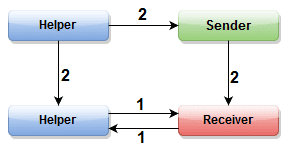
The goal is to find a way for the sender to transmit 4 classical bits of information to the receiver, per tick.
The boxes are quantum computers, capable of processing and sending/receiving qubits.
The edges are one-way quantum communication lines. The number next to the edge indicates how many qubits can be moved over the line per tick, and the direction of the arrow determines which direction the qubit can be sent.
There are initially no entangled qubits shared between any of the boxes, but of course the computers are capable of creating bell pairs and sending them over the communication lines.
For example, each tick the top-left helper could create a bell pair and transmit one of the parts to the sender and the other to the bottom-left helper. Then the bottom-left helper could forward that part to the receiver in the next tick. By pipelining the process, the sender and the receiver will share a fresh bell pair each tick, which is useful...
We find ourselves with the following network:
The goal is to find a way for the sender to transmit 4 classical bits of information to the receiver, per tick.
The boxes are quantum computers, capable of processing and sending/receiving qubits.
The edges are one-way quantum communication lines. The number next to the edge indicates how many qubits can be moved over the line per tick, and the direction of the arrow determines which direction the qubit can be sent.
There are initially no entangled qubits shared between any of the boxes, but of course the computers are capable of creating bell pairs and sending them over the communication lines.
For example, each tick the top-left helper could create a bell pair and transmit one of the parts to the sender and the other to the bottom-left helper. Then the bottom-left helper could forward that part to the receiver in the next tick. By pipelining the process, the sender and the receiver will share a fresh bell pair each tick, which is useful...