Is Molecular Orbital Theory really helpful?

Click For Summary
SUMMARY

Molecular Orbital Theory (MOT) is essential for understanding the bonding in molecules, particularly for those with a higher electron count, such as BF3, which has 24 electrons. The discussion emphasizes the importance of knowing molecular geometry and symmetry, especially in the context of sp3 hybridization, where four orbitals form a tetrahedral arrangement. The user confirms the utility of MOT despite feeling overwhelmed by its complexity. Resources such as the Polyatomic Molecular Orbital Theory guide are recommended for further exploration.

PREREQUISITES
  • Molecular Orbital Theory fundamentals
  • Understanding of sp3 hybridization
  • Basic knowledge of molecular geometry and symmetry
  • Familiarity with bond order calculations
NEXT STEPS
  • Study the Polyatomic Molecular Orbital Theory in detail
  • Learn about bond order calculations for complex molecules
  • Explore the implications of molecular geometry on bonding
  • Investigate advanced concepts in molecular symmetry
USEFUL FOR

Chemistry students, educators, and professionals seeking to deepen their understanding of Molecular Orbital Theory and its applications in molecular bonding and geometry.
prakhargupta3301
Messages
58
Reaction score
1
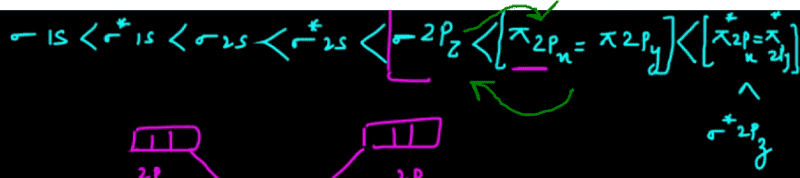
Who am I kidding? Of course it is. But, everywhere I look, the series of increasing levels of orbitals is till
σ*2pz only
upload_2018-7-10_22-38-36.png

That's all.
So if I need to find bond order of , say, some molecule with greater number of e- like BF3 with 24 electrons, how do I proceed?
 

Attachments

  • upload_2018-7-10_22-38-36.png
    upload_2018-7-10_22-38-36.png
    9.9 KB · Views: 901
Chemistry news on Phys.org
In this sort of thing, it helps to know the geometry and any symmetry the molecule may have. In the case of ## sp^3 ## hybridization, if I remember correctly, (it has been quite a few years since I took a sequence of undergraduate chemistry courses, and it also showed up later in a physics group theory graduate course), you get 4 orbitals that form a tetrahedron around the central atom, and if you only have 3 atoms to attach, you may be left with a lone pair of electrons on the 4th corner of the tetrahedron. I haven't used this stuff a lot, but yes, it can be useful. ## \\ ## Edit: And a subsequent google shows I have it correct: https://courses.lumenlearning.com/introchem/chapter/sp3-hybridization/
 
Last edited:
  • Like
Likes   Reactions: prakhargupta3301
  • Like
Likes   Reactions: prakhargupta3301

Similar threads

  • · Replies 3 ·
Replies
3
Views
4K
Replies
2
Views
3K
  • · Replies 5 ·
Replies
5
Views
8K
  • · Replies 3 ·
Replies
3
Views
6K
Replies
7
Views
4K
  • · Replies 2 ·
Replies
2
Views
3K
  • · Replies 9 ·
Replies
9
Views
3K
  • · Replies 3 ·
Replies
3
Views
2K
Replies
4
Views
48K
  • · Replies 9 ·
Replies
9
Views
3K