Is Molecular Orbital Theory really helpful?

Click For Summary

Discussion Overview

The discussion centers around the utility of Molecular Orbital Theory in understanding molecular structures and bond orders, particularly in complex molecules like BF3 with a higher electron count. Participants explore the relevance of orbital hybridization and geometry in this context.

Discussion Character

  • Exploratory
  • Technical explanation
  • Conceptual clarification
  • Homework-related

Main Points Raised

  • One participant expresses confidence in the usefulness of Molecular Orbital Theory but notes a limitation in available orbital information, specifically mentioning the σ*2pz orbital.
  • Another participant suggests that understanding the geometry and symmetry of molecules is important, referencing sp3 hybridization and its implications for molecular shape and lone pairs.
  • A participant reiterates their initial question about determining bond order in BF3 and seeks guidance on how to approach the problem.
  • Links to external resources are provided by participants as potential starting points for further exploration of the topic.
  • One participant acknowledges the complexity of the provided resources, indicating a struggle to grasp the material.

Areas of Agreement / Disagreement

Participants do not reach a consensus on the effectiveness of Molecular Orbital Theory or the best methods for calculating bond order in complex molecules. Multiple viewpoints and levels of understanding are present throughout the discussion.

Contextual Notes

Some participants express uncertainty regarding the application of Molecular Orbital Theory to specific molecules and the complexity of the concepts involved. There is also a reliance on external resources that may not fully address the participants' questions.

Who May Find This Useful

This discussion may be of interest to students and educators in chemistry and physics, particularly those exploring molecular structures, orbital theory, and hybridization concepts.

prakhargupta3301
Messages
58
Reaction score
1
Who am I kidding? Of course it is. But, everywhere I look, the series of increasing levels of orbitals is till
σ*2pz only
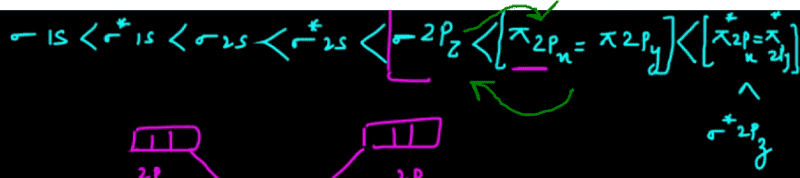
upload_2018-7-10_22-38-36.png

That's all.
So if I need to find bond order of , say, some molecule with greater number of e- like BF3 with 24 electrons, how do I proceed?
 

Attachments

  • upload_2018-7-10_22-38-36.png
    upload_2018-7-10_22-38-36.png
    9.9 KB · Views: 913
Chemistry news on Phys.org
In this sort of thing, it helps to know the geometry and any symmetry the molecule may have. In the case of ## sp^3 ## hybridization, if I remember correctly, (it has been quite a few years since I took a sequence of undergraduate chemistry courses, and it also showed up later in a physics group theory graduate course), you get 4 orbitals that form a tetrahedron around the central atom, and if you only have 3 atoms to attach, you may be left with a lone pair of electrons on the 4th corner of the tetrahedron. I haven't used this stuff a lot, but yes, it can be useful. ## \\ ## Edit: And a subsequent google shows I have it correct: https://courses.lumenlearning.com/introchem/chapter/sp3-hybridization/
 
Last edited:
  • Like
Likes   Reactions: prakhargupta3301
  • Like
Likes   Reactions: prakhargupta3301

Similar threads

  • · Replies 3 ·
Replies
3
Views
4K
Replies
2
Views
3K
  • · Replies 5 ·
Replies
5
Views
8K
  • · Replies 3 ·
Replies
3
Views
6K
Replies
7
Views
4K
  • · Replies 2 ·
Replies
2
Views
3K
  • · Replies 9 ·
Replies
9
Views
3K
  • · Replies 3 ·
Replies
3
Views
2K
Replies
4
Views
48K
  • · Replies 9 ·
Replies
9
Views
3K