Is one side of the Earth faster at night and slower at daytime?

  • Context: High School 
  • Thread starter Thread starter shawnr
  • Start date Start date
  • Tags Tags
    Earth
Click For Summary
SUMMARY

The discussion centers on the relative speeds of points on Earth during day and night, specifically addressing the concept that at midnight, the rotational speed of the Earth adds to its orbital speed around the Sun. According to Yakov Perelman's "Physics for Entertainment," this results in a difference of approximately one kilometer per second between speeds at midday and midnight. The conversation clarifies that this phenomenon is not influenced by gravity but rather by the Earth's rotation and its position in relation to the Sun, emphasizing the importance of understanding both rotational and translational motion.

PREREQUISITES
  • Understanding of Earth's rotation and orbital mechanics
  • Basic knowledge of physics concepts such as translational and rotational motion
  • Familiarity with the concept of relative motion in a rotating frame
  • Awareness of the gravitational effects of celestial bodies
NEXT STEPS
  • Research "Earth's rotational speed and its effects" to understand how rotation influences relative motion.
  • Study "Orbital mechanics" to grasp how celestial bodies interact in space.
  • Explore "Relative motion in physics" to learn about speed differences in rotating systems.
  • Investigate "The Moon's orbit around the Earth and Sun" for insights into lunar dynamics.
USEFUL FOR

Students of physics, educators explaining celestial mechanics, and anyone interested in understanding the dynamics of Earth's motion in relation to the Sun and Moon.

shawnr
Messages
20
Reaction score
0
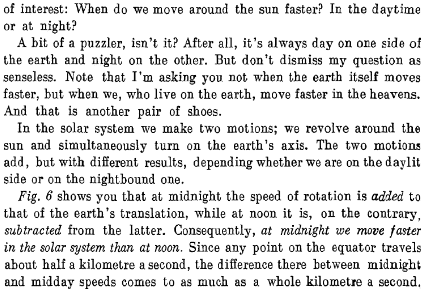
I'm reading Physics for Entertainment by Yakov Perelman and in it he says under "When we move around the sun faster" that at midnight the speed of the rotation of the Earth is added to that of Earth's translation effectively saying we move faster at night than during the day.

He further goes on to say "Since any point travels about the Earth at half a kilometer a second, the difference there between midday and midnight speeds is about a whole kilometer a second."

Does this happen because the gravity of the sun? Is this just a phenomenon of any object, like a wheel (I heard someone explain it on a quora but I wasn't sure if it was related)?

Anyways I don't understand please explain in easy way for me or tell me what to study so I understand it.

A excerpt of the book:
aHgzW.png
 

Attachments

  • aHgzW.png
    aHgzW.png
    24.1 KB · Views: 1,052
Astronomy news on Phys.org
Tracing a point on a wheel is a pretty good analogy to what this is referring to. Your scanned article does not make any reference to how the entire solar system is also moving through space, as well. But understand this first type of motion first.
 
  • Like
Likes   Reactions: sophiecentaur
I see the next chapter was the wheel demonstration saying there's a translation of movement and a rotation of movement and the translation shows a stopping with the wheel meeting the ground. I guess the translation of stoppage in the orbit would be the gravity of the sun stopping it and maybe also the moon's pull makes the night side spin faster? Is that correct?
Or does the stoppage have to do with the circular orbit?
 
Last edited:
shawnr said:
guess the translation of stoppage in the orbit would be the gravity of the sun stopping it and maybe also the moon's pull makes the night side spin faster? Is that correct?
No, there's no gravity involved here (except that of course the sun's gravity is what keeps the Earth in orbit). All that's going is that the Earth is rotating so people standing at different points on the surface of the Earth are moving at different speeds relative to one another. Imagine that you are floating in space above the North Pole, looking down at the Earth turning underneath you. Two people standing on the equator on opposite sides of the Earth will be moving in opposite directions (just as the tip of the hand of a clock is moving to the left at 6:00 but to the right at 12:00).

If you're standing on the equator at midnight, the Earth's rotation is moving you in the same direction as the Earth's orbit around the sun so your total speed is the speed of the center of the Earth around the sun, plus the rotation speed. Meanwhile the Earth's rotation is moving a person on the other side of the Earth (where it is high noon) in the opposite direction from the Earth's orbit around the sun, so we have to subtract the rotational speed instead of adding it.
 
  • Like
Likes   Reactions: shawnr
That makes sense, so there's no stoppage here at all? It's simply a matter of placement in relation to Earth during the transition?
 
@shawnr when you have got your head around the Earth and a wheel, look at this movie which shows a view of the Moon's combined orbits round the Sun and the Earth. :smile:
 
sophiecentaur said:
@shawnr when you have got your head around the Earth and a wheel, look at this movie which shows a view of the Moon's combined orbits round the Sun and the Earth. :smile:
The diameter of the Moon's orbit is 768000 km and it takes ~29.5 days to complete 1 orbit with respect the Sun. Thus it takes 14.75 days to move 768,000 km from leading the Earth in its orbit to trailing it. The Earth's orbital speed is ~30 km/sec, and thus would have moved 38232000 kn along its orbit at in that time. this is nearly 50 times the width of The Moon's orbit. The Moon's heliocentric path can't "back track" over itself.
 
shawnr said:
That makes sense, so there's no stoppage here at all? It's simply a matter of placement in relation to Earth during the transition?

The center of the Earth orbits the Sun at ~30 km/sec
A point on the equator moves relative to the center of the Earth at ~ 0.46 km/sec due to the Earth's rotation.

Thus you get the following (with the sun located below the image):
rot.png


The point of the equator nearest the sun has its rotational speed subtracted from the orbital speed of the Earth in order to get its speed relative to the Sun, while the far side has its rotational speed added to the orbital speed,
 

Attachments

  • rot.png
    rot.png
    4.1 KB · Views: 745
  • Like
Likes   Reactions: shawnr and OmCheeto
  • #10
Janus said:
The Moon's heliocentric path can't "back track" over itself.
Right. But I think it might be the case for some other moons in the solar system, like Neptune's moon Naiad with 11.86 km/s orbital speed around Neptune, against Neptune's 5.43 km/s around the Sun.
 
  • #11
Yes, though it isn't possible for anything orbiting the earth, since even just barely above the atmosphere, the speed of an object orbiting Earth is only a bit less than 8 km/s, far less than Earth's orbital speed around the sun (and even in a highly elliptical orbit, an object couldn't exceed 11km/s otherwise it would escape).
 

Similar threads

  • · Replies 43 ·
2
Replies
43
Views
7K
  • · Replies 5 ·
Replies
5
Views
2K
Replies
6
Views
14K
  • · Replies 27 ·
Replies
27
Views
4K
  • · Replies 24 ·
Replies
24
Views
3K
  • · Replies 5 ·
Replies
5
Views
4K
  • · Replies 4 ·
Replies
4
Views
7K
  • · Replies 18 ·
Replies
18
Views
2K
  • · Replies 33 ·
2
Replies
33
Views
4K
  • · Replies 98 ·
4
Replies
98
Views
8K