Discussion Overview
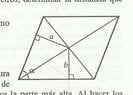
The discussion revolves around the formula for the area of a parallelogram, specifically whether it can be expressed as \( \frac{a}{b} \sin \alpha \). Participants explore the relationships between the sides and angles of the parallelogram and the implications for calculating its area.
Discussion Character
- Debate/contested
- Mathematical reasoning
Main Points Raised
- One participant suggests that the area of the parallelogram can be expressed as \( \frac{a}{b} \sin \alpha \), proposing a relationship between two triangles within the figure.
- Another participant points out that there is a misunderstanding regarding the terms "triangle a" and "triangle B," clarifying that "a" and "b" refer to lengths, not triangles, and emphasizes the need for the actual lengths of the sides to calculate the area.
- A later reply corrects the initial claim, stating that the area should be \( ab \sin \alpha \), where \( a \) and \( b \) are the sides of the parallelogram, not the perpendicular lengths.
- One participant mentions a reference from a book that presents the area as \( \frac{a \sin \alpha}{b} \), prompting further confusion about the validity of this expression for area.
- Another participant challenges the book's expression, asserting that an area cannot be represented as a length divided by a length, reinforcing the requirement for area to be a product of lengths.
Areas of Agreement / Disagreement
Participants express disagreement regarding the correct formula for the area of the parallelogram, with multiple competing views on the relationship between the sides and angles. No consensus is reached on the validity of the proposed expressions.
Contextual Notes
There are unresolved assumptions regarding the definitions of the lengths and angles involved, as well as the context of the figures referenced. The discussion reflects uncertainty about the correct formulation of the area based on the provided diagram.