Is the trefoil knot truly unknottable or is there a way to simplify it?

  • Context: High School 
  • Thread starter Thread starter DaveC426913
  • Start date Start date
  • Tags Tags
    Figure Type
Click For Summary

Discussion Overview

The discussion revolves around the trefoil knot and its topological properties, specifically whether it can be simplified to a less complex shape or if it is truly an unknottable structure. Participants explore concepts related to knot theory, including knot invariants and the nature of complex knots.

Discussion Character

  • Exploratory
  • Debate/contested
  • Technical explanation

Main Points Raised

  • Some participants question whether the trefoil knot can be topologically reduced to simpler shapes, such as a doughnut.
  • Others suggest that the trefoil knot only appears to be linked and can be transformed to unlink it, although they struggle to sketch the operations involved.
  • A participant proposes using knot invariants, such as tricolorability, to analyze the trefoil knot's properties.
  • There are claims that certain shapes, including the trefoil knot, cannot be reduced below a certain level of complexity, indicating the existence of "unknottable" knots.
  • One participant mentions that the trefoil knot allows for tricolorability, which distinguishes it from the unknot, suggesting that these properties indicate the trefoil is a non-trivial knot.
  • Another participant reflects on the historical context of the trefoil knot's representation in educational materials, indicating its significance in sparking curiosity about topology.
  • There is a discussion about the topological differences between various shapes and how they relate to the concept of knots.

Areas of Agreement / Disagreement

Participants express differing views on the reducibility of the trefoil knot, with some asserting it is unknottable while others explore the possibility of simplification. The discussion remains unresolved regarding the definitive nature of the trefoil knot and its classification within knot theory.

Contextual Notes

Participants reference various knot invariants and properties without reaching a consensus on their implications for the trefoil knot. The discussion includes assumptions about the nature of knots and the operations that can be performed on them, which are not fully explored.

DaveC426913
Gold Member
2025 Award
Messages
24,488
Reaction score
8,752
I was watching a video online about something completely different, but in the background I saw a computer monitor displaying an object similar to this.

Can this be topologically reduced to a simpler shape? Such as a simple one-, two- or three-hole doughnut? Or is it an irreducibly complex surface?
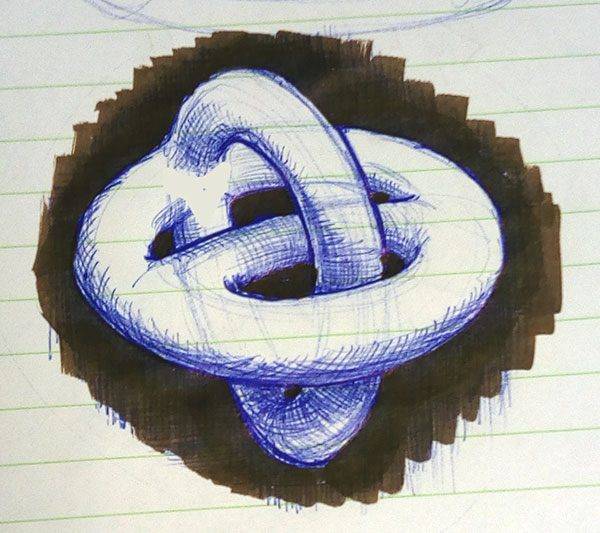
coffee-mug.jpg
or three-hole
 

Attachments

  • coffee-mug.jpg
    coffee-mug.jpg
    51.4 KB · Views: 562
Physics news on Phys.org
I think it only appears to be linked. You can change the object topologically to unlink it and you get three holes? I am having a hard time sketching the operations.
 
upload_2017-11-14_19-58-21.png
Hope this makes sense.
 

Attachments

  • upload_2017-11-14_19-58-21.png
    upload_2017-11-14_19-58-21.png
    50.6 KB · Views: 1,067
Reminds me of this video on numberphile:

 
  • Like
Likes   Reactions: FactChecker
jedishrfu said:
Reminds me of this video on numberphile:


Who are you calling an a hole ? ;).
 
DaveC426913 said:
Is it valid?
Yes, it is. I sketched it up a bit today, and you* are completely right! *Spinnor

I tried a few other shapes, even some apparent knots, and they can be reduced to simple shapes with holes.

Are there shapes that cannot be reduced below a certain level of complexity? Are there bona fide knots in topology?
 
  • #10
DaveC426913 said:
Yes, it is. I sketched it up a bit today, and you* are completely right! *Spinnor

I tried a few other shapes, even some apparent knots, and they can be reduced to simple shapes with holes.

Are there shapes that cannot be reduced below a certain level of complexity? Are there bona fide knots in topology?

Yes, there are " unnoktable" knots, e.g., the trefoil knot. Often you determine these are "genuine" knots by using invariants, i.e., properties intrinsic to knots, such as tricolorability https://en.wikipedia.org/wiki/Tricolorability. You can show the trefoil allows for tricolorability (i.e., painting the figure in 3 colors while satisfying certain conditions) while the unknot does not,which shows the two to be inequivalent ( or, more technically, " non-isotopic" ). Formally, a 3D knot is a copy of the circle that allows for twisting and bending of the circle , but do not allow for tearing , a.k.a ##S^1 ## under some functions called a homeomorphism. 2 images of the circle are considered equivalent if one can be deformed into another along special kinds of maps (" ambient isotopies"). Spinnor made use of this result by showing that the figure you presented can be deformed into the " unknot" by allowable moves; these moves are also called " Reidemeister" moves.

TL; DR: Equivalent knots share some properties, like the tricolorability property described above. Conversely, knots that do not share these properties are inequivalent as knots. Since trefoil and standard unknot do not share the tricolorability property, trefoil is a non-trivial knot.
 
Last edited:
  • #11
WWGD said:
Yes, there are " unknottable" knots, e.g., the trefoil knot.
I guess that would explain its presence on the cover of my high school functions textbook, that I till remember from 35 years ago.

Almost makes me think they put it there to pique my curiosity...

hqdefault.jpg
 

Attachments

  • hqdefault.jpg
    hqdefault.jpg
    11 KB · Views: 975
  • Like
Likes   Reactions: WWGD
  • #12
DaveC426913 said:
I guess that would explain its presence on the cover of my high school functions textbook, that I till remember from 35 years ago.

Almost makes me think they put it there to pique my curiosity...

View attachment 215120
Seems to have worked, albeit with some delay, I guess.
 
  • #13
DaveC426913 said:
I guess that would explain its presence on the cover of my high school functions textbook, that I till remember from 35 years ago.

Almost makes me think they put it there to pique my curiosity...

View attachment 215120
Your yearbook one is topologically different from the original drawing as there are no connection nodes.
 
  • #14
jedishrfu said:
Your yearbook one is topologically different from the original drawing as there are no connection nodes.
??

In post 9 I asked about more complex knots. WWGD referred to the unknottable trefoil knot, in post 10 - subsequent to which I responded, in post 11.

So, yes. It's different. :smile:
 
  • Like
Likes   Reactions: jedishrfu

Similar threads

  • · Replies 10 ·
Replies
10
Views
3K
  • · Replies 5 ·
Replies
5
Views
3K
Replies
29
Views
6K
  • · Replies 65 ·
3
Replies
65
Views
12K
  • · Replies 5 ·
Replies
5
Views
2K
  • · Replies 9 ·
Replies
9
Views
4K
  • · Replies 13 ·
Replies
13
Views
4K
  • · Replies 5 ·
Replies
5
Views
5K
Replies
24
Views
8K