Is the Wedge Product of a 0-Form and l-Form Equal to f * η?

  • Context: Graduate 
  • Thread starter Thread starter Maxi1995
  • Start date Start date
  • Tags Tags
    Product Wedge
Click For Summary

Discussion Overview

The discussion centers on the properties of the wedge product involving a 0-form (a smooth function) and an l-form. Participants explore whether the wedge product can be expressed as a product of the function and the form, specifically questioning the notation and implications of using the asterisk symbol in this context.

Discussion Character

  • Technical explanation
  • Debate/contested
  • Mathematical reasoning

Main Points Raised

  • One participant defines the wedge product using the alternator and questions if the expression for the wedge product of a 0-form and an l-form can be simplified to f * η.
  • Another participant cautions against using the asterisk symbol, suggesting it may be confused with the Hodge operator, and emphasizes that f can be factored out of the sum due to its independence from the permutation σ.
  • A different participant notes that the wedge product is a tensor operation, while the asterisk is a pseudotensor operation, implying a distinction in their mathematical treatment.
  • One participant expresses uncertainty about handling the permutation σ and proposes a method involving transpositions, suggesting that certain terms may cancel out but remains unclear on how to proceed further.
  • Another participant elaborates on the definition of the wedge product, detailing the role of permutations and the significance of the sign function in maintaining the alternating property of the product.

Areas of Agreement / Disagreement

Participants express differing views on the notation and implications of the wedge product, with no consensus reached on whether the expression f * η is appropriate or accurate in this context. The discussion remains unresolved regarding the treatment of permutations and the simplification of the wedge product.

Contextual Notes

Participants highlight potential complications arising from the use of permutations and the definitions involved in the wedge product, indicating that certain assumptions and mathematical steps may need further clarification.

Maxi1995
Messages
14
Reaction score
0
Hello,
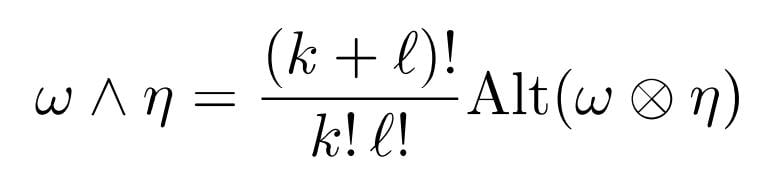
we defined the wedge-product as follows
Untitled01.jpg

Alt is the Alternator and the argument of Alt is the Tensor poduct of one k-form and a l-form (in this order w and eta).
Suppose we have the wedge product of a 0-form (a smooth function) and a l-form , so the following may result:

$$\frac{1}{l!} \sum_{\sigma \in S_k} sgn(\sigma) f \eta(v_{\sigma(1)},...,v_{\sigma(l)}).$$

Does it hold to say that it is equal to $$f*\eta?$$
 

Attachments

  • Untitled01.jpg
    Untitled01.jpg
    9.9 KB · Views: 858
Physics news on Phys.org
You really should not use ##*## here as it may be mistaken for the hodge operator.

That being said, what do you think? ##f## is clearly independent of the permutation ##\sigma## so you can move it outside the sum. It remains for you to show whether
$$
\eta(v_1, \ldots, v_\ell) = \frac{1}{\ell !} \sum_{\sigma \in S_\ell} \operatorname{sgn}(\sigma) \eta(v_{\sigma(1)},\ldots, v_{\sigma(\ell)})
$$
or not.
 
In addition, * is a pseudotensor operation while ##\wedge## is a tensor one
 
Well I weren't sure how to cope with the $$\sigma.$$ My idea was to say that we find for every permutation a counter part, that deviates only by one transposition from our permutation, so to say its form might be $$\sigma \circ \tau,$$ wehere tau is a transposition. By the alternation of the k-form, these parts should vanish. But for the transpositions in the group remain l! possibilities, so that we might get

$$\eta(v_1,...,v_k)-l!\eta(v_1,...,v_k)$$
and if that is not wrong, I don't know how to go on.
 
Maxi1995 said:
Well I weren't sure how to cope with the ##\sigma.##
I think this is too complicated.

##\omega \wedge \eta## is a ##(k+l)-##form, so we have to define ##(\omega\wedge\eta)\,(v_1,\ldots,v_{k+l})##. The formula for the alternator is
$$
Alt(\omega \wedge \eta)=\dfrac{1}{(k+l)!}\sum_{\sigma\in S_{k+l}}\operatorname{sgn}(\sigma)\,(\omega \wedge \eta)(v_{\sigma(1)},\ldots ,v_{ \sigma(k+l) } )
$$
so we have to explain
$$
\begin{align*}
(\omega\wedge\eta)\,(v_1,\ldots,v_{k+l})&=\dfrac{1}{k!\,l!}\sum_{\sigma\in S_{k+l}}\operatorname{sgn}(\sigma)(\omega \wedge \eta)\,(v_{\sigma(1)},\ldots ,v_{ \sigma(k+l) } )\\&=\sum_{\sigma\in S_{k+l}}\operatorname{sgn}(\sigma)\,\dfrac{1}{l!}\omega(v_{\sigma(1)},\ldots ,v_{ \sigma(k) }) \wedge \dfrac{1}{k!}\eta(v_{\sigma(k+1)},\ldots ,v_{ \sigma(k+l) })
\end{align*}
$$
This defines a multilinear, associative, anti-commutative and graded multiplication on ##\Lambda (V) = T(V)/\langle v\otimes w-w\otimes v\rangle##.

The role of ##\sigma## is actually only the role of ##\operatorname{sgn}(\sigma)##, which simply is a count of the number of mismatches in the natural order of ##1,\ldots ,k+l## which makes the entire product alternating. The factors ##\dfrac{1}{l!}\; , \;\dfrac{1}{k!}## can be considered as the amount of permutations which do not have an effect:

Say ##k=2## and ##l=3##. Then for every permutation ##\sigma \in S_5## which affects the order of ##(v_1,v_2)## we have ##3!## identical versions which permute the remaining ##3## indices, which is why we cancel them via division, e.g.
$$
\omega(v_1,v_2)\stackrel{(*)}{=}\dfrac{1}{3!}\left(\sum_{\sigma=(345)}\omega(v_{\sigma(1)}+v_{\sigma(2)})+\sum_{\sigma=(354)}\omega(v_{\sigma(1)}+v_{\sigma(2)})+\sum_{\sigma=(34)}\omega(v_{\sigma(1)}+v_{\sigma(2)})+\sum_{\sigma=(35)}\omega(v_{\sigma(1)}+v_{\sigma(2)})+\sum_{\sigma=(45)}\omega(v_{\sigma(1)}+v_{\sigma(2)})+\sum_{\sigma=(1)}\omega(v_{\sigma(1)}+v_{\sigma(2)})\right)
$$
##(*) ## The sums aren't necessary here as we only sum over one term, they merely serve as a place to write the permutation ##\sigma##.
 

Similar threads

  • · Replies 6 ·
Replies
6
Views
3K
  • · Replies 5 ·
Replies
5
Views
5K
  • · Replies 2 ·
Replies
2
Views
2K
  • · Replies 1 ·
Replies
1
Views
3K
  • · Replies 3 ·
Replies
3
Views
4K
  • · Replies 1 ·
Replies
1
Views
3K
  • · Replies 7 ·
Replies
7
Views
2K
  • · Replies 7 ·
Replies
7
Views
2K
  • · Replies 10 ·
Replies
10
Views
3K
  • · Replies 2 ·
Replies
2
Views
3K