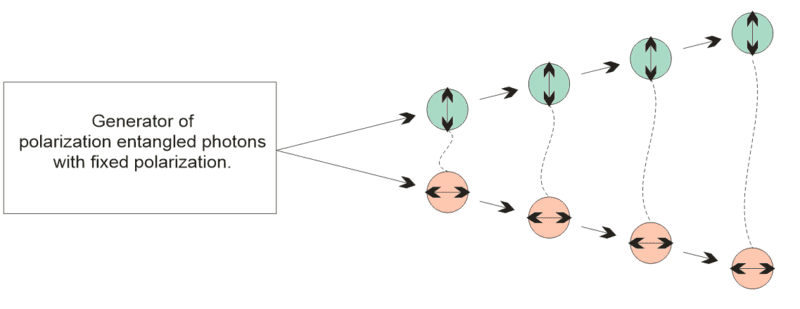
Is there a generator of entangled photons with fixed polarization?

Click For Summary
SUMMARY

The discussion centers on the feasibility of generating entangled photons with fixed polarization. Participants clarify that while it is possible to create pairs of photons with fixed polarization values using crystals, these pairs are not polarization entangled. The conversation highlights the contradiction inherent in the concept of polarization entanglement, emphasizing that entangled particles exist in a superposition of states and do not possess definite polarization until measured. The no-communication theorem is referenced, asserting that shared entanglement cannot be used to transmit information.

PREREQUISITES
  • Understanding of quantum entanglement principles
  • Familiarity with the no-communication theorem
  • Knowledge of polarization states in quantum mechanics
  • Experience with spontaneous parametric down-conversion techniques
NEXT STEPS
  • Research the implications of the no-communication theorem in quantum information theory
  • Explore methods for generating entangled photons using spontaneous parametric down-conversion
  • Study the mathematical representation of quantum superposition and polarization states
  • Investigate experimental setups for measuring polarization entanglement
USEFUL FOR

Quantum physicists, optical engineers, and researchers in quantum information science will benefit from this discussion, particularly those focused on the generation and application of entangled photons in experiments and simulations.

prokopcio
Messages
5
Reaction score
0
Hello everyone!
I don't know where to look for information - maybe here it will work :)

Is there a generator of entangled photons with fixed polarization?
If not, is it theoretically possible to build or is it against the laws of physics.

345011239_1613801935773759_6226039408254900848_n.png

I need this knowledge for further computer simulations.
Unfortunately, no one can answer this question for me :(

Can you help me?
Lukasps.AI chat (GPT) told me that such generators exist but I'm not sure how he would know about it :)
 
Last edited:
Physics news on Phys.org
Theoretically, you can make the state preparation whatever you like. It might not be easy to implement in reality, but experimentalist can be quite clever!
 
  • Like
Likes   Reactions: PeroK, Lord Jestocost and prokopcio
Tkanks, for reply.

here :
https://en.wikipedia.org/wiki/Spontaneous_parametric_down-conversion

i found it :
800px-SPDC_figure.png

This suggests to me that it is possible.

But !!!

According to my computer simulations, such a device can be easily used to send information at superluminal speed, which is ruled out by the fundamental laws of physics.

I can present my simulations here, maybe someone will point out where I am making a mental error.

EDIT :
now I see that the entangled photons in this picture have no definite polarization. My oversight.
So... still waiting for reply if is posible it with definite polarisation ( i think that not ).
 
Have you considered the no communication theorem?

The no-communication theorem thus says shared entanglement alone cannot be used to transmit any information. Compare this with the no-teleportation theorem, which states a classical information channel cannot transmit quantum information. (By transmit, we mean transmission with full fidelity.) However, quantum teleportation schemes utilize both resources to achieve what is impossible for either alone.
 
Yes, I am well aware of this theorem.
I directly agree, which is why I thought such entanglement was impossible.
Still, many people try to use entanglement indirectly.
Me too :).
 
prokopcio said:
Is there a generator of entangled photons with fixed polarization?
If not, is it theoretically possible to build or is it against the laws of physics.

Regardless of how you might interpret the previous comments:

It is an absolute contradiction of terms for a pair of particles to be polarization entangled AND have a fixed polarization. If particles are polarization entangled, they are in a superposition of polarization states - and therefore have no specific polarization value until they are measured.

Yes, it is possible to have a pair of particles that are entangled and have fixed polarization values. There are a variety of ways do accomplish this with crystals (similar to your diagram in post #3). However, such pairs are NOT polarization entangled.
 
  • Like
  • Informative
Likes   Reactions: vanhees71, prokopcio, Lord Jestocost and 2 others
prokopcio said:
This suggests to me that it is possible.
No, it doesn't. You are misinterpreting the diagram. What the diagram is actually saying is that, in the vast majority of cases, the two photons are not entangled. But, in a small minority of cases, where the two photons come out along the lines labeled "entangled photons", then they are entangled--and neither of them have definite polarizations (all you know is that the polarizations are perpendicular).
 
  • Like
Likes   Reactions: vanhees71, DrChinese and prokopcio
DrChinese said:
Regardless of how you might interpret the previous comments:

It is an absolute contradiction of terms for a pair of particles to be polarization entangled AND have a fixed polarization. If particles are polarization entangled, they are in a superposition of polarization states - and therefore have no specific polarization value until they are measured.
It's what i needed , now all is clear and i know where was my important knowledge gaps....
Thank You !!!

One question more if can.... about this:
DrChinese said:
Yes, it is possible to have a pair of particles that are entangled and have fixed polarization values. There are a variety of ways do accomplish this with crystals (similar to your diagram in post #3). However, such pairs are NOT polarization entangled.
PeterDonis said:
You are misinterpreting the diagram. What the diagram is actually saying is that, in the vast majority of cases, the two photons are not entangled. But, in a small minority of cases, where the two photons come out along the lines labeled "entangled photons", then they are entangled--and neither of them have definite polarizations (all you know is that the polarizations are perpendicular).
yes, I wrote that I misunderstood it earlier. But the question is if in this particular case the 2 entangled photons are polarization entangled, but we know it's a vertical+horizontal superposition, I mean (0 degrees)+(90 degrees) and not e.g. +45 degrees -45 degrees.

I'm sorry, my english isn't good but hope that you understand my question.Thanks Again - You are the best !!!
 
If I add two vectors with 45 and -45 degrees of equal size I get horizontal polarization. If I subtract the -45 degrees from the 45 degrees I get vertical polarization. So superposition in horizontal and vertical equals superposition in 45 and -45 degrees, they are equivalent under the unitary transformation ## \frac{1}{\sqrt(2)} \begin{pmatrix}
1 & 1 \\
1 & -1
\end{pmatrix}##
There is such a transformation for any two directions with 90 degree direction difference.
 
  • Like
Likes   Reactions: DrChinese and prokopcio
  • #10
prokopcio said:
if in this particular case the 2 entangled photons are polarization entangled, but we know it's a vertical+horizontal superposition
No, you don't. All you know is that the polarizations are perpendicular.
 
  • #11
prokopcio said:
But the question is if in this particular case the 2 entangled photons are polarization entangled, but we know it's a vertical+horizontal superposition, I mean (0 degrees)+(90 degrees) and not e.g. +45 degrees -45 degrees.

I'm sorry, my english isn't good but hope that you understand my question.

Thanks Again - You are the best !!!

When a pair of those entangled photons are in a vertical/horizontal superposition, they are also in a superposition on all polarization bases. That would include +45 degrees and -45 degrees. Both @Structure seeker and @PeterDonis are also correct in their answers, each coming at your question from a slightly different perspective.
 
  • Like
Likes   Reactions: prokopcio
  • #12
PeterDonis said:
All you know is that the polarizations are perpendicular.
It was clear "always".

For me todays reply is :

It's imposible to generate pair of photons with known polarizations...

Second learn is ( very good and simply explained by all of you ) :
0 and 90 = -45 and +45
i saw it difference before, now after calculation understand how it works.

Before talking to you, everything was exactly the same for me in the simulation, just a different point of view led me to a dead end.
 
Last edited:

Similar threads

  • · Replies 61 ·
3
Replies
61
Views
4K
  • · Replies 1 ·
Replies
1
Views
2K
  • · Replies 15 ·
Replies
15
Views
3K
  • · Replies 58 ·
2
Replies
58
Views
5K
  • · Replies 18 ·
Replies
18
Views
5K
Replies
13
Views
2K
  • · Replies 1 ·
Replies
1
Views
2K
  • · Replies 4 ·
Replies
4
Views
1K
  • · Replies 20 ·
Replies
20
Views
3K
  • · Replies 13 ·
Replies
13
Views
2K