Is there a such thing as being outside of our sun's gravitat

  • Context: High School 
  • Thread starter Thread starter IgnorantofPhysics
  • Start date Start date
  • Tags Tags
    Outside
Click For Summary

Discussion Overview

The discussion centers around the concept of whether it is possible to be outside the gravitational influence of the Sun. Participants explore the implications of gravitational force, escape velocity, and the energy required to overcome gravitational pull, with a focus on theoretical and conceptual aspects rather than definitive conclusions.

Discussion Character

  • Exploratory
  • Conceptual clarification
  • Debate/contested
  • Mathematical reasoning

Main Points Raised

  • Some participants assert that gravity's range is infinite, suggesting that one can never be completely free from the Sun's gravitational influence.
  • Others propose that while gravitational force diminishes with distance, it is possible to escape the Sun's influence by achieving sufficient kinetic energy.
  • A participant mentions that the force required to alter an object's orbit varies with distance, indicating that a smaller force can be effective at greater distances.
  • There is a discussion about the importance of energy over force in space travel, with references to escape velocity and the work done by forces applied over distances.
  • Some participants emphasize the need to consider the amount of fuel required to achieve the necessary kinetic energy for orbital changes, rather than focusing solely on gravitational force.
  • Clarifications are made regarding escape velocity, noting that it is context-dependent and varies with distance from the mass exerting the gravitational pull.
  • Participants discuss the nature of orbits, including hyperbolic and elliptical paths, and the conditions under which an object may escape or remain bound to a gravitational body.

Areas of Agreement / Disagreement

Participants express differing views on the nature of gravitational influence and the conditions necessary for escape. While some agree on the importance of kinetic energy and energy input, there is no consensus on the implications of gravitational force at various distances.

Contextual Notes

The discussion highlights the complexity of gravitational interactions and the varying definitions of escape velocity. Limitations in understanding the precise conditions for escape and the role of energy versus force are acknowledged but remain unresolved.

Who May Find This Useful

This discussion may be of interest to those exploring gravitational physics, orbital mechanics, and the principles of space travel, particularly in relation to energy requirements and the nature of gravitational influence.

IgnorantofPhysics
Messages
6
Reaction score
0
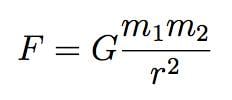
Is there a such thing as being outside of our sun's gravitational influence? Please forgive my ignorance. I recall this formula
inverse-square.jpe
But, what ought I plug into it, along with the sun's mass, such that I could say "it's far enough out there that there is not even a tug resultant from F"?
Any thoughts are appreciated.
 
Astronomy news on Phys.org
Nope. Gravity's range is infinite. No matter how far away from the Sun you were, you would never reach zero influence from it.
 
IgnorantofPhysics said:
Is there a such thing as being outside of our sun's gravitational influence? Please forgive my ignorance. I recall this formula
inverse-square.jpe
But, what ought I plug into it, along with the sun's mass, such that I could say "it's far enough out there that there is not even a tug resultant from F"?
Any thoughts are appreciated.
The Force is always with you, however far away you go but it is possible to 'escape' by having enough Kinetic Energy to beat the Gravitational Potential. This link on wiki explains it. It's Energy and not Force that counts in these situations.
If you wanted to think of it in terms of Force then you could, perhaps, appreciate that the Force that's needed to move away from a distant orbit around a star becomes less and less with increasing distance. A relatively small kick would take Pluto out of its present orbit but a bigger kick would be needed to shift it if it were at the same distance as the Earth.
 
Thank you Drakkith and SophieCentaur.
sophiecentaur said:
A relatively small kick would take Pluto out of its present orbit but a bigger kick would be needed to shift it if it were at the same distance as the Earth.
This is brilliant. I wish there were a universe simulator, that would let me change values so that I could learn what values are sufficient to make "kicks." This quote has helped me understand that maybe it is not the number F calculated in isolation among say our sun and the Europa moon of Jupiter, that is needed. Instead, it is the fact that FSun calculated among our sun and Europa is not a strong-enough F to have more influence than a FJupiter calculated among Europa and Jupiter; it's not a big enough force to do a "kick." If it is correct, then I just have to figure out what enough force is to say knock Europa out of its orbit.
 
IgnorantofPhysics said:
Thank you Drakkith and SophieCentaur.
This is brilliant. I wish there were a universe simulator, that would let me change values so that I could learn what values are sufficient to make "kicks." This quote has helped me understand that maybe it is not the number F calculated in isolation among say our sun and the Europa moon of Jupiter, that is needed. Instead, it is the fact that FSun calculated among our sun and Europa is not a strong-enough F to have more influence than a FJupiter calculated among Europa and Jupiter; it's not a big enough force to do a "kick." If it is correct, then I just have to figure out what enough force is to say knock Europa out of its orbit.
Just look up escape velocity of the solar system and of the various planets.
 
IgnorantofPhysics said:
what enough force is to say knock Europa out of its orbit.
It isn't the Force that counts. You would appreciate that a large force, applied over a very short distance, could make very little difference to Europa's position. A Force, applied over a distance represents the Work done - or Energy input and that's the important thing. (Work is equal to Force times the distance it acts over) You could look at the situation in terms of the amount of fuel needed (per kg of object, perhaps). The amount of fuel would relate to the Kinetic Energy added to the object. So a teaspoon of fuel out in Pluto's orbit would do the job of several kg of fuel at Earth's distance. The term 'escape velocity' (as Dave has pointed out) is the commonly used description of the KE per kg of a spacecraft . It's an easy to remember figure that tells you most of what you want to know. Whatever you do, you need to progress beyond using the Force as a meaningful measure of what's needed in space travel. Use Energy.
Deep spacecraft are being developed that use Ion Drives. These produce tiny forces but they are running all the time and can, eventually, accelerate a craft to very high speeds. They will do the job of a conventional rocket without needing to carry cast amounts of propellant (the stuff that's fired out the back of a rocket to make it go forward)
 
I have looked up escape velocity as DaveC426913 and SophieCentaur have suggested. Here is what I've learned in my own words:
An Escape Velocity is usually given assuming an object is on the surface of a specified mass. It is a speed, irrespective of direction, where if the object achieves that speed it would not change direction and fall back to the surface, nor perpetually fall into an orbit of the larger mass. I learned that at farther distances than the surface the Escape Velocity is a smaller value.

I also want to thank SophieCentaur's direction in helping me know that force is the improper focus; the focus should be on kgs of fuel needed to do work.
I am learning a lot today : ) Thank you everyone
 
IgnorantofPhysics said:
the focus should be on kgs of fuel needed to do work.
Not so much "should" but fuel quantity gives a good idea of the Energy needed. The Energy word is more of a 'should'. It's just a bit more abstract.

Your point about Escape velocity is well made as that's the usual situation that it's used for. But you can also take it from a 'stationary' point elsewhere in space. (In which case, it will be a lot lot lower)
 
IgnorantofPhysics said:
where if the object achieves that speed it would not change direction
I just re-read this. The object can change direction, because the gravitational force will still be operating and, if the initial direction is not 'radial' it will have to be diverted. But not enough to pull it back. It will take an orbital path that is a hyperbola, which will never return. If the energy supplied is insufficient, the orbit will be an ellipse, which will keep the object going round the star (planet or whatever). Many comets have a hyperbolic orbit and only pass by once because their speed when at the closest approach is greater than escape velocity. This link may be of interest as it discusses the energy conditions for different orbit shapes. In a hyperbolic orbit, there is energy to spare.
 

Similar threads

  • · Replies 4 ·
Replies
4
Views
3K
  • · Replies 8 ·
Replies
8
Views
8K
  • · Replies 169 ·
6
Replies
169
Views
9K
  • · Replies 5 ·
Replies
5
Views
3K
  • · Replies 8 ·
Replies
8
Views
3K
  • · Replies 11 ·
Replies
11
Views
3K
  • · Replies 3 ·
Replies
3
Views
2K
  • · Replies 12 ·
Replies
12
Views
2K
  • · Replies 15 ·
Replies
15
Views
2K
  • · Replies 5 ·
Replies
5
Views
4K