Is this another Maxwell's demon?

  • Context: Graduate 
  • Thread starter Thread starter pkv
  • Start date Start date
  • Tags Tags
    Demon Maxwell's demon
Click For Summary

Discussion Overview

The discussion revolves around a thought experiment related to a system of gas chambers separated by pores that allow unidirectional flow of gas molecules. Participants explore whether such a system could lead to a violation of the second law of thermodynamics, akin to Maxwell's demon, and examine the implications of using devices like Tesla valves in this context.

Discussion Character

  • Exploratory
  • Debate/contested
  • Conceptual clarification
  • Technical explanation

Main Points Raised

  • One participant proposes a thought experiment involving gas chambers with pores that allow easier passage in one direction, questioning if this would lead to pressure differences and potential energy extraction.
  • Another participant asserts that the size of the holes is the critical factor, suggesting that baffling does not affect the outcome.
  • A participant shares simulation results indicating that gas density equilibrates regardless of the configuration of the pores, leading to the idea of a different type of Maxwell demon that counts particle flow.
  • Discussion about the Tesla valve includes skepticism regarding its effectiveness as a unidirectional flow device for individual particles, with some participants expressing confusion about its operational principles.
  • One participant reflects on Nikola Tesla's legacy, discussing both his contributions and the controversies surrounding his ideas, particularly regarding wireless power transmission.
  • A later post introduces the concept that for a Maxwell demon to function, it must gain information about particle movement, which could incur thermodynamic costs, thus not violating the second law of thermodynamics.
  • Another participant mentions recent developments in quantum versions of Maxwell's demon, referencing information theory and entropy related to qubits.

Areas of Agreement / Disagreement

Participants express differing views on the implications of the thought experiment and the effectiveness of the Tesla valve. There is no consensus on whether the proposed system could violate the second law of thermodynamics, and the discussion remains unresolved regarding the operational principles of the devices mentioned.

Contextual Notes

Some discussions involve assumptions about the behavior of gas particles and the effectiveness of certain devices without fully resolving the underlying mathematical or physical principles. The implications of information theory in relation to thermodynamics are also noted but not conclusively established.

pkv
Messages
11
Reaction score
0
A though experiment:

We have two gas chambers at the same temperature and pressure, separated by a wall punctuated by very small pores. Let's say small enough to allow the pass of only a few gas molecules at a time (so, no complex interactions between gas molecules inside the pore).

These pores are designed to allow molecules passing from one chamber to the other easy, and hard or very hard in reverse.

This design (for the pore) comes to mind:

Non-imaging optics CEC
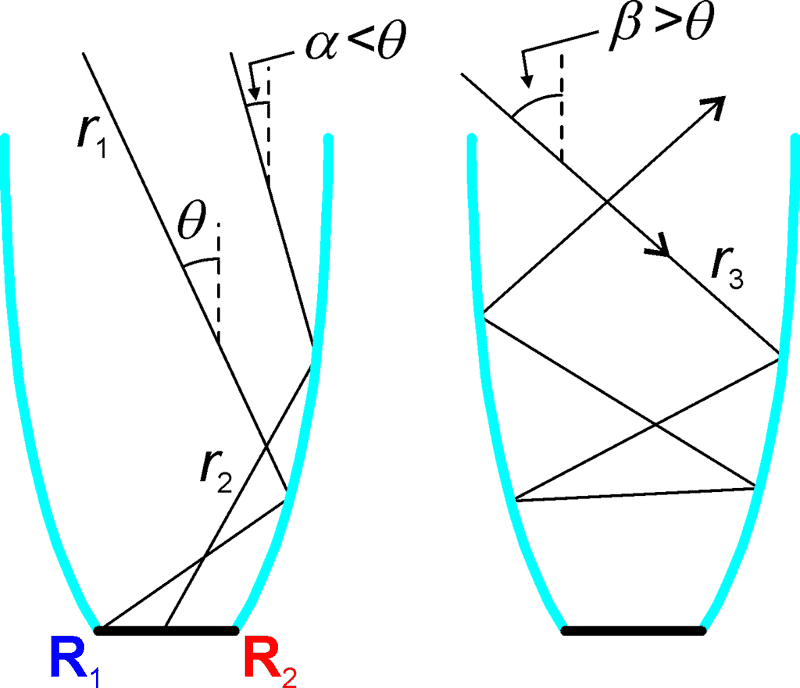
Nonimaging.png


Another one could be a version of a Tesla valve, although I am not so sure of it's validity for single molecules.
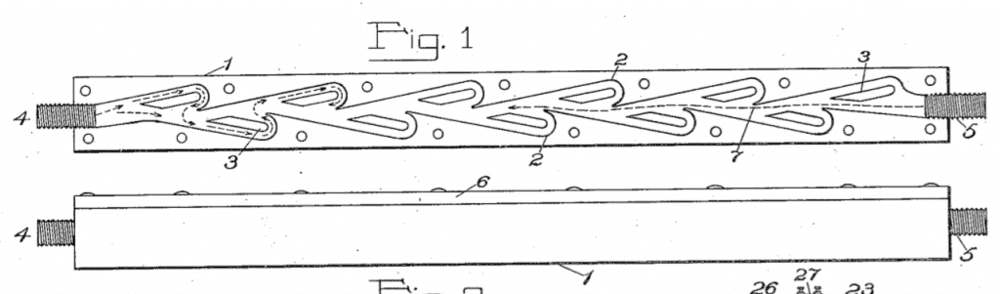
valve.png
The question is: would pressure/temperature in both chambers remain stable, or would the gas slowly migrate to the "easy pass" chamber, raising it's pressure?
If the second option happens, the systems seems to me akin to the Maxwell demon, as it violates the second law.
Such a system would allow to extract mechanical energy from the gases without a cold reservoir, until it's kinetic energy is exhausted, so I guess it's impossible.

Where is the catch?
 
Physics news on Phys.org
All that matters is the size of the hole between chambers. Any baffling you put in the chambers is irrelevant.
 
Yep, that was correct.
I simulated a gas and different connections between chambers and eventually the gas density always equilibrates...
I used this program as base, and added code for vector walls.

https://www.falstad.com/gas/
Simple passage
passage.png


Using a CEC
cec.png


Using a Tesla valve
tesla.png


...didn't see any noticeable difference in any scenario.

An interesting thing I noticed (for any configuration, like the simple passage), for low quantities of particles (<100) you can't get temporal density irregularities, sometimes quite high (like 20 particles in one side, 30 in the other).

That makes me think you can define a different type of Maxwell demon, one which only needs to count how many particles pass in each direction in the passage, and close it just once whenever the densities are different enough.

That would cause different densities in both chambers, but not necessarily different temperatures I guess. In that case, it wouldn't violate 2n law, right?
 
pkv said:
Using a Tesla valve
The name "Tesla" seems to grab my attention whenever I see it and it so often is associated with apparent 'Magic'. That valve is only an extension (surely) of the same effect that allows an aerodynamically shaped car body to move forward at a given speed than it can move backwards (with the same mpg). Fluid flow is not perfectly reversible so that 'party trick' valve is not particularly remarkable.
Am I over-sensitive to that guy or did he really promise much more than has been actually achieved in his name?
 
I was trying to answer the question about if it's possible to build a Maxwell demon only using non-moving parts. A kind of diode device that allows particles to pass on on direction but not in the other, without having any information about such particles (unlike Maxwell's demon).

The only check valve I know using only non-moving parts is the Tesla valve (which is being used in microfluidics). I don't think it's magic, but I was obviously misunderstanding its working principles.

I guess a Tesla valve acts as a diode only with a coherent and dense stream of particles.
 
A bit off topic but ...

sophiecentaur said:
Am I over-sensitive to that guy or did he really promise much more than has been actually achieved in his name?

Yes and no. Tesla was a true genius, and a prolific inventor. The 3 phase induction motor, the Tesla turbine, and the Tesla Valve are examples of his contributions. He had more than 300 patents

https://en.wikipedia.org/wiki/List_of_Nikola_Tesla_patents
But later in life he became erratic, kooky or worse. His infamously bad idea was wireless power transmission. That made him a cult hero and a scientist's devil forevermore.

Both descriptions of the man are true making him a true enigma.
 
  • Like
Likes   Reactions: vanhees71
anorlunda said:
He had more than 300 patents
There's nothing about a patent to say a device is of any use or that it will actually work.
anorlunda said:
a prolific inventor.
. . . and successful self-publicist, I think.
anorlunda said:
erratic, kooky or worse
He obviously filled a need at that time. I guess that one can't judge him in isolation. But there is a serious lack of numerical evidence to support his ideas. His fans tend to ignore this and they 'all' quote his Wireless Power Transmission idea as if it actually worked. I wonder how he would have fared if he were alive these days.
anorlunda said:
a true enigma.
Hmm. That term can be interpreted in an over appreciated way. But I guess he was relatively harmless and not many were killed as a result of his efforts.
 
pkv said:
That makes me think you can define a different type of Maxwell demon, one which only needs to count how many particles pass in each direction in the passage, and close it just once whenever the densities are different enough.

In order to count molecules, the demon must be able to see them. He is in a container in equilibrium at constant temperature, where the radiation must be that of a blackbody. As it is impossible to see anything in the interior of a black body (the demon has the same temperature), he needs photons with energy above the thermal background to locate the molecules. Gaining information by this way is thermodynamically costly, so that the second law of thermodynamics cannot be violated on the whole as has been proved by L. Brillouin.

L. Brillouin in “Maxwell's Demon Cannot Operate: Information and Entropy. I” (Journal of Applied Physics 22, 334 (1951)):

In an enclosure at constant temperature, the radiation is that of a ``blackbody,'' and the demon cannot see the molecules. Hence, he cannot operate the trap door and is unable to violate the second principle. If we introduce a source of light, the demon can see the molecules, but the over‐all balance of entropy is positive.
 
  • Like
Likes   Reactions: vanhees71 and sophiecentaur
A quantum version of Maxwell's demon has recently been realized, and the famous information theoretical work by Landauer and Szilard has been confirmed (the entropy of a qubit is ##k_{\text{B}} \ln 2##:

https://www.pnas.org/content/114/29/7561
 
  • Informative
Likes   Reactions: anorlunda

Similar threads

  • · Replies 8 ·
Replies
8
Views
3K
  • · Replies 28 ·
Replies
28
Views
3K
  • · Replies 5 ·
Replies
5
Views
2K
  • · Replies 2 ·
Replies
2
Views
2K
  • · Replies 12 ·
Replies
12
Views
5K
  • · Replies 7 ·
Replies
7
Views
2K
  • · Replies 5 ·
Replies
5
Views
10K
  • · Replies 2 ·
Replies
2
Views
4K
  • · Replies 81 ·
3
Replies
81
Views
19K
  • · Replies 4 ·
Replies
4
Views
2K