Is this interpretation correct? (diagrams of Carbon Monoxide and Carbon Dioxide)

Click For Summary
SUMMARY

The forum discussion focuses on the hybridization and bonding structures of Carbon Monoxide (CO) and Carbon Dioxide (CO2). Users clarify that CO2's orbital diagrams are nearly accurate but require additional bonding representations for the negative phase of the Pz and Py orbitals. For CO, the resonance structures are discussed, emphasizing that the bond order cannot be distinctly represented in the diagrams. Additionally, the complexity of hybridization in larger atoms and the implications for bonding in compounds like PF3 and PF5 are highlighted.

PREREQUISITES
  • Understanding of hybridization concepts in molecular chemistry
  • Familiarity with resonance structures and bond order
  • Knowledge of molecular orbital theory versus valence bond theory
  • Basic principles of molecular geometry and bonding in CO and CO2
NEXT STEPS
  • Research the differences between sp, sp2, and sp3 hybridization
  • Learn about resonance structures in molecular bonding
  • Study the implications of hybridization in larger atoms beyond the second period
  • Explore the concept of banana bonds and their significance in molecular orbital theory
USEFUL FOR

Chemistry students, educators, and professionals interested in molecular bonding, hybridization, and resonance structures in small molecules like CO and CO2.
prakhargupta3301
Messages
58
Reaction score
1
*SORRY FOR BAD DIAGRAM*

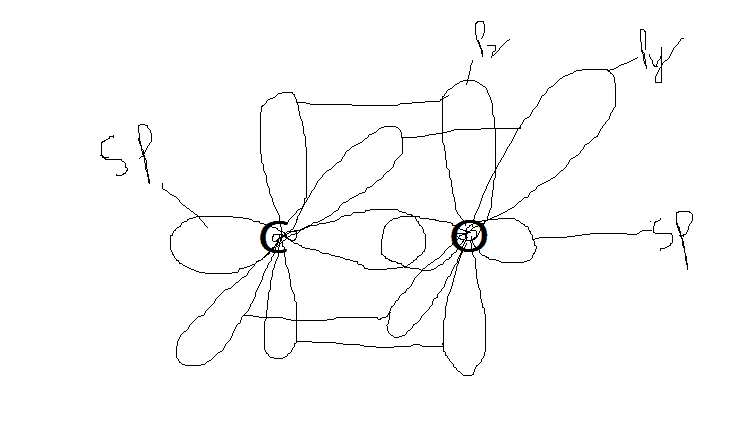
Is this correct for C(triple bond)O ie Carbon Monoxide
upload_2018-7-10_19-10-45.png

upload_2018-7-10_19-46-57.png

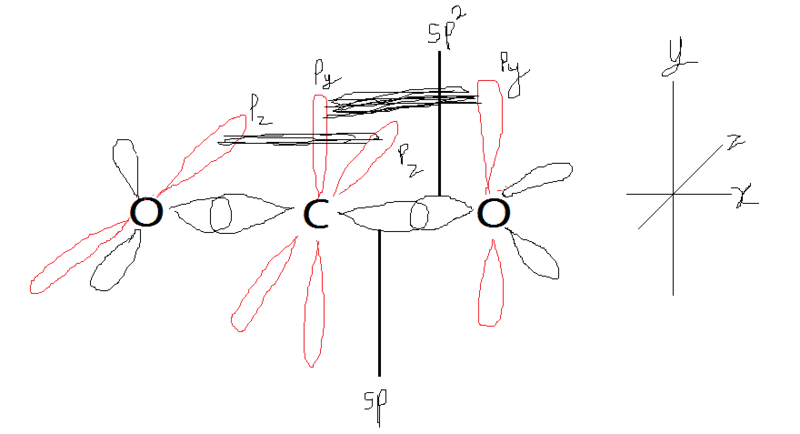
This is for CO2. Please check both.
ALso check everything ie hybridized orbitals, bondings etc. I'm trying to clear concepts.
(Note: red= unhybridized, black= hybridized)

Thank you.
 

Attachments

  • upload_2018-7-10_19-10-45.png
    upload_2018-7-10_19-10-45.png
    4.5 KB · Views: 1,924
  • upload_2018-7-10_19-46-57.png
    upload_2018-7-10_19-46-57.png
    12.6 KB · Views: 2,343
Last edited:
Chemistry news on Phys.org
First, the orbitals are fine. Some details can be improved though.

I'm going to explain CO2 first. It is very close to being right. You forgot to draw bonding (black scribble between orbitals) for the other side (negative phase) of the Pz and Py orbitals. I'm sure this is a careless mistake because you did it for CO. Otherwise, they are good.

As for the CO, the orbitals are a mixture of a resonance structure ⊕:C≡O:⊖ ↔ :C=O:: (sorry the four electrons on the oxygen is wrong, two electrons belong on sp and the other two on Pz, but I cannot write that here). In that sense, the orbitals are fine, but the bond order cannot be discretely written in the diagram.

EDIT: You forgot to color code CO for the unhybridized or hybridized.
 
Last edited:
  • Like
Likes   Reactions: Spinnor, prakhargupta3301 and berkeman
HAYAO said:
First, the orbitals are fine. Some details can be improved though.

I'm going to explain CO2 first. It is very close to being right. You forgot to draw bonding (black scribble between orbitals) for the other side (negative phase) of the Pz and Py orbitals. I'm sure this is a careless mistake because you did it for CO. Otherwise, they are good.

As for the CO, the orbitals are a mixture of a resonance structure ⊕:C≡O:⊖ ↔ :C=O:: (sorry the four electrons on the oxygen is wrong, two electrons belong on sp and the other two on Pz, but I cannot write that here). In that sense, the orbitals are fine, but the bond order cannot be discretely written in the diagram.

EDIT: You forgot to color code CO for the unhybridized or hybridized.
Okay, the silly mistakes apart. I wanted to ask you something, will side atoms (or ligands. here O) show hybridization too? People on my other posts have said they won't..
:\
Thanks
 
prakhargupta3301 said:
Okay, the silly mistakes apart. I wanted to ask you something, will side atoms (or ligands. here O) show hybridization too? People on my other posts have said they won't..
:\
Thanks

I think I need to clear the misunderstanding first. DrDu meant to say that hybridization won't fully explain what happens in PF3. Any elements beyond 2nd period is going to be quite complicated. As an example, as you may already know, compounds containing phosphorous can sometimes show hypervalency (such as PF5), which you won't see for 1st and 2nd period elements. Larger atoms tend to be quite complicated where conventional understanding of bonding may or may not apply.

Carbon and oxygen in CO2 and CO can surely be explained well by hybridized orbitals.
 
CO2 is an example where you can see that different assumptions about hybridization lead to comparable bonding schemes. In the case of CO2 you have several choices:
a) take the O's to be sp2 hybridized, which is what you apparently did. Note that you can draw two equivalent structures depending on whether the sp2 hybrids on the left oxygen atom lie in the xy plane or xz plane. You can even get resonance stabilization by considering both structures at once.
b) Take the O's to be sp hybridized. Then you get again at least two resonance structures depending on whether the pi bond between the o on the left and the central c lies in the xy or xz plane. There will be a bit more repulsion between the lone pairs on O and the pi bonds as in case a.
c) Consider the oxygens as completely unhybridized. This will lead to somewhat weaker sigma bonds as in case b.
d) Consider all atoms to be sp3 hybridized. This will lead to so-called "banana bonds" between the atoms (https://en.wikipedia.org/wiki/Bent_bond). Banana bonds are energetically favourable over sigma-pi type bonds as the "bananas" are at greater distance from each other which reduces electrostatic repulsion between the bonds. There is some confusion about this even on wikipedia. The reason is that in molecular orbital theory banana-bonds and sigma-pi bonds are equivalent while in valence bond theory, they are not.
 

Similar threads

  • · Replies 15 ·
Replies
15
Views
3K
  • · Replies 5 ·
Replies
5
Views
2K
  • · Replies 1 ·
Replies
1
Views
3K
  • · Replies 19 ·
Replies
19
Views
9K
  • · Replies 9 ·
Replies
9
Views
4K
  • · Replies 15 ·
Replies
15
Views
3K
Replies
15
Views
6K
  • · Replies 6 ·
Replies
6
Views
3K
  • · Replies 15 ·
Replies
15
Views
3K
Replies
35
Views
8K