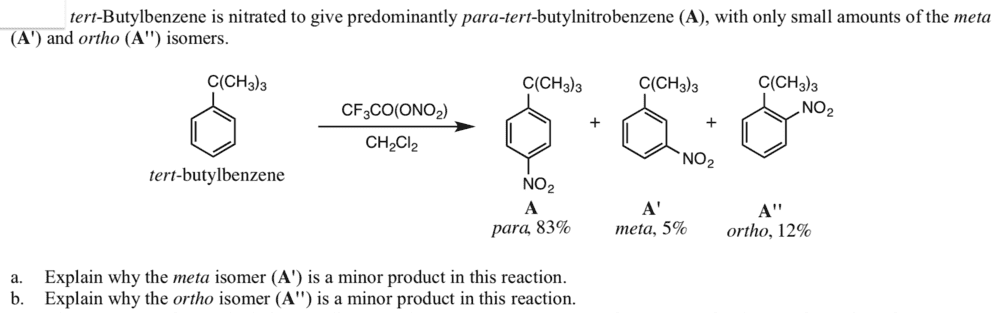
This nitration agent appears to be a way of producing the electrophilic NO
2+ , does that help answer your first question?
That said, it is not the classical nitrating agent in all textbooks which is sulphuric/nitric acid mixture. In this mixture the stronger sulphuric acid superprotonates the weaker nitric and then dehydrates it to produce the said NO
2+ (nitrosylate) ion. See e,g,
https://chem.libretexts.org/Bookshe...f_Arenes/Nitration_and_Sulfonation_of_Benzene
I have not myself (not a chemist) heard that I remember your cited nitrating agent. (Googling a bit it is not something that hit me in the eye, in fact I found no trace of it). I do not know what its advantages are, just conjecture that it minimises dinitration.I am perplexed by the fact that trifluoroacetic acid is a weaker acid than nitric. But then it looks that this is all in a non-aqueous solution (methylene dichloride). So I'm not answering for you, which we don't do here anyway, but hopefully you are now primed to find answers in your up-to-date textbook or recall something explained in your lectures.You would up your standing here if you brought back anything you find out resolving the incompleteness and perplexities above!
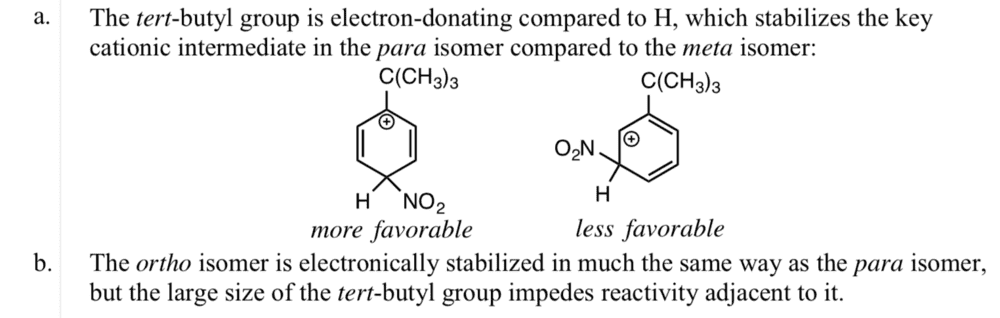
Likewise priming you, I suggest you draw out the resonant structures you can achieve with -C(NO
2)HC- in the three positions (include explicitly all the H atoms) and if you then do not see an answer to your second question show them to us and we will see if we agree.