Will multi-core processors reach their limit with Intel's new Ivy Bridge?

  • Thread starter Thread starter FishmanGeertz
  • Start date Start date
  • Tags Tags
    Bridge
Click For Summary
SUMMARY

The discussion centers on Intel's Ivy Bridge processor, which is confirmed to be a shrink of the Sandy Bridge architecture, transitioning from a 32nm to a 22nm process. Participants express skepticism about the necessity and practicality of 16-core processors, suggesting that current software, particularly PC games, cannot effectively utilize such high core counts. The conversation highlights the industry's struggle with performance limits, reminiscent of the pre-dual core era, and emphasizes the growing reliance on GPU computing power, particularly through Nvidia's CUDA technology.

PREREQUISITES
  • Understanding of Intel's processor architectures, specifically Sandy Bridge and Ivy Bridge
  • Familiarity with semiconductor manufacturing processes, particularly 22nm technology
  • Knowledge of multi-core processing and its implications for software performance
  • Awareness of GPU computing and technologies like Nvidia CUDA
NEXT STEPS
  • Research the architectural differences between Sandy Bridge, Ivy Bridge, Haswell, and Rockwell processors
  • Explore the impact of core count on software performance, particularly in gaming and video encoding
  • Investigate advancements in GPU computing and the role of CUDA in modern applications
  • Examine industry trends regarding processor performance limits and potential breakthroughs
USEFUL FOR

Hardware engineers, software developers, and technology enthusiasts interested in the evolution of processor architectures and the implications of multi-core technology on performance.
FishmanGeertz
Messages
189
Reaction score
0
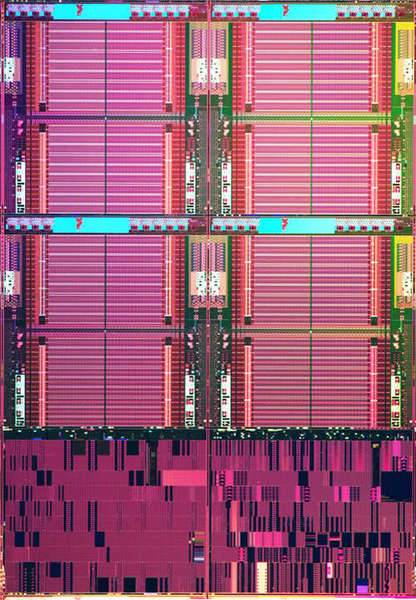
I think it's a little early for a die shot of the 8-16 core Intel "Ivy Bridge" processor, but this is an alleged photo.

IvyBridge.jpg


Is it real?
 
Computer science news on Phys.org
Whats the source of the image?
 
KrisOhn said:
Whats the source of the image?

http://mtmcv.com/intel-plans-new-factory-in-the-u-s-the-modernization-of-other-22nm-tech/
 
Last edited by a moderator:
All the Ivy Bridge is, is a shrinking of the Sandy Bridge architecture. This seems legit, other sources are saying the same thing, so yeah, Ivy Bridge is happening.

Whether that is a legitimate picture of the new die, I couldn't tell you.
 
KrisOhn said:
All the Ivy Bridge is, is a shrinking of the Sandy Bridge architecture. This seems legit, other sources are saying the same thing, so yeah, Ivy Bridge is happening.

Whether that is a legitimate picture of the new die, I couldn't tell you.

I thought the Ivy Bridge was an entirely new micro-architecture.

What about Haswell and Rockwell?
 
Ivy Bridge is just a shrink of Sandy Bridge. From 32nm to 22nm.

Haswell and Rockwell should be entirely new architecture.
 
KrisOhn said:
Ivy Bridge is just a shrink of Sandy Bridge. From 32nm to 22nm.

Haswell and Rockwell should be entirely new architecture.

When will we see 16-core chips?
 
Hopefully never.

I feel the industry is coming up against another wall just like they did in the pre-dual core era, when they were just trying to get chips to run higher and higher clock speeds to get them faster, they were coming up against a limit of how far they could push the chips. Now they're just shoving more and more cores onto the chips to get them faster... we need another break like we had when the dual cores came out.

Edit: wooo, post 100.
 
KrisOhn said:
Hopefully never.

I feel the industry is coming up against another wall just like they did in the pre-dual core era, when they were just trying to get chips to run higher and higher clock speeds to get them faster, they were coming up against a limit of how far they could push the chips. Now they're just shoving more and more cores onto the chips to get them faster... we need another break like we had when the dual cores came out.

Edit: wooo, post 100.

I don't see how things like PC games could utilize the power of 16 cores/32 threads. The only thing which would really benefit from that much CPU horsepower are things like HD video encoding and CAD.

With Nvidia "CUDA" CPU tasks are being handed to the computationally superior GPU. The difference in speed is like day and night. Most high-end GPU's have teraflop (trillions of calculations per second) computing power. CPU's don't have TFLOP power, yet.
 

Similar threads

  • · Replies 8 ·
Replies
8
Views
2K
  • · Replies 16 ·
Replies
16
Views
3K
Replies
3
Views
3K
  • · Replies 6 ·
Replies
6
Views
6K
  • · Replies 11 ·
Replies
11
Views
4K
Replies
17
Views
5K
  • · Replies 1 ·
Replies
1
Views
3K
  • · Replies 16 ·
Replies
16
Views
3K
  • · Replies 21 ·
Replies
21
Views
5K
  • · Replies 4 ·
Replies
4
Views
2K