Jacobson Radical and Right Annihilator Ideals ....

  • Context: Undergrad 
  • Thread starter Thread starter Math Amateur
  • Start date Start date
  • Tags Tags
    Radical
Click For Summary
SUMMARY

The discussion centers on Proposition 6.1.7 from Paul E. Bland's book "Rings and Their Modules," specifically regarding the proof that establishes the relationship between the right annihilator ideals and the Jacobson radical. The key conclusion is that if \( a \in \text{ann}_r(R / \mathfrak{m}) \), then \( a \in \mathfrak{m} \), leading to the assertion that \( \bigcap_{\mathcal{S}} \text{ann}_r(S) \subseteq J(R) \). This is confirmed through logical deductions based on the definitions of annihilators and the properties of the Jacobson radical.

PREREQUISITES
  • Understanding of the Jacobson radical in ring theory
  • Familiarity with right annihilator ideals
  • Knowledge of modules over rings
  • Basic concepts of algebraic structures in abstract algebra
NEXT STEPS
  • Study the properties of the Jacobson radical in various ring types
  • Explore the implications of right annihilator ideals in module theory
  • Investigate examples of rings where \( \bigcap_{\mathcal{S}} \text{ann}_r(S) \) is explicitly calculated
  • Review additional propositions in Bland's "Rings and Their Modules" for deeper insights
USEFUL FOR

Mathematicians, particularly those specializing in abstract algebra, graduate students studying ring theory, and anyone seeking a deeper understanding of Jacobson radicals and annihilator ideals.

Math Amateur
Gold Member
MHB
Messages
3,920
Reaction score
48
I am reading Paul E. Bland's book, "Rings and Their Modules".

I am focused on Section 6.1 The Jacobson Radical ... ...

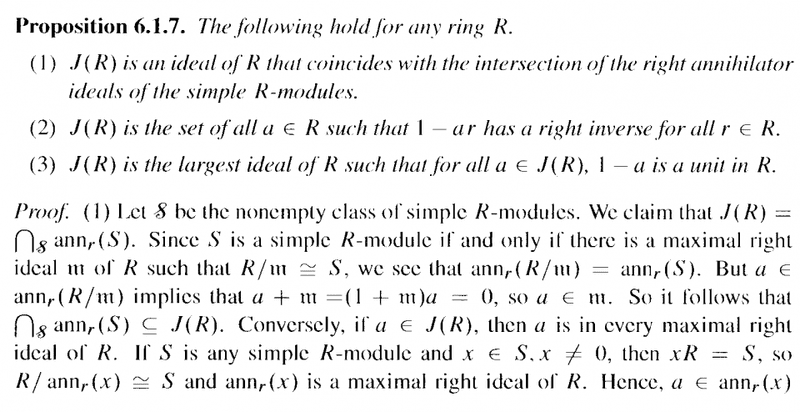
I need help with the proof of Proposition 6.1.7 ...Proposition 6.1.7 and its proof read as follows:
?temp_hash=57814fcc0e503006e7153e48b9211c10.png

?temp_hash=57814fcc0e503006e7153e48b9211c10.png

In the above text from Bland ... in the proof of (1) we read the following:" ... ... we see that ##\text{ann}_r( R / \mathfrak{m} ) = \text{ann}_r(S)##. But ##a \in \text{ann}_r( R / \mathfrak{m} )## implies that ##a + \mathfrak{m} = ( 1 + \mathfrak{m} ) a = 0## , so ##a \in \mathfrak{m}##.

So, it follows that ##\bigcap_\mathcal{S} \text{ann}_r(S) \subseteq J(R)## ... ... "
Could someone please explain why it follows that ##\bigcap_\mathcal{S} \text{ann}_r(S) \subseteq J(R)## ... ... ?Hope someone can help ...

Peter
 

Attachments

  • Bland - 1 - Proposition 6.1.7 ... ... PART 1.png
    Bland - 1 - Proposition 6.1.7 ... ... PART 1.png
    79.8 KB · Views: 772
  • Bland - 2 - Proposition 6.1.7 ... ... PART 2.png
    Bland - 2 - Proposition 6.1.7 ... ... PART 2.png
    42.9 KB · Views: 803
Physics news on Phys.org
Math Amateur said:
I am reading Paul E. Bland's book, "Rings and Their Modules".

I am focused on Section 6.1 The Jacobson Radical ... ...

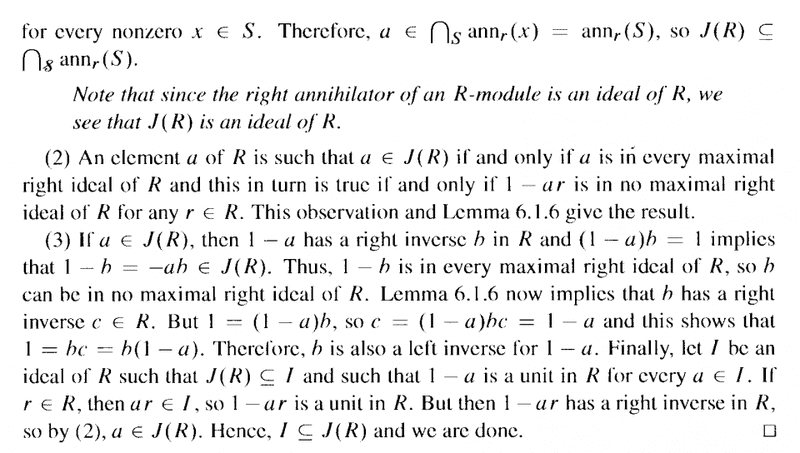
I need help with the proof of Proposition 6.1.7 ...Proposition 6.1.7 and its proof read as follows:
?temp_hash=57814fcc0e503006e7153e48b9211c10.png

?temp_hash=57814fcc0e503006e7153e48b9211c10.png

In the above text from Bland ... in the proof of (1) we read the following:" ... ... we see that ##\text{ann}_r( R / \mathfrak{m} ) = \text{ann}_r(S)##. But ##a \in \text{ann}_r( R / \mathfrak{m} )## implies that ##a + \mathfrak{m} = ( 1 + \mathfrak{m} ) a = 0## , so ##a \in \mathfrak{m}##.

So, it follows that ##\bigcap_\mathcal{S} \text{ann}_r(S) \subseteq J(R)## ... ... "
Could someone please explain why it follows that ##\bigcap_\mathcal{S} \text{ann}_r(S) \subseteq J(R)## ... ... ?Hope someone can help ...

Peter
Just some thoughts on my own question ... ...Just some thoughts ...

Since ##\text{ann}_r( R / \mathfrak{m} ) = \text{ann}_r(S)##

we have ##a \in \text{ann}_r( R / \mathfrak{m} )## means ##a \in \text{ann}_r(S)## ...

thus ##a \in \bigcap_\mathscr{S} \text{ann}_r(S)## ... ...

But ... we also have that ##a \in \text{ann}_r( R / \mathfrak{m} )## implies that ##a \in \mathfrak{m}## ... ...

But this means that ##a \in J(R)## ...

Thus ##a \in \bigcap_\mathscr{S} \text{ann}_r(S) \Longrightarrow a \in J(R)## ... ...

So ##\bigcap_\mathscr{S} \text{ann}_r(S) \subseteq J(R)## ...Is that correct?Peter
 

Similar threads

Replies
1
Views
1K
  • · Replies 3 ·
Replies
3
Views
2K
Replies
1
Views
1K
  • · Replies 6 ·
Replies
6
Views
3K
Replies
8
Views
2K
  • · Replies 31 ·
2
Replies
31
Views
2K
  • · Replies 3 ·
Replies
3
Views
1K
  • · Replies 5 ·
Replies
5
Views
1K
  • · Replies 10 ·
Replies
10
Views
2K
  • · Replies 7 ·
Replies
7
Views
3K