Just a question about the tangent basis

  • Context: High School 
  • Thread starter Thread starter etotheipi
  • Start date Start date
  • Tags Tags
    Basis Tangent
Click For Summary
SUMMARY

The discussion centers on the interpretation of tangent vectors and their representation in the context of differential geometry, specifically regarding the notation of partial derivatives. Participants clarify that the operators ##\frac{\partial}{\partial x^i}## serve as basis vectors in the tangent space ##T_p M##, and that these should not be conflated with the position vector ##\vec{x}##. The conversation emphasizes the importance of defining an appropriate inner product on the tangent space and correctly identifying the coordinate basis for ##T_p \mathbb{R}^n##. The notes referenced provide a clearer presentation of these concepts, eliminating confusing shorthand.

PREREQUISITES
  • Understanding of tangent spaces in differential geometry
  • Familiarity with the concept of basis vectors and their roles
  • Knowledge of coordinate charts and their mappings in manifolds
  • Basic grasp of inner products and their significance in vector spaces
NEXT STEPS
  • Study the properties of tangent spaces in differential geometry
  • Learn about the relationship between vector fields and directional derivatives
  • Explore the construction of inner products on tangent spaces
  • Investigate the role of coordinate charts in manifold theory
USEFUL FOR

Students and professionals in mathematics, physics, and engineering who are studying differential geometry, particularly those interested in the concepts of tangent spaces and vector calculus on manifolds.

etotheipi
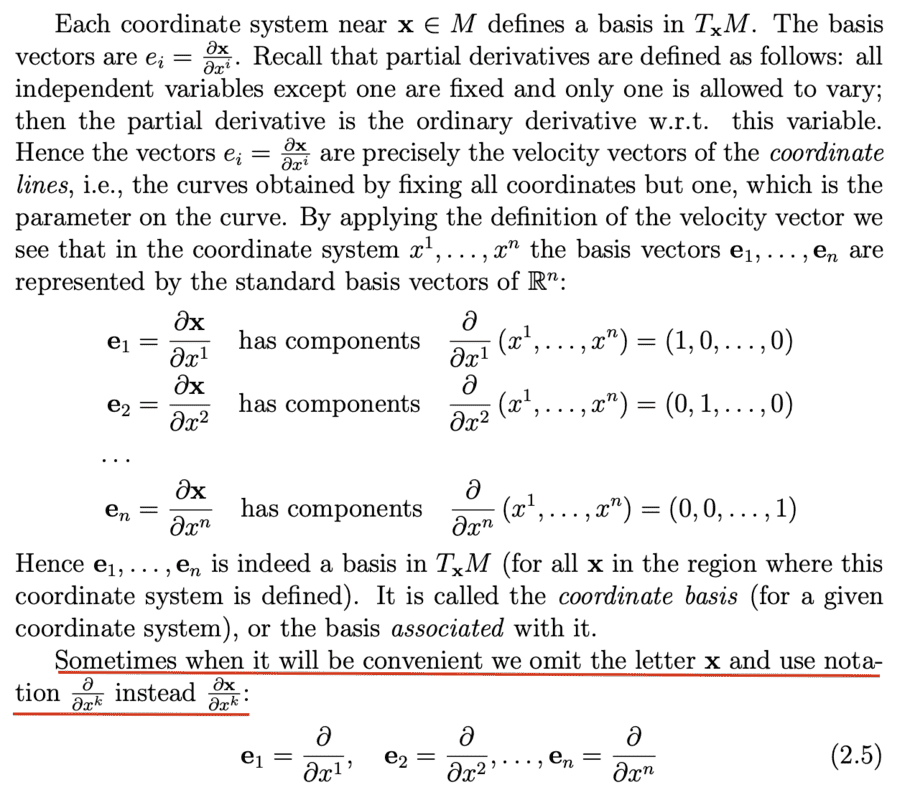
I was reading these notes and then on page 23 I saw something a bit weird. Back in this thread I learned that ##\{ \partial_i \}## form a basis of ##T_p M##, and that a tangent vector can be written ##X = X^i \partial_i##, and it's not too difficult to show that components transform like ##\bar{X}^j = \frac{\partial \bar{x}^j}{\partial x^i} X^i##. But this guy says that
1600791887772.png


The most alarming part of that is that he seems to suggest that ##\frac{\partial}{\partial x^i}## is just shorthand/notation for ##\frac{\partial \vec{x}}{\partial x^i}##. That seems quite wrong, since I thought the operators ##\frac{\partial}{\partial x^i}## are basis vectors already, in their own right. And ##\partial_i## and ##\partial_i \vec{x}## are completely different objects. Plus, the base space is not even necessarily a vector space, in which case I thought the position vector ##\vec{x}## is not even defined!

So I wondered if this section is wrong, or if I am missing something 😁. Thanks!
 
Last edited by a moderator:
  • Like
Likes   Reactions: JD_PM
Physics news on Phys.org
I think that ##\vec x = (x^1, x^2, \dots , x^n)## is slightly loose notation, as this is more the coordinates than a vector. But, I'd say ##\frac{\partial}{\partial x^1}## is definitely shorthand for fixing all other coordinates and letting only ##x^1## vary.

The transition to treating ##\frac{\partial}{\partial x^1}## as a vector, however you define it, is by identifying a basis vector with this and then the key ingredient is to define an inner product by making the inner product of your basis vectors dependent on the metric.

Effectively what you have done - when all is said and done - is simply defined a tangent space with an appropriate inner product. How precisely you relate that back to the manifold is not actually that important.

PS I mean the precise justification is not important. You obviously have to get precisely the right inner product on your tangent space.
 
Last edited:
  • Like
Likes   Reactions: etotheipi
etotheipi said:
I thought the operators ##\frac{\partial}{\partial x^i}## are basis vectors already, in their own right.

They are if you use the one-to-one correspondence between vectors and directional derivative operators, and treat ##\frac{\partial}{\partial x^i}## as the directional derivative operator along the "coordinate grid" curve on which only ##x^i## changes and all other coordinates are constant. I think that's what this author is referring to when he says that ##\frac{\partial}{\partial x^i}## are "the velocity vectors of the coordinate lines". I agree he is fudging somewhat when he appears to treat the n-tuple of coordinates as a vector.
 
  • Like
Likes   Reactions: etotheipi
Ah, okay, I think I get it. He's writing coordinate basis of ##T_p \mathbb{R}^n##. I think I was getting confused because in a Euclidean space, where a position vector makes sense, sometimes it's written$$\vec{E}_a = \frac{\partial \vec{x}}{\partial y^a} = \frac{\partial x^i}{\partial y^a} \vec{e}_i$$where the ##\vec{e}_i## are a Cartesian set. But that's a different usage of the symbol ##\vec{x}## to what he's doing here. Thanks!
 
Last edited by a moderator:
Funnily enough, I found another version of these same notes, and they've gotten rid of the confusing shorthand:

https://personalpages.manchester.ac.uk/staff/theodore.voronov/Teaching/Differentiable%20Manifolds/2018-2019/4-tangent-vectors.pdf

This is a lot better, because ##\frac{\partial \mathbf{x}}{\partial x^i}## is a tuple in ##\mathbb{R}^n##. The weird shorthand ##\frac{\partial}{\partial x^i}## would have you believe that it's actually a derivative, or an operator, which is a bit silly.

Anyway, I think I'm done for today. Thanks for helping!
 
etotheipi said:
Ah, okay, I think I get it. He's writing coordinate basis of ##T_p \mathbb{R}^n##. I think I was getting confused because in a Euclidean space, where a position vector makes sense, sometimes it's written$$\vec{E}_a = \frac{\partial \vec{x}}{\partial y^a} = \frac{\partial x^i}{\partial y^a} \vec{e}_i$$where the ##\vec{e}_i## are a Cartesian set. But that's a different usage of the symbol ##\vec{x}## to what he's doing here. Thanks!
I wouldn't use ##\vec{x}## as a notation for ##x^{\mu}##, because in GR these are not components of a vector but just the coordinates (of a local chart).
 
  • Like
Likes   Reactions: etotheipi
etotheipi said:
Ah, okay, I think I get it. He's writing coordinate basis of ##T_p \mathbb{R}^n##. I think I was getting confused because in a Euclidean space, where a position vector makes sense, sometimes it's written$$\vec{E}_a = \frac{\partial \vec{x}}{\partial y^a} = \frac{\partial x^i}{\partial y^a} \vec{e}_i$$where the ##\vec{e}_i## are a Cartesian set. But that's a different usage of the symbol ##\vec{x}## to what he's doing here. Thanks!
I'm working through Gravity and Geometry by Sean Carroll. Here is my summary of the tangent space as he presents it.

Consider the set of all parametrised curves thru a point ##p## in a manifold, ##M##. Note that:
  • Each curve itself is a geometric object, which will be used to define/identify a direction at ##p##; and,
  • Each specific parameterisation of the curve is associated with a magnitude of rate of change of the curve at ##p##
  • Together these will be associated with a local vector at ##p##.
Note: as ##M## is a manifold, we have ##p \in U##, for some open set ##U## and at least one coordinate chart (a 1-1 mapping of ##U## into ##\mathbb{R}^n##). We may use this mapping to associate functions and derivatives of real-valued functions on ##U## with functions on ##\mathbb{R}^n##. It would get cluttered to include all these mappings, so we assume that everything works via mappings backwards and forwards from ##M## to ##\mathbb{R}^n## where required.

Suppose we have a curve, ##C##, parametrised by ##\lambda## and a smooth real-valued function ##f## on ##M##. We can define a (total) derivative of ##f## with respect to this curve by:
$$\frac{df}{d\lambda} = \frac{\partial f}{\partial x^{\mu}} \frac{dx^{\mu}}{d \lambda}$$
Note that this is coordinate independent (easy to check) and hence well defined.

Now, we consider the set ##F## of all smooth real-valued functions on ##U##. And we see that ##C[\lambda]## is a linear operator/functional on ##F##:
$$C[\lambda](f) = \frac{df}{d\lambda}$$
Moreover, the set of all parameterised curves is a vector space of linear operators on ##F##. This is fairly easy to check.

The tangent space ##T_p## is then associated with this space of linear operators ##C[\lambda]##.

Next, given a coordinate chart, we want to establish the coordinate basis for ##T_p##. First, note that the partial derivatives ##\partial_{\mu} = \frac{\partial }{\partial x^{\mu}}## are themselves in ##T_p##. It's easy to find a simple parametrisation of a curve for which ##C[\lambda](f) = \partial_{\mu}f##. Not surprisingly, these operators will be our coordinate basis. Then any vector ##V \in T_p## has the representation in the coordinate basis:
$$C[\lambda] = V = V^{\mu}e_{\mu} = \frac{dx^{\mu}}{d \lambda}\partial_{\mu}$$
In summary:
  • Parameterised curves in ##M## are associated with linear operators (on the space of smooth real-valued functions on ##M##) are associated with vectors in the tangent space
  • Given any coordinate chart, the coordinate partial derivatives form a basis (of linear operators); and,
  • The components are the derivatives of the coordinates with respect to the specific parameter
If we tried to dot the mathematical i's and cross the t's, we'd get bogged down in mappings going back and forth. In any case, Carroll presents a solid mathematical foundation for the tangent space.

Note: the ##C[\lambda]## is my notation.
 
  • Like
Likes   Reactions: etotheipi and vanhees71

Similar threads

  • · Replies 20 ·
Replies
20
Views
2K
  • · Replies 47 ·
2
Replies
47
Views
7K
  • · Replies 7 ·
Replies
7
Views
3K
  • · Replies 17 ·
Replies
17
Views
2K
  • · Replies 5 ·
Replies
5
Views
2K
  • · Replies 8 ·
Replies
8
Views
2K
  • · Replies 15 ·
Replies
15
Views
3K
  • · Replies 3 ·
Replies
3
Views
1K
  • · Replies 38 ·
2
Replies
38
Views
7K
  • · Replies 28 ·
Replies
28
Views
3K