KIC 8462852 (dipping again in March 2018)

  • Context: Graduate 
  • Thread starter Thread starter craigi
  • Start date Start date
Click For Summary

Discussion Overview

The discussion revolves around the unusual light curves observed from the star KIC 8462852, particularly focusing on the significant dips in brightness and potential explanations for these phenomena. Participants explore various hypotheses, including the possibility of local obstructing bodies, alien structures, and the star's own variability, while referencing scientific literature and media interpretations.

Discussion Character

  • Exploratory
  • Debate/contested
  • Technical explanation
  • Conceptual clarification

Main Points Raised

  • Some participants suggest that the smooth light curve indicates a single body transit rather than multiple bodies, leading to a significant drop in brightness.
  • Others question whether the obstructing bodies are local to KIC 8462852 or if they could be stray asteroids closer to Earth, challenging the assumption of them being in orbit.
  • There are discussions about the implications of a Dyson Sphere and whether it could obscure the star in a more regular pattern, with some humorously critiquing the idea of alien construction.
  • Some participants propose that the star itself may be variable, drawing parallels to other variable stars that were once classified differently.
  • Concerns are raised about the media's portrayal of the situation, particularly regarding sensationalist interpretations linking the phenomenon to extraterrestrial life.
  • Several participants emphasize the need to refer to scientific papers for constraints on the size and orbit of potential debris, arguing against the Dyson Sphere hypothesis based on these constraints.
  • Speculation about the nature of the obscuring object includes ideas about planetary rings and their potential to cause variable light blocking.

Areas of Agreement / Disagreement

Participants express a range of competing views regarding the cause of the light dips, with no consensus reached on a singular explanation. The discussion remains unresolved, with ongoing debate about the validity of various hypotheses.

Contextual Notes

Participants note the limitations of current understanding, including the need for further analysis and the potential for misinterpretation of data. There are references to specific sections of scientific papers that provide constraints on the discussed models.

craigi
Messages
615
Reaction score
36
There doesn't seem to be a thread about this, but it's very popular in the news today. I thought it'd be good to have a place to discuss it here.
 
  • Like
Likes   Reactions: Borg
Astronomy news on Phys.org
KIC 8462852.

8f399a18a919d56ca41455a22f23a8a1.jpg
 
  • Like
Likes   Reactions: CalcNerd, Grim Arrow, BiGyElLoWhAt and 4 others
Some really intriguing light curves here. Read the article for some explanation.

http://www.slate.com/blogs/bad_astr...ge_dips_in_brightness_are_a_bit_baffling.html
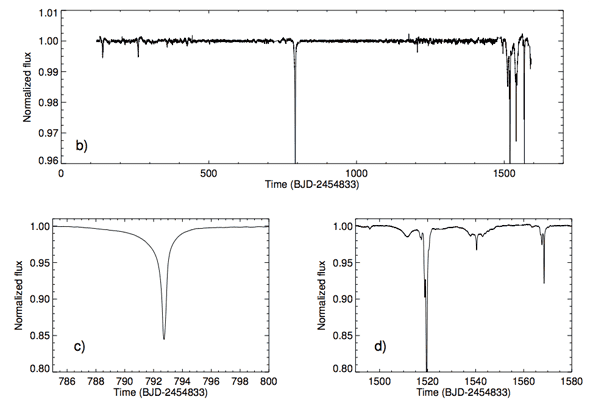
star_alien_dips.png


Look at the smooth curve lower left. That has got to be a single body transit. Multiple bodies couldn't make such a smooth curve. Yet that body results in a 15% drop in the light curve!
And it's cold, so not a companion star.

I don't see how exo-comet fragments can explain this.

Black dwarf? :smile:
 
Last edited:
  • Like
Likes   Reactions: Artribution
Can we be sure that the obstructing bodies are local to KIC 8462852's system? Are they known to be in orbit around KIC 8462852?
Perhaps they appear so large because they may be a group of stray asteroids which are much closer to us than we think, and not in fact in orbit.
 
  • Like
Likes   Reactions: BiGyElLoWhAt and RealTwistedTwin
That's been considered, yes.
The problem is, the farther from the star the more incredibly unlikely that they would line up and stayed lined up.
 
DaveC426913 said:
That's been considered, yes.
The problem is, the farther from the star the more incredibly unlikely that they would line up and stayed lined up.

DaveC426913 said:
Some really intriguing light curves here. Read the article for some explanation.

http://www.slate.com/blogs/bad_astr...ge_dips_in_brightness_are_a_bit_baffling.html
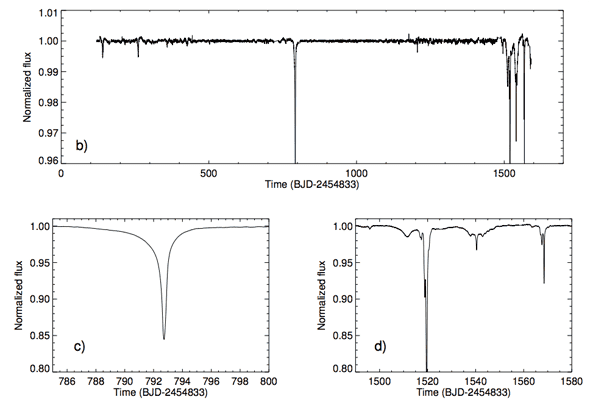
star_alien_dips.png


Look at the smooth curve lower left. That has got to be a single body transit. Multiple bodies couldn't make such a smooth curve. Yet that body results in a 15% drop in the light curve!
And it's cold, so not a companion star.

I don't see how exo-comet fragments can explain this.

Black dwarf? :smile:
The universe isn't old enough for black dwarfs, they would still be brown dwarfs radiating mad infrared at least.
 
Borg said:
Shouldn't a part of Dyson Sphere be a bit closer thus obscure its star in more regular and frequent pattern?
Those aliens really do a shoddy work and park their panels on wrong orbits. Next time, when they arrive to make crop circles someone would have to explain that to them ;)

EDIT: Media are delighted because right now no explanation is really convincing, but this "alien did it" part is also not so good.

Personally I'd opt for some collision stuff, planets with rings and selection bias.
 
It's not out of the question that the star itself is variable. It doesn't fit any known categories, but in 1994 neither did Gamma Doradus. (Now it's in the category of "Gamma Doradus variables".)
 
  • Like
Likes   Reactions: JMz and mheslep
  • #10
Czcibor said:
...
EDIT: Media are delighted because right now no explanation is really convincing, but this "alien did it" part is also not so good.

This is another case where IMO it takes 'Two to Tango'. Someone with book on Aliens sees the KIC 8462852 paper, makes a juicy line and calls a media friend to push it. The media person calls the author of the original paper and pushes them for an Alien connection that they probably laugh at and say sure that's, possible.

Next stop, Dyson Sphere and Time Ships.
 
  • #11
Czcibor said:
Shouldn't a part of Dyson Sphere be a bit closer thus obscure its star in more regular and frequent pattern?
Those aliens really do a shoddy work and park their panels on wrong orbits.

Aliens: Thank you, Earth ape. We'd love to have a look at one of your designs.
 
  • Like
Likes   Reactions: Ratman, Grim Arrow, Drakkith and 1 other person
  • #12
DaveC426913 said:
Some really intriguing light curves here. Read the article for some explanation.

http://www.slate.com/blogs/bad_astr...ge_dips_in_brightness_are_a_bit_baffling.html

star_alien_dips.png


Look at the smooth curve lower left. That has got to be a single body transit. Multiple bodies couldn't make such a smooth curve. Yet that body results in a 15% drop in the light curve!
And it's cold, so not a companion star.

I don't see how exo-comet fragments can explain this.

Black dwarf? :smile:
That lightcurve looks very similar (except for it's magnitude) to the one produced by KIC12557548, which is discussed in this Scientific American blog from May 2012. They also give a possible explanation.
 
  • Like
Likes   Reactions: Artribution
  • #13
TurtleMeister said:
That lightcurve looks very similar (except for it's magnitude) to the one produced by KIC12557548, which is discussed in this Scientific American blog from May 2012.

Same group too.
 
  • #14
inuk2600 said:
The universe isn't old enough for black dwarfs, they would still be brown dwarfs radiating mad infrared at least.
I know. Looking for plausible explanations.
 
  • #15
Once we blow through all the alien jokes, maybe we can talk serious. :wink:
 
  • #16
DaveC426913 said:
I know. Looking for plausible explanations.

It was new to me, I had to wiki it. Any new ideas bubbling up out there?
 
  • #17
Here it is, captured @ 85/2, 1 hr integration time, 300% magnification:
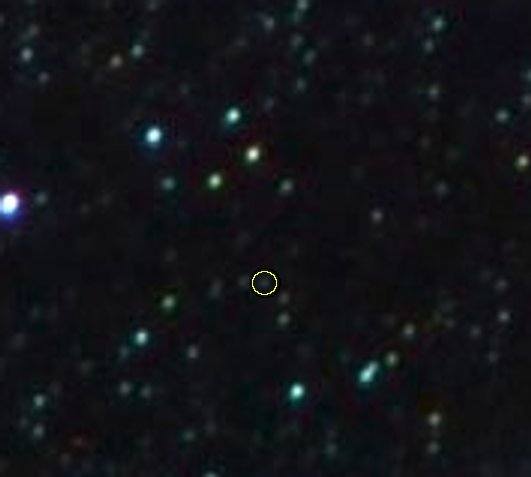
KIC%208462852_zps3dguzl5u.jpg
 
  • #18
inuk2600 said:
It was new to me, I had to wiki it. Any new ideas bubbling up out there?
Here's a new idea from 1957:

220px-THBLCKCLDH1957.jpg
 
  • #19
Andy Resnick said:
Here it is, captured @ 85/2, 1 hr integration time, 300% magnification:

KIC%208462852_zps3dguzl5u.jpg

I KNEW it!
Look at that giant ring. Aliens, plain as day!
:woot:
 
  • Like
Likes   Reactions: JMz, jbstemp, BiGyElLoWhAt and 4 others
  • #20
So the object in orbit is very close, has too little mass to create much of a wobble in the host star, but covers a surface area much larger than Jupiter?
DaveC426913 said:
I KNEW it!
Look at that giant ring. Aliens, plain as day!
:woot:
Giant ring huh? Obviously a Halo joke, but it gave me an idea.

If you tipped Saturn on it's side like Uranus and put it close to the sun, would it block enough light? It'd be quite variable since sometimes you'd see the rings head on and it'd block only as much light as the planet disc itself, but sometimes you'd see the rings from "above" and it'd have a shadow of hundreds of thousands of miles.

If the planet is that close to the star, it's moons are probably quite active and could easily create a ring I wo
 
Last edited:
  • Like
Likes   Reactions: RealTwistedTwin
  • #21
newjerseyrunner said:
Giant ring huh? Obviously a Halo joke, but it gave me an idea.
No, look at the picture! Post 17. Oh never mind, the joke's lost.

Besides, Larry Niven's Ringworld was around decades before today's video games... :P
 
  • #22
DaveC426913 said:
Besides, Larry Niven's Ringworld was around decades before today's video games... :P

Nonsense! The world didn't exist before video games!
 
  • #23
We'll know more when SETI tunes in ... and, oh let's point ole Hubble at 'er and see what's up.
 
  • #24
inuk2600 said:
Perhaps they appear so large because they may be a group of stray asteroids which are much closer to us than we think, and not in fact in orbit.
Would it be naive of me to suggest that, if that were the explanation, they would be regularly blocking off the light from many other sources? That would take an almost trivial test to verify the idea or otherwise.
 
  • #25
Before jumping to conclusions and speculation, I'd suggest people first read the paper linked by nsaspook in post #7. Section 4.4.1 provides constraints on the size and orbit of the debris.
To be frank, I don't even see where the whole Dyson sphere (or swarm or ring) idea came from, other than an off-kilter comment by one of the scientists. It doesn't fit the constraints at all.
 
  • #26
sophiecentaur said:
Would it be naive of me to suggest that, if that were the explanation, they would be regularly blocking off the light from many other sources? That would take an almost trivial test to verify the idea or otherwise.

If we had the capabilitity to apply Kepler level analysis to whole sky then yes I think we would see such a thing happening. Are you suggesting the possibility of a stray but dense swarm of asteroids (ok how about comets) in interstellar space is absurd?
 
Last edited:
  • #27
Bandersnatch said:
Before jumping to conclusions and speculation, I'd suggest people first read the paper linked by nsaspook in post #7. Section 4.4.1 provides constraints on the size and orbit of the debris.
To be frank, I don't even see where the whole Dyson sphere (or swarm or ring) idea came from, other than an off-kilter comment by one of the scientists. It doesn't fit the constraints at all.

The author specifies constraints based on the assumption of a circular orbit.
 
  • #28
inuk2600 said:
The author specifies constraints based on the assumption of a circular orbit.
Follow to section 4.4.5.
 
  • #29
Bandersnatch said:
Follow to section 4.4.5.

Still the author is assuming the objects are in orbit. However unlikely the relative speeds may be, can we confidently rule out the possibility that the objects are in interstellar space?
What other crazy ideas are we considering here? Orbital comets that massively occult a star that's bigger than the sun and an alien Dyson sphere.
 
  • #30
inuk2600 said:
What other crazy ideas are we considering here? Orbital comets that massively occult a star that's bigger than the sun and an alien Dyson sphere.
I prefer Hoyle's black cloud to an alien Dyson sphere.
 

Similar threads

  • · Replies 5 ·
Replies
5
Views
4K
  • · Replies 7 ·
Replies
7
Views
3K
  • · Replies 25 ·
Replies
25
Views
3K
  • · Replies 17 ·
Replies
17
Views
5K
  • · Replies 10 ·
Replies
10
Views
2K
  • · Replies 3 ·
Replies
3
Views
2K
  • · Replies 54 ·
2
Replies
54
Views
8K
  • · Replies 55 ·
2
Replies
55
Views
12K
  • · Replies 1 ·
Replies
1
Views
2K
  • · Replies 0 ·
Replies
0
Views
3K