Kinematics problem - changing coordinates

Click For Summary
The discussion revolves around solving a kinematics problem by changing the coordinate system to align the x-axis with the slope direction. Participants explore the implications of this approach, noting that it introduces horizontal acceleration, which had not been previously considered. There is a contrast between using specific numerical values versus general variables in problem-solving. The conversation hints at a preference for traditional methods over modern "plug-n-chug" techniques. Ultimately, the feasibility of solving the problem with a new coordinate system is affirmed as an interesting exercise.
StillAnotherDave
Messages
74
Reaction score
8
Homework Statement
Is it possible to solve this problem by changing the coordinate axes?
Relevant Equations
Kinematic equations
Hi folks,

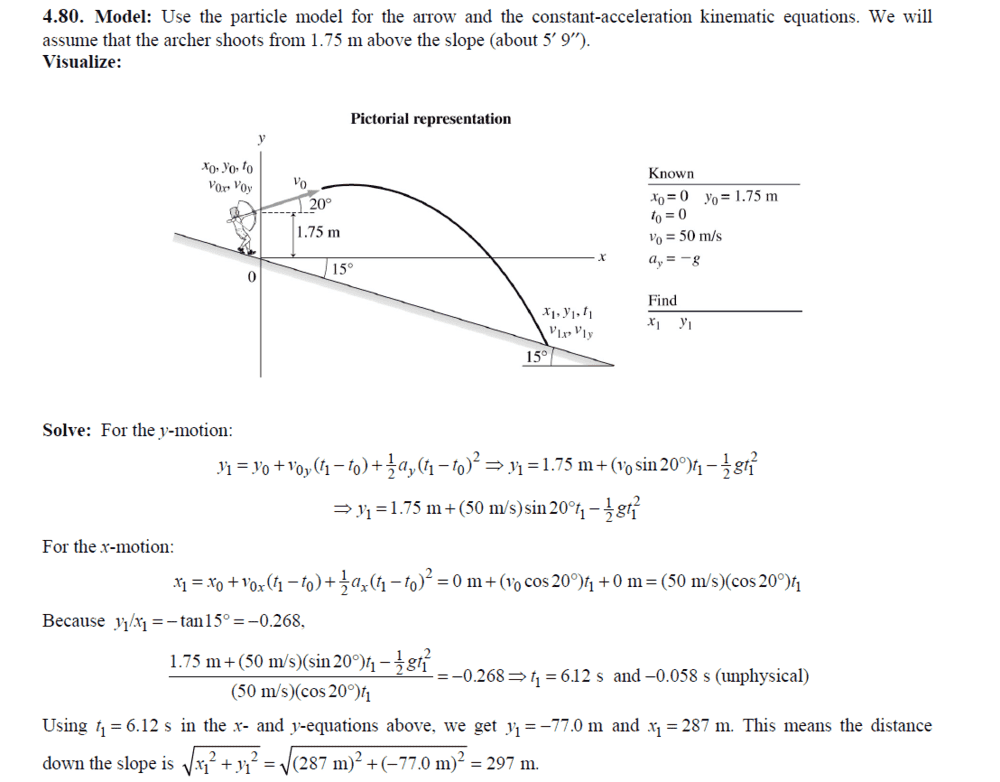
See below for a solved question finding the down slope distance of an arrow. How easy would it be to solve this question by making the x-axis the slope direction?
1586512522048.png
 
Physics news on Phys.org
StillAnotherDave said:
How easy would it be to solve this question by making the x-axis the slope direction?
One way to find out is to do it ! You'll have acceleration on two axes.
 
Aha, yes horizontal acceleration is what I didn't consider.
 
StillAnotherDave said:
Homework Statement:: Is it possible to solve this problem by changing the coordinate axes?
Relevant Equations:: Kinematic equations

Hi folks,

See below for a solved question finding the down slope distance of an arrow. How easy would it be to solve this question by making the x-axis the slope direction?

View attachment 260327
It's interesting to see something as advanced as this done with specific numbers, rather than with general variables. It can't be any harder to do it generally.

But, I guess "plug-n-chug" is what's taught these days.
 
  • Like
Likes BvU
Or is the exercise from an old book :wink: ?
 
The book claims the answer is that all the magnitudes are the same because "the gravitational force on the penguin is the same". I'm having trouble understanding this. I thought the buoyant force was equal to the weight of the fluid displaced. Weight depends on mass which depends on density. Therefore, due to the differing densities the buoyant force will be different in each case? Is this incorrect?

Similar threads

  • · Replies 43 ·
2
Replies
43
Views
2K
  • · Replies 25 ·
Replies
25
Views
3K
Replies
18
Views
2K
  • · Replies 4 ·
Replies
4
Views
2K
  • · Replies 20 ·
Replies
20
Views
2K
  • · Replies 5 ·
Replies
5
Views
2K
Replies
2
Views
1K
  • · Replies 1 ·
Replies
1
Views
3K
Replies
2
Views
4K
Replies
27
Views
1K