Kirchoff's Loop Rule Involving 2 Resistors and a Capacitor

Click For Summary

Homework Help Overview

The discussion revolves around a circuit involving a 5μF capacitor, a 2MΩ resistor in parallel, and a 1MΩ resistor in series with a 12V battery. The original poster is attempting to determine the time taken for the voltage across the capacitor to rise from zero to 2V after closing the switch, utilizing Kirchhoff's loop and junction rules.

Discussion Character

  • Exploratory, Conceptual clarification, Assumption checking

Approaches and Questions Raised

  • Participants discuss the forced and transient responses of the circuit, with one suggesting the use of voltage division to find steady-state voltage. There is also mention of solving a differential equation to determine the transient response. Questions arise regarding the time constant and how to calculate it given the series and parallel resistors.

Discussion Status

Some participants have provided hints and guidance on approaching the problem, including the suggestion to consider the Thevenin equivalent. Multiple interpretations of the circuit configuration and the calculation of the time constant are being explored without reaching a consensus.

Contextual Notes

There is uncertainty regarding the calculation of the time constant due to the presence of both series and parallel resistors in the circuit. The original poster expresses confusion about the setup and the implications for their calculations.

Niall Kennedy
Messages
7
Reaction score
0
Member advised to use the homework template for posts in the homework sections of PF.
A 5μF capacitor is connected in parallel with a 2MΩ resistor and the combination is then connected in series with a 1MΩ resistor through a switch to a 12V battery. Find the time taken for the voltage across the capacitor to rise from zero initial value to 2V after the switch is closed.From what I understand this requires Kirchoff's loop and junction rules which is okay up until I hit the voltage across the capacitor which is where I get stuck.Here's the diagram I made to work from, hopefully it's right:
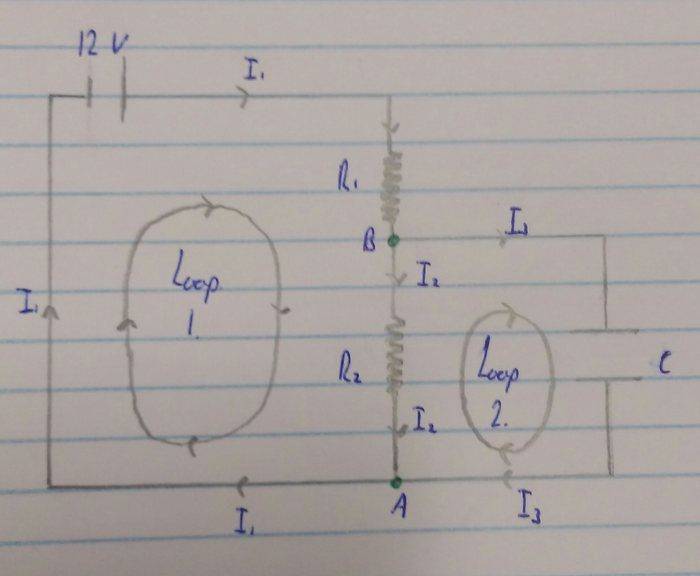
yV9S3QY.jpg
 
Physics news on Phys.org
Vc(t)=Forced response + Transient response
forced response"steady state response" is found at time equals infinity at which the capacitor becomes open circuit
here it is : 12*(2/3)=8 volts ... voltage division
____________
transient response (after solving a differential equation) is : A*exp(-t/taw) where "taw" is the time constant RC
then you can find A by substituting the initial condition which is the initial voltage of the capacitor at time t<0
here A is -8 volts
___________
now: Vc(t)=8 - 8*exp(-t/taw)
and you can easily find the time at which the voltage reaches 2 volts by sitting Vc(t)=2
 
Thanks for the help, I was going to go around it that way but my issue was that taw = RC and I'm not sure what taw is since there's a resistor in series and one in parallel
 
R is the parallel combination of R1 and R2
 
Hint: Think Thevenin equivalent.
 

Similar threads

  • · Replies 7 ·
Replies
7
Views
2K
  • · Replies 6 ·
Replies
6
Views
3K
  • · Replies 3 ·
Replies
3
Views
2K
  • · Replies 3 ·
Replies
3
Views
3K
  • · Replies 1 ·
Replies
1
Views
3K
  • · Replies 3 ·
Replies
3
Views
4K
  • · Replies 2 ·
Replies
2
Views
4K
Replies
5
Views
3K
  • · Replies 11 ·
Replies
11
Views
3K
  • · Replies 12 ·
Replies
12
Views
8K