Leithold Calculus: Overcoming Difficulties & Learning Property

  • Thread starter Thread starter dumplump
  • Start date Start date
  • Tags Tags
    Calculus
Click For Summary

Discussion Overview

The discussion revolves around the challenges faced by students using the textbook "The Calculus 7" by Louis Leithold. Participants share their experiences with the difficulty of the exercises, particularly in relation to integration techniques and problem-solving strategies. The conversation includes personal anecdotes about overcoming these difficulties and the effectiveness of the textbook in teaching calculus concepts.

Discussion Character

  • Exploratory
  • Technical explanation
  • Conceptual clarification
  • Debate/contested
  • Homework-related

Main Points Raised

  • One participant notes that the exercises in Leithold's textbook are significantly more difficult than those encountered in class, leading to confusion and reliance on tools like Symbolab.
  • Another participant emphasizes the importance of creative problem-solving techniques, such as adding zero or multiplying by one, to simplify integrals.
  • Several participants share their own experiences with the textbook, indicating that it may not be widely used, which could explain the lack of responses to the original query.
  • One participant mentions a specific problem involving the integral of xsin^-1(x) and the necessity of consulting a teaching assistant for guidance.
  • Another participant reflects on their learning experience, highlighting the value of solving numerous problems in class alongside the instructor as a method for mastering the material.
  • Some participants suggest that tricks and techniques are often learned through experience rather than formal instruction, indicating a more experiential approach to learning calculus.

Areas of Agreement / Disagreement

Participants express a range of experiences with the textbook, with no clear consensus on its effectiveness or the best strategies for overcoming difficulties. Some agree on the challenges posed by the text, while others share differing views on how to approach problem-solving.

Contextual Notes

Participants mention specific techniques and problems without providing a comprehensive resolution to the challenges discussed. There is a reliance on personal experiences and anecdotal evidence rather than established methods or solutions.

Who May Find This Useful

This discussion may be useful for students currently using or considering using Leithold's "The Calculus 7," as well as those seeking strategies for tackling difficult calculus problems.

dumplump
Messages
39
Reaction score
0
I have recently purchased this textbook. When I compare it to my class, I find that the exercises are of significantly higher difficulty. There are tricks to solving the problems that I never would have thought of because quite honestly I never learned them. For example the textbook, chapter on integration by parts, there is a problem that is solved by adding and subtracting 1 from the numerator.
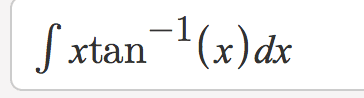
upload_2014-10-4_21-12-28.png


I did not know I could do that, and I was stuck until I plugged the problem into Symbolab.

Here is the property that is needed in order to solve, but I was not able to find the name of this property

upload_2014-10-4_21-13-15.png

For those who have used this book, The Calculus 7 Louis Leithold, how did you overcome these difficulties? I have purchased Leithold's Before Calculus text as well. I feel that my previous textbook just was not sufficient because I did not see the following property above in the text, or should I say I do not remember it being in the text.
 
Physics news on Phys.org
Thanks for the post! Sorry you aren't generating responses at the moment. Do you have any further information, come to any new conclusions or is it possible to reword the post?
 
My post was mostly about how to overcome the difficulties presented in the text. It appears that this text is not used that much or no one has used it, and thus no responses.
 
Well, the problem is quite clear. The thread should be moved to the homework section. I guess you mean \tan^{-1} x=\arctan x. The notation \tan^{-1} for the inverse of a function is very bad. Never ever use it! It could be mistaken as \tan^{-1} x=1/\tan x.

Anyway, we want to solve
F(x)=\int \mathrm{d} x x \arctan x.
You can simplify this integral first by using integration by parts
\int \mathrm{d} x u'(x) v(x)=u(x) v(x)-\int \mathrm{d} x u(x) v'(x).
Setting u'(x)=x, v(x)=\arctan x. Then u(x)=x^2/2, v(x)=1/(1+x^2), leading to
F(x)=\frac{x^2}{2} \arctan x-\frac{1}{2} \int \mathrm{d} x \frac{x^2}{1+x^2}.
Now comes the simple trick
F(x)=\frac{x^2}{2} \arctan x - \frac{1}{2} \int \mathrm{d} x \frac{x^2+1-1}{1+x^2}= \frac{x^2}{2} \arctan x - \frac{1}{2} \int \mathrm{d} x \left (1- \frac{1}{1+x^2} \right )=\frac{x^2}{2} \arctan x -\frac{x}{2}+\frac{1}{2}\arctan x+C=\frac{x^2+1}{2} \arctan x-\frac{x}{2}+C.
To check this take the derivative again
F'(x)=x \arctan x + \frac{x^2+1}{2(x^2+1)}-\frac{1}{2}=x \arctan x.
:-).
 
vanhees71 said:
Well, the problem is quite clear. The thread should be moved to the homework section. I guess you mean \tan^{-1} x=\arctan x. The notation \tan^{-1} for the inverse of a function is very bad. Never ever use it! It could be mistaken as \tan^{-1} x=1/\tan x.

Anyway, we want to solve
F(x)=\int \mathrm{d} x x \arctan x.
You can simplify this integral first by using integration by parts
\int \mathrm{d} x u'(x) v(x)=u(x) v(x)-\int \mathrm{d} x u(x) v'(x).
Setting u'(x)=x, v(x)=\arctan x. Then u(x)=x^2/2, v(x)=1/(1+x^2), leading to
F(x)=\frac{x^2}{2} \arctan x-\frac{1}{2} \int \mathrm{d} x \frac{x^2}{1+x^2}.
Now comes the simple trick
F(x)=\frac{x^2}{2} \arctan x - \frac{1}{2} \int \mathrm{d} x \frac{x^2+1-1}{1+x^2}= \frac{x^2}{2} \arctan x - \frac{1}{2} \int \mathrm{d} x \left (1- \frac{1}{1+x^2} \right )=\frac{x^2}{2} \arctan x -\frac{x}{2}+\frac{1}{2}\arctan x+C=\frac{x^2+1}{2} \arctan x-\frac{x}{2}+C.
To check this take the derivative again
F'(x)=x \arctan x + \frac{x^2+1}{2(x^2+1)}-\frac{1}{2}=x \arctan x.
:).
The problem is clear, but that was not the premise of my question. The question was basically asks for people who have used this text, and how they overcame the difficulties of the text. No once did I state that I needed help solving the problem.
 
The first-year calculus course that I took as a student many, many years ago used an earlier edition of Leithold as its text. I don't remember "problems" with it, but this could be due to the long passage of time.

Two important tricks are creatively adding zero or multiplying by one. It is sometimes useful to make a part of a numerator equal to the denominator. In this case, this was done by adding zero in the form ##0 = -1 + 1##.

$$\frac{a}{1 + a} = \frac{-1 +1 +a}{1 + a} = \frac{-1}{1 + a} + \frac{1 + a}{1 + a}.$$
 
George Jones said:
The first-year calculus course that I took as a student many, many years ago used an earlier edition of Leithold as its text. I don't remember "problems" with it, but this could be due to the long passage of time.

Two important tricks are creatively adding zero or multiplying by one. It is sometimes useful to make a part of a numerator equal to the denominator. In this case, this was done by adding zero in the form ##0 = -1 + 1##.

$$\frac{a}{1 + a} = \frac{-1 +1 +a}{1 + a} = \frac{-1}{1 + a} + \frac{1 + a}{1 + a}.$$
Thank you for pointing that out. I will keep an eye for it. That was the type of response I was looking for.
 
Probably the most difficult textbook problem was trying to find the integral of xsin^-1(x) from 0 to 1 only using integration by parts. I had to confer with my TA, and specifically state that I needed to use integration by parts not trig substitutions.
 
Last edited:
I used this text during my first three semesters at university for my calculus classes. It seems that the author aims at computational proficiency, basically what we did was learn the theory and then solve a whole lot of problems in class atthe same time as the teacher did it on the blackboard, that way you could always look if you got stuck. Besides that, we got assignments with a lot of problems to solvre on a regular basis.
If your class isn't like this maybe you should consider trying to solve as many problems as you can on your own.
On the other hand, tricks like the one you tslk about in the OP are seldom taught by themselves, you rather learn them when you get stuck and look for help like you did here, or maybe one day youre more creativethan usual and just come up with them yourself.
Anyways, the key is to tackle the problems and get the experience :)
 
  • #10
nearlynothing said:
I used this text during my first three semesters at university for my calculus classes. It seems that the author aims at computational proficiency, basically what we did was learn the theory and then solve a whole lot of problems in class atthe same time as the teacher did it on the blackboard, that way you could always look if you got stuck. Besides that, we got assignments with a lot of problems to solvre on a regular basis.
If your class isn't like this maybe you should consider trying to solve as many problems as you can on your own.
On the other hand, tricks like the one you tslk about in the OP are seldom taught by themselves, you rather learn them when you get stuck and look for help like you did here, or maybe one day youre more creativethan usual and just come up with them yourself.
Anyways, the key is to tackle the problems and get the experience :)
Thanks for the reply. I acquired this book because I felt that in my current calculus 2 textbook has problems that are too simple. I just experienced the difficulty of Liethold's text, and thought I would reach out and ask those who have used the text to figure out how they overcame some of the difficulties of solving the problems. One problem that I was stuck on for quite sometime was integration by parts of xsin^-1(x). I had to refer to my TA in order to solve that problem.
 

Similar threads

  • · Replies 3 ·
Replies
3
Views
3K
  • · Replies 22 ·
Replies
22
Views
6K
  • · Replies 17 ·
Replies
17
Views
11K
  • · Replies 12 ·
Replies
12
Views
4K
  • · Replies 5 ·
Replies
5
Views
2K
  • · Replies 5 ·
Replies
5
Views
4K
  • · Replies 19 ·
Replies
19
Views
4K
  • · Replies 5 ·
Replies
5
Views
5K
  • · Replies 9 ·
Replies
9
Views
2K
  • · Replies 1 ·
Replies
1
Views
2K