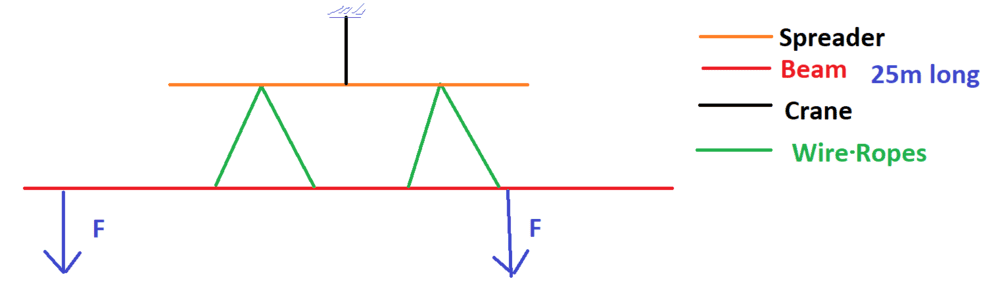
Some things to consider when lifting:
If the center of gravity is not directly under the crane hook before lifting, it will be after lifting. In between, it will swing, possibly violently.
It is necessary to calculate strength of the lifting beam, and also the load. It is not a given that the load can be lifted by connecting where convenient.
It is necessary to calculate the strength of every lifting sling. Also the strength of all shackles, eyebolts, and other lifting hardware.
It is necessary to calculate the strength of lifting lugs, and their attachment to the load. Do not assume that bolt patterns and/or welds are loaded symmetrically.
The crane load includes the weight of the lifting beam and other hardware.
Slings come in discrete nominal lengths. The exact lengths are all different. Three or more slings in a row will not share the load the way you think. One way to deal with this is to have two slings plus ratchet straps. Tighten the ratchet straps while lifting the load so as to properly share the load.
Sometimes you are better to design the load for lifting. That can be lower cost than designing and building a lifting beam that only gets used once.
Beware the trap of dumping all lifting calculations on one person, then telling that person that "regular work" is more important. They will pencil whip the lifting diagrams. Not me, but I have seen it.