SUMMARY
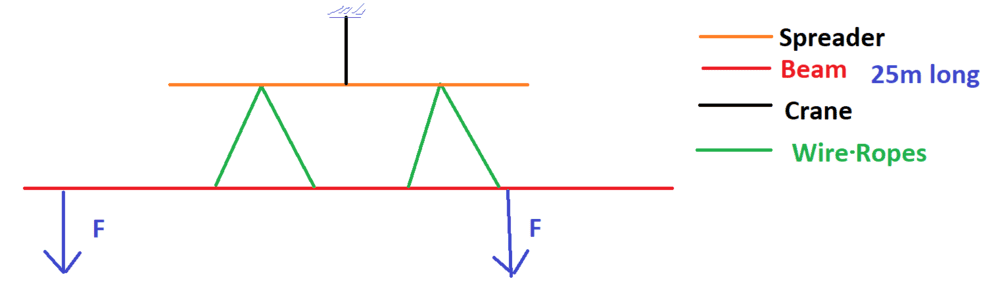
The discussion focuses on the lifting arrangement of beams and the capacity of inner slings compared to external slings. It establishes that the center of gravity must be directly under the crane hook to avoid imbalance during lifting. Key factors include the stiffness of the beam, tension distribution among slings, and the necessity of calculating the strength of all lifting components, including slings, shackles, and lifting lugs. The conversation emphasizes the importance of proper load design and the potential pitfalls of relying on a single individual for lifting calculations.
PREREQUISITES
- Understanding of lifting beam mechanics and load distribution
- Familiarity with sling tension and beam stiffness concepts
- Knowledge of lifting hardware specifications, including shackles and eyebolts
- Awareness of Airy points and their role in lifting long structures
NEXT STEPS
- Research "Lifting beam design principles" to optimize load handling
- Learn about "Sling tension calculations" for accurate load distribution
- Investigate "Airy points in lifting" for effective beam handling
- Explore "Whipple-tree mechanisms" for improved load stability
USEFUL FOR
Engineers, crane operators, and project managers involved in lifting operations, particularly those dealing with long or flexible structures requiring precise load management.