Limit comparison test

  • Topic:
  • Thread starter jaychay
  • Start date
  • Tags Tags
    Limit Test
11 replies · 3K views · last reply
jaychay
Messages
58
Reaction score
0
Summation from k=1 to infinity of k divided by (k + 2k^2 + 3k^3), written as a series in sigma notation.


Can you please help me
Thank you in advance
 
Have you tried to apply the limit comparison test or find the limit of the terms as $k\to\infty$?
 
Evgeny.Makarov said:
Have you tried to apply the limit comparison test or find the limit of the terms as $k\to\infty$?
okay I will try to do it from what you guide me and I will let you check it for me.
 
Evgeny.Makarov said:
Have you tried to apply the limit comparison test or find the limit of the terms as $k\to\infty$?
Handwritten derivation applying the limit comparison test to the series sum from k=1 to infinity of k/(k+2k^2+3k^3), with a_k = 1/(3k^3) and b_k = 1/(3k^3+2k^2+k), and a limit of a_k/b_k written as k approaches infinity.

I am struggle at this point sir
Please help me
 
Why didn't you include the numerator $k$ in $a_k$ and $b_k$? Your $b_k$ is different from the series in the problem statement.

I suggest using $a_k=1/k^2$ and $b_k$ as in the original series. Also use the following rule. If $f(x)=ax^m+\sum_{i=0}^{m-1}a_ix^i$ and $g(x)=bx^n+\sum_{i=0}^{n-1}b_ix^i$, then
$$\lim_{x\to\infty}\frac{f(x)}{g(x)}=\begin{cases}0,&m<n\\a/b,&m=n.\\\infty,&m>n\end{cases}$$
 
Evgeny.Makarov said:
Why didn't you include the numerator $k$ in $a_k$ and $b_k$? Your $b_k$ is different from the series in the problem statement.

I suggest using $a_k=1/k^2$ and $b_k$ as in the original series. Also use the following rule. If $f(x)=ax^m+\sum_{i=0}^{m-1}a_ix^i$ and $g(x)=bx^n+\sum_{i=0}^{n-1}b_ix^i$, then
$$\lim_{x\to\infty}\frac{f(x)}{g(x)}=\begin{cases}0,&m<n\\a/b,&m=n.\\\infty,&m>n\end{cases}$$
Can you guide me more because I am very confused right now ?
 
The limit comparison test says that in order to ascertain convergence of $\sum b_k$ one can come up with another series $\sum a_k$ for which it is known whether it converges. If $\lim a_k/b_k=c$ and $0<c<\infty$, then the answer for $\sum b_k$ is the same as the one for $\sum a_k$.

I suggest considering $\sum b_k$ to be the series from the problem statement and $a_k=1/k^2$. It is known that $\sum 1/k^2$ converges. What limit do we have to consider to determine the convergence for $\sum b_k$?
 
jaychay said:

note ...

$\dfrac{k}{k+2k^2+3k^3} = \dfrac{1}{1+2k+3k^2} < \dfrac{1}{k^2} \text{ for all } k > 1$

$\displaystyle \implies \sum_{k=1}^\infty \dfrac{1}{1+2k+3k^2} \text{ converges by direct comparison to the known convergent series } \sum_{k=1}^\infty \dfrac{1}{k^2}$
 
Evgeny.Makarov said:
The limit comparison test says that in order to ascertain convergence of $\sum b_k$ one can come up with another series $\sum a_k$ for which it is known whether it converges. If $\lim a_k/b_k=c$ and $0<c<\infty$, then the answer for $\sum b_k$ is the same as the one for $\sum a_k$.

I suggest considering $\sum b_k$ to be the series from the problem statement and $a_k=1/k^2$. It is known that $\sum 1/k^2$ converges. What limit do we have to consider to determine the convergence for $\sum b_k$?
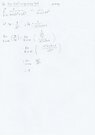
So here is the work that I have done recently so how can I determine that it is convergent or divergent ?
Thank you in advance
 
Attachments
  • Handwritten work on a limit comparison test: sum from k=1 to infinity of k/(k+2k^2+3k^3) compared with 1/(1+2k+3k^2), set a_k = 1/(3k^2) and b_k = 1/(3k^2+2k+1), then the limit of a_k/b_k as k goes to infinity is worked out to equal 1.
    IMG_20210824_0001.jpg
    406.9 KB · Views: 183
jaychay said:
so how can I determine that it is convergent or divergent ?
Evgeny.Makarov said:
It is known that $\sum 1/k^2$ converges.
In fact, $\sum_{k=1}^\infty 1/k^2=\pi^2/6$ (see Wikipedia).
 
Evgeny.Makarov said:
In fact, $\sum_{k=1}^\infty 1/k^2=\pi^2/6$ (see Wikipedia).
I still do not understand what you are trying to tell me sir.
 
The limit comparison test is a theorem that has the following form: "For every two series $\sum a_k$ and $\sum b_k$, if ..., then ...". What is the conclusion of this implication, i.e., what is written after "then"?