Homework Help Overview
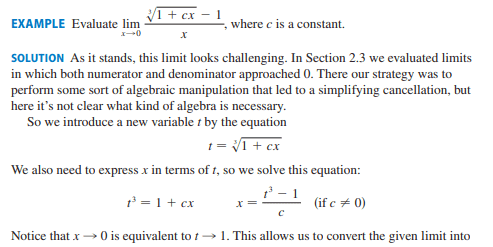
The discussion revolves around the limit of a rational function involving a variable transformation from \(x\) to \(t\), specifically examining the behavior as \(x\) approaches zero and its implications for \(t\). The subject area includes limits and rational functions in calculus.
Discussion Character
- Exploratory, Assumption checking, Conceptual clarification
Approaches and Questions Raised
- Participants explore the relationship between the limits of \(x\) and \(t\), questioning the equivalence of their approaches to zero and one, respectively. There are attempts to clarify the transformation and its implications for the limit, along with discussions about the correct interpretation of mathematical notation.
Discussion Status
Some participants have provided feedback on the original poster's reasoning and notation, prompting further clarification and exploration of the concepts involved. There is an ongoing examination of the assumptions made regarding the transformation between \(x\) and \(t\).
Contextual Notes
Participants note potential misunderstandings regarding the distribution of roots in expressions and the meaning of proportionality in mathematical notation. These points highlight areas where assumptions may need to be reconsidered.