Linear combinations of atomic orbitals

Join the discussion
Ask a follow-up here, or get your own question answered by working scientists, mathematicians and engineers — people, not an autocomplete.
Real named experts · corrections over time · the nuance an AI answer skips
1 reply · 3K views
Avardia
Messages
6
Reaction score
0
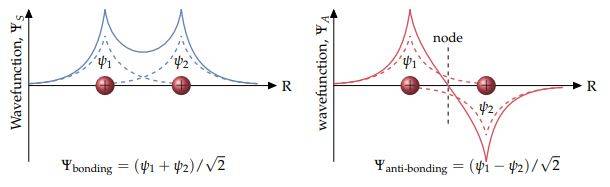
So I've been looking at covalent bonds and come across the approx you can do of the molecular orbital for ##H^+_2## by just summing two 1s orbitals, the method is called the linear combinations of atomic orbitals, and you get what is below which I believe is exact in this case since the 1s orbital is all there is. And the orbital is just the wavefunction of electron.
241690


So one is the bonding and the other is anti-bonding orbital. My question is why in the anti-bonding orbital do we have one of the summed 1s wavefunctions as negative?
 
Physics news on Phys.org
Avardia said:
My question is why in the anti-bonding orbital do we have one of the summed 1s wavefunctions as negative?
You don't have to. You're essentially doing a change of basis from the atomic orbitals to the molecular orbitals, so you can choose any two combinations of hydrogen 1s orbitals, as long as the combinations are linearly independent. It so happens that the fully symmetric and fully antisymmetric linear combinations of atomic orbitals closely approximate the bonding and antibonding molecular orbitals. You could choose a different basis, but you'd have much more complicated looking functions for your molecular orbitals.
 
  • Like
Likes   Reactions: DrClaude