Undergrad Linearity of power spectral density calculations

Click For Summary
The discussion centers on the differences in power spectral density (PSD) calculations from concatenated epochs versus averaged epochs of a time series. It highlights that while both methods should theoretically yield similar results, discrepancies arise due to the nature of averaging signals, which can lead to a loss of information. Specifically, averaging can result in a zero signal if the components cancel each other out, affecting the PSD outcome. The confusion stems from misunderstanding the relationship between the concatenated epochs and the averaged signal. Ultimately, the analytical explanation for the discrepancies lies in the effects of averaging on the signal's characteristics.
Schwann
Messages
7
Reaction score
4
TL;DR
Does PSD computed from concatenated epochs of time series differ from PSD computed from averaged epochs of the same time series?
I have a question related to linearity of power spectral density calculation.

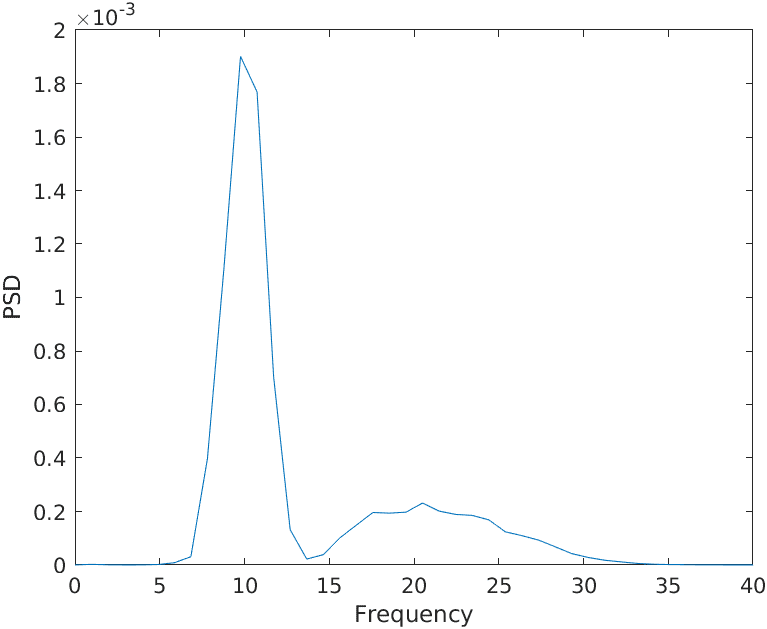
Suppose I have a time series, divided into some epochs. If I compute PSD by Welch's method with a time window equal to the length of an epoch and without any overlap, I obtain this result:
1594982808504.png


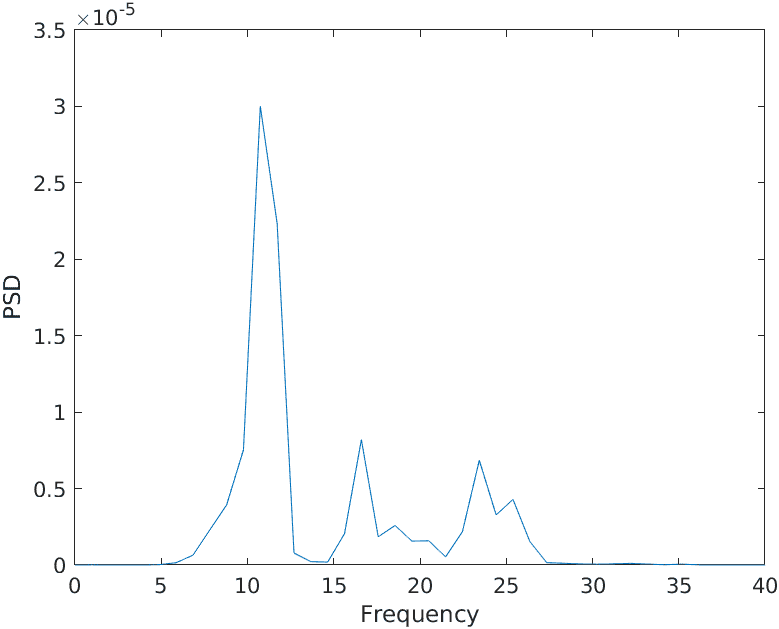
If I calculate the average of my time series over the epochs, obtain the averaged signal, the length of which is equal to the length of one epoch (obviously), and then compute PSD by the same method using this averaged signal, I get a slightly different result:
1594982921650.png


I thought that these two scenarios could not be different, as PSD from the concatenated epochs is presumably equal to PSD from averaged epochs (in my opinion). However, the results are different.

I am looking for analytical explanation of these discrepancies.

Thank you!
 
Physics news on Phys.org
Schwann said:
Summary:: Does PSD computed from concatenated epochs of time series differ from PSD computed from averaged epochs of the same time series?
No. PSD of the same set of particles is calculated. Time doesn't play a role and you do the same calculation in both cases.
analytical explanation of these discrepancies
You must have a mistake somewhere. Hard to say what without having all the details.
 
Thank you for your answer. What I meant is not computing PSD based on the same set of time points with different order.
BvU said:
No. PSD of the same set of particles is calculated. Time doesn't play a role and you do the same calculation in both cases.

Whan I meant is the following.

Scenario 1. I have a long time series made of concatenated epochs. Then I compute PSD.
1594998152344.png


Scenario 2. From the same epochs I compute the average and then compute PSD.

1594998270007.png


In Scenario 1 we have averaged PSDs from each epoch, because the time window in Welch's method I set as the length of the epoch. In Scenario 2 we have PSD from the averaged signal. It seems that they are not equal, as evident from the plots in my initial question. But I don't understand why...
 
Oops, professional brainwashing over an extended period made me read "particle size distribution" for PSD o:)

To add insult to injury I didn't understand the scenario: I figured PSD versus average of epoch PSDs instead of PSD of epoch average.

An averaged signal ruins a power spectral density: the average of a nonzero signal can be zero in a worst case
 
  • Like
Likes Schwann
There are probably loads of proofs of this online, but I do not want to cheat. Here is my attempt: Convexity says that $$f(\lambda a + (1-\lambda)b) \leq \lambda f(a) + (1-\lambda) f(b)$$ $$f(b + \lambda(a-b)) \leq f(b) + \lambda (f(a) - f(b))$$ We know from the intermediate value theorem that there exists a ##c \in (b,a)## such that $$\frac{f(a) - f(b)}{a-b} = f'(c).$$ Hence $$f(b + \lambda(a-b)) \leq f(b) + \lambda (a - b) f'(c))$$ $$\frac{f(b + \lambda(a-b)) - f(b)}{\lambda(a-b)}...

Similar threads

  • · Replies 3 ·
Replies
3
Views
2K
  • · Replies 0 ·
Replies
0
Views
2K
  • · Replies 6 ·
Replies
6
Views
2K
  • · Replies 3 ·
Replies
3
Views
3K
  • · Replies 7 ·
Replies
7
Views
3K
  • · Replies 4 ·
Replies
4
Views
2K
  • · Replies 8 ·
Replies
8
Views
5K
  • · Replies 3 ·
Replies
3
Views
26K
Replies
1
Views
2K
  • · Replies 1 ·
Replies
1
Views
1K