Location of the magnetopause using Chapman-Ferraro equation

  • Context: Undergrad 
  • Thread starter Thread starter Kovac
  • Start date Start date
Click For Summary

Discussion Overview

The discussion revolves around the calculation of the magnetopause subsolar point on Earth using the Chapman-Ferraro equations. Participants explore the differences between two versions of these equations, their applicability to specific scenarios, and the physical parameters involved in the calculations.

Discussion Character

  • Technical explanation
  • Debate/contested
  • Mathematical reasoning

Main Points Raised

  • Some participants inquire about the differences between the Chapman-Ferraro equations, specifically why one includes a factor of 2^(1/3) and what the variables "pl" and "E" represent.
  • There is a suggestion that the simpler Chapman-Ferraro equation may correspond to the midday (subsolar) radius, while the equation with the additional term may relate to the dawn or dusk radius.
  • Participants express uncertainty about which equation is more applicable for realistic calculations, noting that both yield different results.
  • Questions arise regarding the physical meaning of terms in the equations, such as the significance of the signs in the denominator and the interpretation of variables like B and μ0.
  • Some participants reference external sources, including Wikipedia, to clarify the definitions of variables like solar wind density, velocity, and magnetic field strength.
  • There is a correction regarding the value of μ0, with a participant suggesting it should be 4π x 10^-7, while another provides a different value and context for μ0.
  • One participant shares excerpts from a geophysics handbook that define the Chapman-Ferraro equation and its variables, but expresses confusion about the relevance of the factor 2^(1/3) in the second equation.

Areas of Agreement / Disagreement

Participants do not reach a consensus on which Chapman-Ferraro equation is more appropriate for calculating the magnetopause for Earth, and there are multiple competing views regarding the interpretation of the equations and their variables.

Contextual Notes

Participants note that the magnetopause is not a spherical surface with a single radius, indicating that the equations may apply differently depending on the time of day. There are also unresolved questions about the definitions and values of certain physical constants and parameters.
Kovac
Messages
13
Reaction score
2
TL;DR
.
Hello,

Lets say you need to calculate the location of the magnetopause subsolar point on earth and you only have this information:

> Solar wind proton number density: 10 cm−3

> Solar wind speed: 700 km s−1

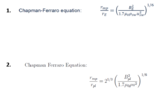
Chapman_ferraro equations:

What is the difference between the above chapman-ferraro equations? Why does one of them have 2^1/3 in front and one doesnt? What does the "pl" & "E" stand for?

Which one is more applicable to my case scanario?
 

Attachments

  • chapman_ferraro_eq.PNG
    chapman_ferraro_eq.PNG
    10.2 KB · Views: 152
Astronomy news on Phys.org
It might help to know what source those two equations came from.
 
My suspicion is that the simple CF equation gives the midday (subsolar) radius, and that the added term of; 2^(1/3) = 1.26; gives the dawn or dusk radius.
 
Ibix said:
It might help to know what source those two equations came from.
These equations are coming from lecture slides.
 
Baluncore said:
My suspicion is that the simple CF equation gives the midday (subsolar) radius, and that the added term of; 2^(1/3) = 1.26; gives the dawn or dusk radius.
So if you want realistic values, is it the second equation to be used? Because both give different results
 
Kovac said:
Because both give different results
They are different because they are applied at different times of the day.
The magnetopause is not a spherical surface with one radius.
 
Ibix said:
It might help to know what source those two equations came from.
Here are both equations mentioned in the slides.


Attachments

  • cfeq.PNG
    cfeq.PNG
    20.5 KB · Views: 148
Baluncore said:
They are different because they are applied at different times of the day.
The magnetopause is not a spherical surface with one radius.
Alright, could you help me understand what the signs in the denominator stands for.
What is the B in the numerator?
I assume the last term in the denominator is the solar wind velocity, the middle term pressure? And the u0 term is what?
 
https://en.wikipedia.org/wiki/Magnetopause

According to this link the p= density of the solar wind, v = velocity, B=magnetic field strength of the planet.
How do I get the μ0? Can I get it through the proton number density?
 
  • #11
Kovac said:
https://en.wikipedia.org/wiki/Magnetopause

According to this link the p= density of the solar wind, v = velocity, B=magnetic field strength of the planet.
How do I get the μ0? Can I get it through the proton number density?
##B_{E}## and ##\mu_{0}## characterize the magnetic properties of the planet. The magnetic field of the Earth can be modeled as a magnetic dipole (https://en.wikipedia.org/wiki/Dipole_model_of_the_Earth's_magnetic_field), with the value of the field at the Earth's surface along the equator taking the value ##B_{E}=3.12\times10^{-5}\text{ tesla}##. And the magnetic permeability of vacuum, ##\mu_{0}=1.26\times10^{-6}{\rm \ N/A^{2}}##, is a basic constant of electromagnetism.
 
  • #12
renormalize said:
##B_{E}## and ##\mu_{0}## characterize the magnetic properties of the planet. The magnetic field of the Earth can be modeled as a magnetic dipole (https://en.wikipedia.org/wiki/Dipole_model_of_the_Earth's_magnetic_field), with the value of the field at the Earth's surface along the equator taking the value ##B_{E}=3.12\times10^{-5}\text{ tesla}##. And the magnetic permeability of vacuum, ##\mu_{0}=1.26\times10^{-6}{\rm \ N/A^{2}}##, is a basic constant of electromagnetism.
Are you sure about u0? Because it seems it should be 4pi * 10^-7 as it is the magnetic permiability of free space:
http://www.sp.ph.imperial.ac.uk/~mkd/AdvancedOption3solutions.pdf
 

Attachments

  • mu0.PNG
    mu0.PNG
    4.8 KB · Views: 119
  • #13
Here are the first 4 pages of chap-8, The Handbook of Geophysics and Space Environments.
It defines the CF equation you should use and the variables.
 

Attachments

  • #15
renormalize said:
Try multiplying out ##4\times 3.14159\times 10^{-7}##. What do you get?
Yes correct, my bad!
 
  • Like
Likes   Reactions: renormalize
  • #16
Baluncore said:
Here are the first 4 pages of chap-8, The Handbook of Geophysics and Space Environments.
It defines the CF equation you should use and the variables.
So in the equation density p= mass of proton x proton density of the solar wind x 1000 000 (conversion between kgcm^-3 to kgm^-3).
B = M/r^3 where M= magnetic dipole of the planet in question, r= radius of the planet in question.
μ0= 4pi x 10^-7 Vs/Am [magnetic permiability of free space]
u= solar wind velocity.

But I still dont understand why the second equation has 2^1/3 in front? Which one is more correct if you want to calculate for earth?
 
  • #17
Kovac said:
But I still dont understand why the second equation has 2^1/3 in front? Which one is more correct if you want to calculate for earth?
In post #7, the lower RHS of your attachment reads, as best as I can OCR;
"Assuming B=0 In the magnetosheath the induced Bmp, must cancel the geomagnetic dipole field in this region. This yields

Bmp = Bdipole(Rmp)

However, just inside the magnetosphere, B will increase the total B to

B = 2⋅Bdipole⋅(Rmp) = 2^(1/3) * ....
"
Do you want the Rmp, or do you want B ?
 

Similar threads

  • · Replies 1 ·
Replies
1
Views
2K
  • · Replies 3 ·
Replies
3
Views
10K
Replies
4
Views
1K
  • · Replies 7 ·
Replies
7
Views
2K
  • · Replies 5 ·
Replies
5
Views
2K
  • · Replies 2 ·
Replies
2
Views
4K
  • · Replies 1 ·
Replies
1
Views
2K
  • · Replies 6 ·
Replies
6
Views
2K
Replies
1
Views
2K
  • · Replies 14 ·
Replies
14
Views
10K