Discussion Overview
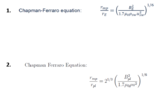
The discussion revolves around the calculation of the magnetopause subsolar point on Earth using the Chapman-Ferraro equations. Participants explore the differences between two versions of these equations, their applicability to specific scenarios, and the physical parameters involved in the calculations.
Discussion Character
- Technical explanation
- Debate/contested
- Mathematical reasoning
Main Points Raised
- Some participants inquire about the differences between the Chapman-Ferraro equations, specifically why one includes a factor of 2^(1/3) and what the variables "pl" and "E" represent.
- There is a suggestion that the simpler Chapman-Ferraro equation may correspond to the midday (subsolar) radius, while the equation with the additional term may relate to the dawn or dusk radius.
- Participants express uncertainty about which equation is more applicable for realistic calculations, noting that both yield different results.
- Questions arise regarding the physical meaning of terms in the equations, such as the significance of the signs in the denominator and the interpretation of variables like B and μ0.
- Some participants reference external sources, including Wikipedia, to clarify the definitions of variables like solar wind density, velocity, and magnetic field strength.
- There is a correction regarding the value of μ0, with a participant suggesting it should be 4π x 10^-7, while another provides a different value and context for μ0.
- One participant shares excerpts from a geophysics handbook that define the Chapman-Ferraro equation and its variables, but expresses confusion about the relevance of the factor 2^(1/3) in the second equation.
Areas of Agreement / Disagreement
Participants do not reach a consensus on which Chapman-Ferraro equation is more appropriate for calculating the magnetopause for Earth, and there are multiple competing views regarding the interpretation of the equations and their variables.
Contextual Notes
Participants note that the magnetopause is not a spherical surface with a single radius, indicating that the equations may apply differently depending on the time of day. There are also unresolved questions about the definitions and values of certain physical constants and parameters.