LogLikelihood - Poisson distribution

Click For Summary
SUMMARY

The discussion centers on the application of log-likelihood minimization for fitting parameters of particle energy and direction using pulse amplitudes as input data, specifically within the context of a Poisson distribution. The user identifies a critical issue where higher pulse amplitudes yield lower Poisson probabilities, leading to a counterintuitive higher likelihood value. This discrepancy raises concerns about the importance of accurately modeling the probabilities for higher amplitudes, which are significant in the analysis of photoelectrons. The user seeks solutions to correct this effect in their likelihood function.

PREREQUISITES
  • Understanding of log-likelihood minimization techniques
  • Familiarity with Poisson distribution properties
  • Knowledge of statistical modeling in particle physics
  • Experience with data analysis involving pulse amplitudes
NEXT STEPS
  • Research methods to adjust Poisson probabilities for higher amplitude pulses
  • Explore alternative statistical distributions that may better fit the data
  • Investigate the use of Bayesian inference in parameter fitting
  • Learn about advanced likelihood function optimization techniques
USEFUL FOR

Particle physicists, data analysts, and statisticians involved in modeling and analyzing experimental data, particularly those working with pulse amplitude measurements and likelihood functions.

Zuzana
Messages
12
Reaction score
1
Hello :)
I try to fit some parameters of the particle (e.g. energy, direction) be means of log-likelihood minimization.
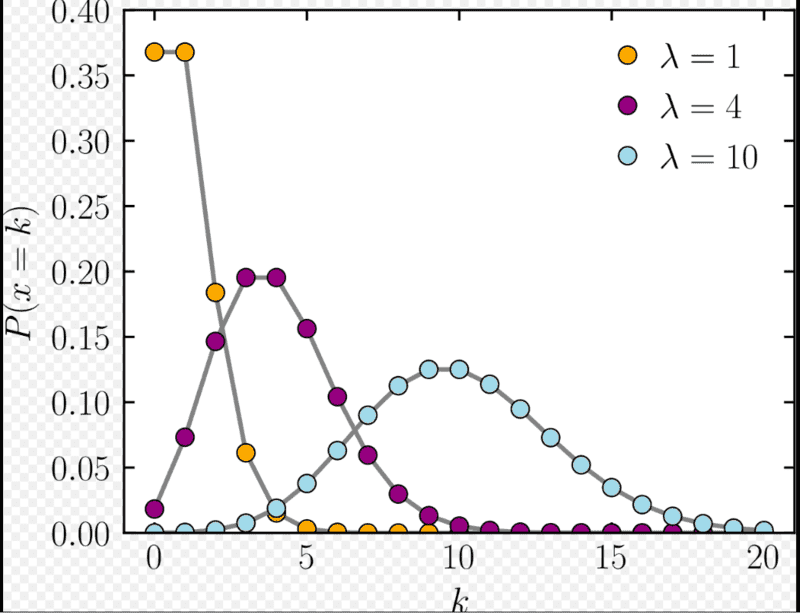
Input data to likelihood function are pulses amplitudes, while Poisson distribution is used. However, the problem is that Poisson distribution is as follows
1661160531826.png

i.e. for higher pulse amplitute there is a lower Poisson probability and thus higher likelihood value. However, pulses with higher amplitudes are very important in the event and the probability for them should be higher, not? Please, do you know how to correct this effect? Or what would you suggest to do?

Thank you very much in advance.
 
Physics news on Phys.org
What are you comparing?
 
mathman said:
What are you comparing?
number of photoelectrons. measured vs expected
 

Similar threads

  • · Replies 12 ·
Replies
12
Views
4K
Replies
1
Views
2K
  • · Replies 3 ·
Replies
3
Views
1K
  • · Replies 1 ·
Replies
1
Views
1K
  • · Replies 5 ·
Replies
5
Views
4K
  • · Replies 10 ·
Replies
10
Views
2K
Replies
4
Views
2K
Replies
28
Views
4K
  • · Replies 37 ·
2
Replies
37
Views
5K
  • · Replies 1 ·
Replies
1
Views
5K