Love Means Different Things in Different Languages

  • Context: Lingusitics 
  • Thread starter Thread starter BillTre
  • Start date Start date
  • Tags Tags
    Love Means
Click For Summary
SUMMARY

A recent study published in Science magazine reveals that the concept of love varies significantly across languages, with different words associated with distinct emotions. The research highlights that love-related terms in various languages form unique networks, indicating that understanding love requires more than just vocabulary; it necessitates cultural context. The study emphasizes that language learners must grasp the cultural nuances surrounding words to fully comprehend their meanings, as illustrated by the Indo-European language's association of love with envy.

PREREQUISITES
  • Understanding of linguistic networks and semantics
  • Familiarity with cultural context in language learning
  • Basic knowledge of Indo-European language characteristics
  • Awareness of emotional connotations in language
NEXT STEPS
  • Research the impact of cultural context on language acquisition
  • Explore the emotional semantics of love in different languages
  • Study linguistic networks and their implications for language learning
  • Investigate the relationship between language and cultural identity
USEFUL FOR

Language learners, linguists, cultural anthropologists, and educators interested in the intersection of language and emotion.
BillTre
Science Advisor
Gold Member
Messages
2,739
Reaction score
11,966
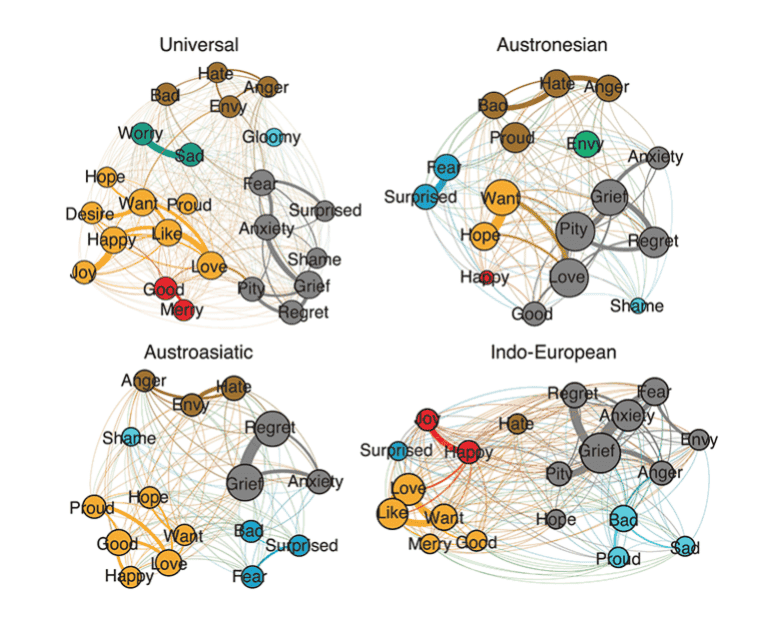
A recent study (Science mag news report) has shown that words for love are associated with different emotions in different languages and therefore vary in meaning somewhat. Comparing networks of related terms in different languages has revealed these differences.
Love related groups of words are yellow in the figure.

Screen Shot 2019-12-20 at 4.36.03 PM.png
 
  • Like
Likes   Reactions: QuantumQuest and 256bits
Science news on Phys.org
... and "love" means zero in tennis. :oldbiggrin:

The tennis term is derived from French: l'oeuf, or the egg, which is sort of shaped like the numeral zero.
 
  • Like
  • Informative
Likes   Reactions: Klystron, QuantumQuest, gleem and 1 other person
The Indo-European has love meaning Wart?:) - I would love to know who gave that response in the survey.
II want, I mean would love to have the T-shirt. That would be lovely .
 
  • Like
Likes   Reactions: Evo
I think the "wart" is actually "want".
The right side descender is obscured by its circle.
 
  • Like
Likes   Reactions: 256bits
BillTre said:
I think the "wart" is actually "want".
The right side descender is obscured by its circle.
Well, it was supposed to be tongue-n-cheek comment.
But.
Doesn't love also represent envy for Indo-European.
Envy seems to positioned far north of love.
EX
" I love that dress."
"I love that car he's driving."
 
  • Like
Likes   Reactions: Evo
This last paragraph of the cited publication
At the very least, Jackson hopes his study offers some insight for language learners. “Just learning the words isn’t learning the language,” he says. You also need to learn the context."
sums interesting and elusive facets of learning a language: understanding the culture and customs.

Studying and learning language remains incomplete without cultural moorings to understand the society.
 
  • Like
Likes   Reactions: BillTre

Similar threads

  • · Replies 1 ·
Replies
1
Views
2K
  • · Replies 2 ·
Replies
2
Views
2K
  • · Replies 17 ·
Replies
17
Views
6K
  • · Replies 1 ·
Replies
1
Views
2K
  • · Replies 2 ·
Replies
2
Views
2K
Replies
6
Views
3K
  • · Replies 44 ·
2
Replies
44
Views
5K
  • · Replies 1 ·
Replies
1
Views
2K
Replies
7
Views
4K
  • · Replies 15 ·
Replies
15
Views
6K