Can Maglev Trains Be Used for Exercise?

Click For Summary
SUMMARY

This discussion focuses on the educational exploration of MagLev trains, specifically electrodynamic suspension (EDS) systems. The participant, a high school student, has engaged with various resources, including articles and reports, to understand the interaction of currents and magnetic fields in MagLev technology. Key resources referenced include a report on functioning MagLev trains and a document detailing calculations related to overcoming gravity. The student successfully navigated complex equations with community support, clarifying the distinction between magnetic field variables B and H.

PREREQUISITES
  • Understanding of electrodynamic suspension (EDS) systems
  • Familiarity with magnetic fields and their properties
  • Basic knowledge of physics equations related to forces and motion
  • Ability to interpret technical documents and research articles
NEXT STEPS
  • Research the principles of electrodynamic suspension (EDS) in MagLev trains
  • Study the relationship between magnetic field variables B and H
  • Explore real-world applications and calculations of MagLev technology
  • Investigate the physics of overcoming gravitational forces in transportation systems
USEFUL FOR

This discussion is beneficial for high school physics students, educators in transportation technology, and anyone interested in the principles of magnetic levitation and its applications in modern transit systems.

paulcaimp
Messages
9
Reaction score
2
Homework Statement
Find an exercise about maglev trains to which Maxwell's equations can be applied
Relevant Equations
Maxwell's Equations with derivative and integrals
Hi everyone, I'm an Italian High Schooler and I need a problem about maglev trains for the final exam. I apologize in advance if my english is bad or if I didn't follow some rules. I'm not native and new to this forum.
 
Physics news on Phys.org
Welcome to PhysicsForums. :smile:

If I understand correctly, you are asked to come up with a homework-like problem about MagLev trains and solve that problem?

What reading have you been doing about MagLev in general and trains in particular? Can you posts to your reading so far? Thanks.
 
  • Like
Likes   Reactions: paulcaimp
Yes, so it's been a couple of days during which I've been looking up some videos on youtube () and reading articles (https://sites.tufts.edu/eeseniordesignhandbook/2015/maglev-magnetic-levitating-trains/) to grasp how currents and magnetic fields interact between each other during a maglev train ride. I also found out that two types of maglev trains exist, but for my work I will focus only on electrodynamic suspension trains. I also come across a report of functioning maglev trains that has all kind of datas, so it would be awesome if we can come up with a problem involving these real life figures. It is located at this url (https://www.osti.gov/servlets/purl/10134413) and the pages that treat eds systems are the 54 and 56. Thanks for your attention
 
  • Like
Likes   Reactions: Delta2
berkeman said:
Welcome to PhysicsForums. :smile:

If I understand correctly, you are asked to come up with a homework-like problem about MagLev trains and solve that problem?

What reading have you been doing about MagLev in general and trains in particular? Can you posts to your reading so far? Thanks.
Yes, so it's been a couple of days during which I've been looking up some videos on youtube () and reading articles (https://sites.tufts.edu/eeseniordesignhandbook/2015/maglev-magnetic-levitating-trains/) to grasp how currents and magnetic fields interact between each other during a maglev train ride. I also found out that two types of maglev trains exist, but for my work I will focus only on electrodynamic suspension trains. I also come across a report of functioning maglev trains that has all kind of datas, so it would be awesome if we can come up with a problem involving these real life figures. It is located at this url (https://www.osti.gov/servlets/purl/10134413) and the pages that treat eds systems are the 54 and 56. Thanks for your attention
 
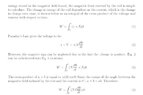
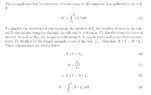
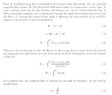
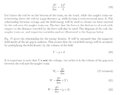
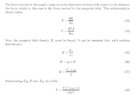
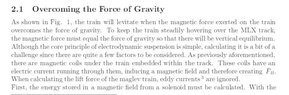
After a week of desperate searching, I've come across this document (on https://www.academia.edu/34876525/Magnetic_Levitation_Transportation) that shows a series of calculations that are perfect for my assignment. They are under the section "Overcoming the force of gravity" at pages 8-12. Although, I get lost around the sixth equation because I'm not sure the procedure is legit. What do you think?
 
I'm posting the screenshots of the calculations
 

Attachments

  • 1.JPG
    1.JPG
    31.8 KB · Views: 225
  • 2.JPG
    2.JPG
    23 KB · Views: 180
  • 3.JPG
    3.JPG
    20.2 KB · Views: 202
  • 4.JPG
    4.JPG
    29.9 KB · Views: 191
  • 5.JPG
    5.JPG
    10.4 KB · Views: 199
  • 6.JPG
    6.JPG
    33.6 KB · Views: 176
  • 7.JPG
    7.JPG
    17.2 KB · Views: 187
Which part are you following okay, and what part is tripping you up?
 
I am now able to follow till the 24th passage. The only thing I'm not getting it's this costant switch between B and H, what's their difference? And also why at the 25th equation we have two forces?
 
  • #10
paulcaimp said:
I am now able to follow till the 24th passage. The only thing I'm not getting it's this costant switch between B and H, what's their difference? And also why at the 25th equation we have two forces?
Do you mean equation 24? If so, can you describe your understanding up to that point, and what confuses you? B versus H usually involves the material that the magnetic field is in:

##B = \mu H##

so you will likely see H for non-ferrous regions and B for the field in a ferrous material.

1621904487452.png
 
  • #11
Actually, after some efforts and thanks to your heads up, I was able to rewrite all the equations in the way I needed, so I'd say "problem solved". Thank you for the support, guidance and patience
 
  • Like
Likes   Reactions: berkeman

Similar threads

  • · Replies 9 ·
Replies
9
Views
4K
  • · Replies 1 ·
Replies
1
Views
1K
  • · Replies 19 ·
Replies
19
Views
12K
  • · Replies 10 ·
Replies
10
Views
1K
  • · Replies 2 ·
Replies
2
Views
2K
  • · Replies 16 ·
Replies
16
Views
2K
  • · Replies 13 ·
Replies
13
Views
5K
Replies
8
Views
3K
  • · Replies 2 ·
Replies
2
Views
2K
  • · Replies 12 ·
Replies
12
Views
2K