Magnetic field of running current in a wire

Click For Summary

Discussion Overview

The discussion revolves around the nature of the magnetic field generated by a running current in a wire, specifically why the magnetic field lines are circular rather than straight. Participants explore theoretical concepts, provide analogies, and reference fundamental principles such as Maxwell's equations.

Discussion Character

  • Exploratory
  • Technical explanation
  • Conceptual clarification
  • Debate/contested

Main Points Raised

  • Some participants question why magnetic field lines are circular and not straight towards the wire.
  • One participant suggests that the circular nature is due to the symmetry of the arrangement of the wire.
  • Another participant notes that symmetry alone does not exclude the possibility of radial lines, indicating that additional factors are involved.
  • There is a reference to contour lines on maps as an analogy for understanding the circular nature of magnetic fields.
  • Some participants discuss the direction of magnetic field lines, noting that they point from north to south, but question the definitions of these poles in the context of a wire.
  • A participant mentions that the circular field lines are idealized and do not account for the influence of the entire circuit, suggesting that the actual field is more complex.
  • There is a debate regarding the direction of the magnetic field lines in relation to the current, with some asserting that it is counterclockwise when viewed from above, while others argue it appears clockwise when viewed in the direction of the current.
  • One participant emphasizes the need to refer to Maxwell's equations to understand the behavior of electric and magnetic fields.

Areas of Agreement / Disagreement

Participants express differing views on the nature of magnetic field lines and their direction, leading to an unresolved discussion with multiple competing perspectives on the topic.

Contextual Notes

Participants reference Maxwell's equations and the idealized nature of magnetic field representations, indicating that the discussion is limited by assumptions about the simplicity of the wire's configuration and the complexity of real-world circuits.
yrjosmiel
Messages
53
Reaction score
5
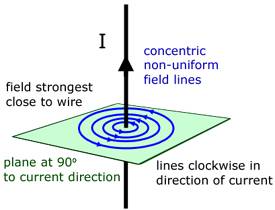
Why are they circular?
You know, like this:
mag-strt-wire-diag.jpg

Why not straight toward the wire?
 
Physics news on Phys.org
yrjosmiel said:
Why are they circular?
You know, like this:
View attachment 209712
Why not straight toward the wire?
Because that's the way it is. Electric fields can radiate outwards from a point or line but the Magnetic Lines of Force have no beginning or end (even in a bar magnet, the lines can be regarded as running through the metal between the two poles.
You cannot have an isolated magnetic pole but to understand why, you need to get into and be familiar with Maxwell's Equations. I don't know of a simple explanation.
 
Hint: Why do contour lines on a map go in circles around a hill and not straight up and down the slope?
 
  • Like
Likes   Reactions: sophiecentaur
Due to the symmetry of the arrangement I think the circular shapes are predictable.
 
  • Like
Likes   Reactions: sophiecentaur
Dadface said:
Due to the symmetry of the arrangement I think the circular shapes are predictable.

Symmetry alone wouldn't rule out radial lines.
 
pixel said:
Symmetry alone wouldn't rule out radial lines.
Symmetry plus the other factors.
 
CWatters said:
Hint: Why do contour lines on a map go in circles around a hill and not straight up and down the slope?
To represent magnitude?
If that is so, then why the arrows in the field? Why is there a counter-clockwise turning?
 
Yes. As with contour lines the closer they are together the stronger the field. The arrows indicate the direction of the field.

They point from north to south but north and south poles are just names we allocated years ago. Just as we defined positive current as electricity flowing from positive to negative terminals on a battery.

See also Fleming rules.
 
CWatters said:
They point from north to south but north and south poles are just names we allocated years ago. Just as we defined positive current as electricity flowing from positive to negative terminals on a battery.
Where exactly is the "north" and the "south" in the wire?
 
  • #10
yrjosmiel said:
Why are they circular?
You know, like this:
View attachment 209712
Why not straight toward the wire?
Good question!

Basically, the magnetic field lines are circular because the wire is circular.

For a typical straight circular wire carrying current, the magnetic field is generated to be perpendicular to the direction of the current.

Around a circular wire, the magnetic field lines will be concentric circles with the current perpendicular to the planes of the circles.

But, it doesn’t always have to be this way! You could have a conductor that has a rectangular cross section, for example, and then determining the shape of the magnetic field lines can get very “interesting”. See this paper for details.
 
  • Like
Likes   Reactions: yrjosmiel
  • #11
yrjosmiel said:
Where exactly is the "north" and the "south" in the wire?

North and South are not in the wire.

Magnetic field lines do not have a "start" or an "end" that you call north or south. The just have a direction from North to South. Even for a bar magnet the magnetic field lines go through the magnet itself.

bar.jpg
mag-strt-wire-diag.jpg
 
  • Like
Likes   Reactions: jerromyjon
  • #12
I would like to add a bit more detail for the case of the case of the straight wire. The circular field lines we see are idealised and take into account the straight section of wire only. They do not take into account the field from other places.

To actually plot the field we have to drive a current through the wire and to do that requires a circuit with a power supply and one or more connecting wires. In other words the actual field we observe in a plane normal to the wire, is not due to the straight section of wire only but is due to the circuit loop.

I like to think of the loop as a mini solenoid with the the poles very close to each other and one at each end of the loop. The attached diagram which is also idealised shows the field due to a circular loop.
 

Attachments

  • 9908391_orig loop.jpg
    9908391_orig loop.jpg
    9.4 KB · Views: 667
  • Like
Likes   Reactions: CWatters
  • #13
yrjosmiel said:
To represent magnitude?
If that is so, then why the arrows in the field? Why is there a counter-clockwise turning?

My first question would be: why does the image say 'lines clockwise in direction of current', while the magnetic field lines around a
wire are always counterclockwise to the direction of current...? The image is wrong (or at least, the text inside it)
 
  • #14
If you look downwards it's counter clockwise but if you look "in the direction of the current" it is clockwise.
 
  • #15
CWatters said:
If you look downwards it's counter clockwise but if you look "in the direction of the current" it is clockwise.

No matter how I look at it, it remains counterclockwise.
 
  • #16
Look at it from underneath.

mag-strt-wire-diag.jpg
 
  • #17
yrjosmiel said:
Why are they circular?
You know, like this:
View attachment 209712
Why not straight toward the wire?

This is just because the nature creates magnetic field in this way.

I think you should rather ask about that law of nature which dictates the magnetic field to be so.

Well, there are four equations in Electrodynamics known as Maxwell's equations. Those equations describe the 'behaviour' of electric and magnetic filed. Using those you can easily find out the magnetic filed created by a straight current carrying wire.
 

Similar threads

  • · Replies 22 ·
Replies
22
Views
2K
  • · Replies 7 ·
Replies
7
Views
2K
  • · Replies 5 ·
Replies
5
Views
2K
  • · Replies 6 ·
Replies
6
Views
2K
  • · Replies 27 ·
Replies
27
Views
3K
  • · Replies 8 ·
Replies
8
Views
2K
  • · Replies 1 ·
Replies
1
Views
2K
  • Sticky
  • · Replies 0 ·
Replies
0
Views
4K
  • · Replies 5 ·
Replies
5
Views
2K
  • · Replies 1 ·
Replies
1
Views
2K