Magnetic Field Surrounding a Straight Conductor

Join the discussion
Ask a follow-up here, or get your own question answered by working scientists, mathematicians and engineers — people, not an autocomplete.
Real named experts · corrections over time · the nuance an AI answer skips
2 replies · 1K views
member 731016
Homework Statement
Please see below
Relevant Equations
Please see below
For this problem,
1673658720024.png

Part of the solution is,
1673658743775.png

1673658803501.png

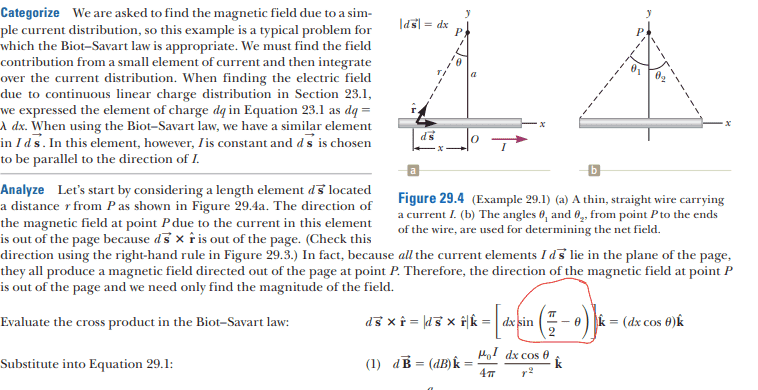
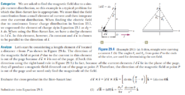
However, would someone please tell me where they got the sine function circled in red from?

Many thanks!
 

Attachments
  • 1673658629770.png
    1673658629770.png
    8.2 KB · Views: 159
  • 1673658699232.png
    1673658699232.png
    35.2 KB · Views: 143
Physics news on Phys.org
Callumnc1 said:
However, would someone please tell me where they got the sine function circled in red from?
You're working with the cross product ##\vec{ds} \times \hat r##. How is the angle between ##\vec{ds}## and ##\hat r## related to the angle ##\theta## shown in diagram ##a##?
 
Reply
  • Like
Likes   Reactions: member 731016
TSny said:
You're working with the cross product ##\vec{ds} \times \hat r##. How is the angle between ##\vec{ds}## and ##\hat r## related to the angle ##\theta## shown in diagram ##a##?
Thank you @TSny ! I see how they got theta now. :) If we call the angle between ds and r hat as theta 2, then from the definition of the cross product:

dxsin(theta 2) = dxsin(pi/2 - theta) where I found theta 2 using angles in a triangle add up to 180 degrees.
 
Reply
  • Like
Likes   Reactions: TSny