Baptiste Debes
- 6
- 0
Hello everyone,
My question is between theorie and practical (so I'm still wondering if it's the right place). I'm reading Serway and Jewett. There's an example about the magnetic flux through a rotating bar and so and induced emf. I understand this emf will be equal to the the opposite of the variation of magnetic flux with respect to the time. But here, as you may see in the picture, B is uniform. (Hoping I can post this kind of picture, I'll delete it straightaway if not)
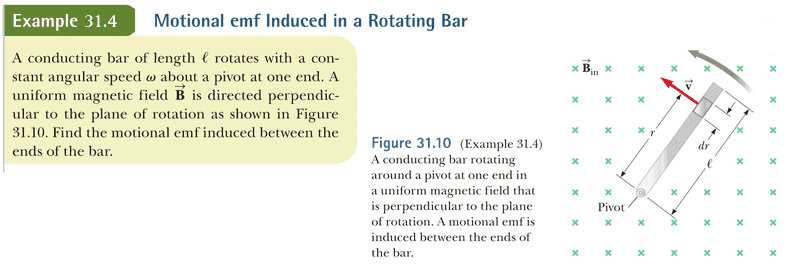
So why is the flux changing ? The area (assuming there is one ?), angle and B field are constant. They're actually using a result coming from a previous example : the sliding bar on two rails with a resistance R between and immerged in a uniform magnetic field. This result is that EMF = -Blv (with l the length of the bar and v its speed). I understood this. But I don't get it when they're using it for the rotating bar saying dEMF = Bvdr.
Many thanks,
Baptiste Debes
My question is between theorie and practical (so I'm still wondering if it's the right place). I'm reading Serway and Jewett. There's an example about the magnetic flux through a rotating bar and so and induced emf. I understand this emf will be equal to the the opposite of the variation of magnetic flux with respect to the time. But here, as you may see in the picture, B is uniform. (Hoping I can post this kind of picture, I'll delete it straightaway if not)
So why is the flux changing ? The area (assuming there is one ?), angle and B field are constant. They're actually using a result coming from a previous example : the sliding bar on two rails with a resistance R between and immerged in a uniform magnetic field. This result is that EMF = -Blv (with l the length of the bar and v its speed). I understood this. But I don't get it when they're using it for the rotating bar saying dEMF = Bvdr.
Many thanks,
Baptiste Debes