zenterix
- 774
- 84
- Homework Statement
- Consider a capacitor that is charging, as in the picture below. The capacitor is ideal (no edge effects).
Points ##a## and ##b## areat a distance ##r_1>R## with respect to the center line, and ##c## and ##d## are at a distance ##r_2<R##.
- Relevant Equations
- Which of the following statements about ##B##, the magnitude of the magnetic field, at points ##a,b,c,## and ##d## are true?
##B(a)>B(b)##
##B(a)<B(b)##
##B(a)=B(b)##
##B(c)>B(d)##
##B(c)<B(d)##
##B(c)=B(d)##
Here is a picture depicting the capacitor and the points of interest.
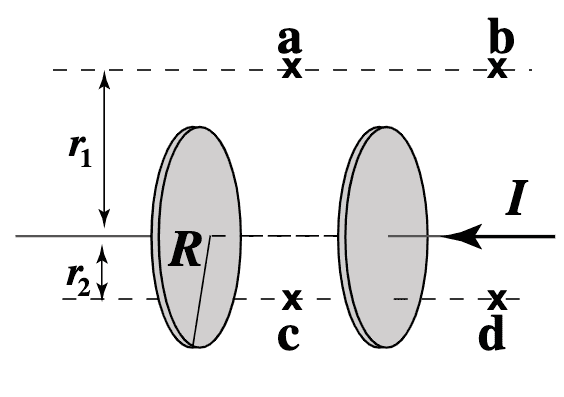
I approached this problem by applying the Ampere-Maxwell law.
For each point I used an circular Amperian loop that I denote by ##P##, enclosing a circular surface ##S##.
Thus, for point ##b## we have
$$\oint_{P_b}\vec{B}\cdot d\vec{s}=B_b2\pi r_1=\mu_0 I\implies B_b=\frac{\mu_0 I}{2\pi r_1}$$
Similarly, for point ##d##
$$B_d=\frac{\mu_0 I}{2\pi r_2}$$
Next, I considered points ##a## and ##c##.
The magnitude of the electric field between the plates is ##\frac{q}{\epsilon_0 A}## where ##A## is the area of a capacitor plate.
$$\oint_{P_a}\vec{B}\cdot d\vec{s}=B_a2\pi r_1=\mu_0\frac{d}{dt}\left (\frac{q}{\epsilon_0 A}\right )\pi R^2$$
$$=\frac{\mu_0 I\pi R^2}{\epsilon_0\pi R^2}$$
$$\implies B_a=\frac{\mu_0I}{\epsilon_0 2\pi r_1}$$
Similarly
$$B_c2\pi r_2=\mu_0\frac{d}{dt}\left (\frac{q}{\epsilon_0 A}\right )\pi r_2^2=\frac{\mu_0 I\pi r_2^2}{\epsilon_0\pi R^2}$$
$$=\frac{\mu_0 Ir_2^2}{\epsilon_0 R^2}$$
$$B_c=\frac{\mu_0 I r_2}{\epsilon_0 2\pi R^2}$$
These are my calculations currently. They seem incorrect. Having a ##\epsilon_0## factor in the denominator of these expressions seems incorrect at first glance given that the order of magnitude of this constant is ##10^{-12}##.
I approached this problem by applying the Ampere-Maxwell law.
For each point I used an circular Amperian loop that I denote by ##P##, enclosing a circular surface ##S##.
Thus, for point ##b## we have
$$\oint_{P_b}\vec{B}\cdot d\vec{s}=B_b2\pi r_1=\mu_0 I\implies B_b=\frac{\mu_0 I}{2\pi r_1}$$
Similarly, for point ##d##
$$B_d=\frac{\mu_0 I}{2\pi r_2}$$
Next, I considered points ##a## and ##c##.
The magnitude of the electric field between the plates is ##\frac{q}{\epsilon_0 A}## where ##A## is the area of a capacitor plate.
$$\oint_{P_a}\vec{B}\cdot d\vec{s}=B_a2\pi r_1=\mu_0\frac{d}{dt}\left (\frac{q}{\epsilon_0 A}\right )\pi R^2$$
$$=\frac{\mu_0 I\pi R^2}{\epsilon_0\pi R^2}$$
$$\implies B_a=\frac{\mu_0I}{\epsilon_0 2\pi r_1}$$
Similarly
$$B_c2\pi r_2=\mu_0\frac{d}{dt}\left (\frac{q}{\epsilon_0 A}\right )\pi r_2^2=\frac{\mu_0 I\pi r_2^2}{\epsilon_0\pi R^2}$$
$$=\frac{\mu_0 Ir_2^2}{\epsilon_0 R^2}$$
$$B_c=\frac{\mu_0 I r_2}{\epsilon_0 2\pi R^2}$$
These are my calculations currently. They seem incorrect. Having a ##\epsilon_0## factor in the denominator of these expressions seems incorrect at first glance given that the order of magnitude of this constant is ##10^{-12}##.
Last edited: