Making a vertical stabilizer for a Space Shuttle Discovery model

10 replies · 12K views · last reply
Science Advisor
Gold Member
Messages
4,458
Reaction score
3,266
I hope it's appropriate to post a picture of a battery operated model of the Space Shuttle Discovery which flew in the 1960's ; lights and sounds.

I came across it at the antique mall. It's missing it's vertical stabilizer, but I can make that,
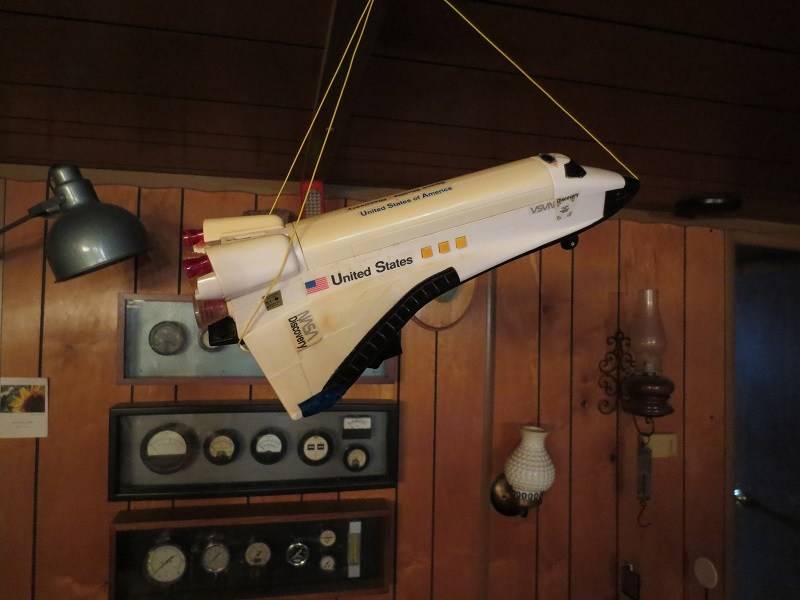
Model of the Space Shuttle Discovery hanging by strings from the ceiling, with 'United States' and 'United States of America' printed on the white fuselage and wings, and no vertical stabilizer on the tail.


White model of the Space Shuttle Discovery hanging from yellow strings above a wood-paneled wall, with a 'United States' label on its fuselage and no vertical stabilizer on its tail.
 
Last edited:
  • Like
Likes   Reactions: Klystron and berkeman
The shuttle Discovery first flew in 1983. Fun model!
 
  • Like
Likes   Reactions: dlgoff
Do the Bay Doors open and the mechanical arm can come out?
 
  • Like
Likes   Reactions: dlgoff
berkeman said:
Do the Bay Doors open and the mechanical arm can come out?
The doors do open but no movable arm. Then landing gears, wheels & nose, can be pulled down out of their compartments.
 
  • Like
Likes   Reactions: Klystron
dlgoff said:
The doors do open but no movable arm.
So I predict you will be building more than just the vertical stabilizer! :cool:
 
  • Skeptical
Likes   Reactions: dlgoff
hutchphd said:
The shuttle Discovery first flew in 1983. Fun model!
I remember it well. What an accomplishment.
 
berkeman said:
So I predict you will be building more than just the vertical stabilizer! :cool:
You know me too well. :olduhh:
 
  • Like
Likes   Reactions: berkeman
dlgoff said:
I hope it's appropriate to post a picture of a battery operated model of the Space Shuttle Discovery which flew in the 1960's ; lights and sounds.

I came across it at the antique mall. It's missing it's vertical stabilizer, but I can make that,

View attachment 273260
I see two elevons in the photo. Is the model damaged or built with reentry elevons?

The wing leading edge tiles in black are a nice touch.

[edit: I retract my question. Misunderstood OP. Thanks.]
 
Last edited:
Klystron said:
I see two elevons in the photo. Is the model damaged or built with reentry elevons?

The wing leading edge tiles in black are a nice touch.
I don't know what you are seeing. There's no damage. Are you maybe seeing the slightly visible landing gears? As they are in the down and locked position.
 
There was one Canadian Arm, which was swapped around to all the Shuttles
...
Ah, here we go:
The Canadarm was signed over to NASA in February 1981, at Spar's Toronto plant, where it was built. After being carefully trucked to the Kennedy Space Center, it was integrated into the space shuttle Columbia in June.

The Canadarm’s first flight was with the space shuttle Columbia on 13 November 1981. Columbia was the second of NASA’s shuttle missions (also known as STS-2).

It performed well and exceeded all design goals. Between 1981 and its final flight in 2011, the Canadarm flew 90 times. In addition to Columbia, its flight history included missions with all of NASA’s other shuttles: Challenger, Discovery, Atlantis and Endeavour.


(from: https://www.thecanadianencyclopedia.ca/en/article/canadarm)

Cheers,
Tom
 
  • Informative
  • Love
Likes   Reactions: dlgoff and berkeman
dlgoff said:
It's missing it's vertical stabilizer, but I can make that,
Making the vertical stabilizer was harder than I thought. I had no idea what it even looked like, but after searching for drawings, etc, I used this drawing to capture the stabilizer:

Technical side-view drawing of the Buran space shuttle on its Energia rocket, with a labelled orbiter detail and dimensions in millimetres and metres.


I then rescaled it and printed it onto a sheet of decal paper. I put the decal on a plastic piece cut to the correct size. Then with a little paint:

Photo of a white plastic Space Shuttle Discovery model hanging by strings in a room with lanterns and a framed University of Kansas engineering diploma; the fuselage reads United States and VSM1.
 
  • Like
Likes   Reactions: berkeman