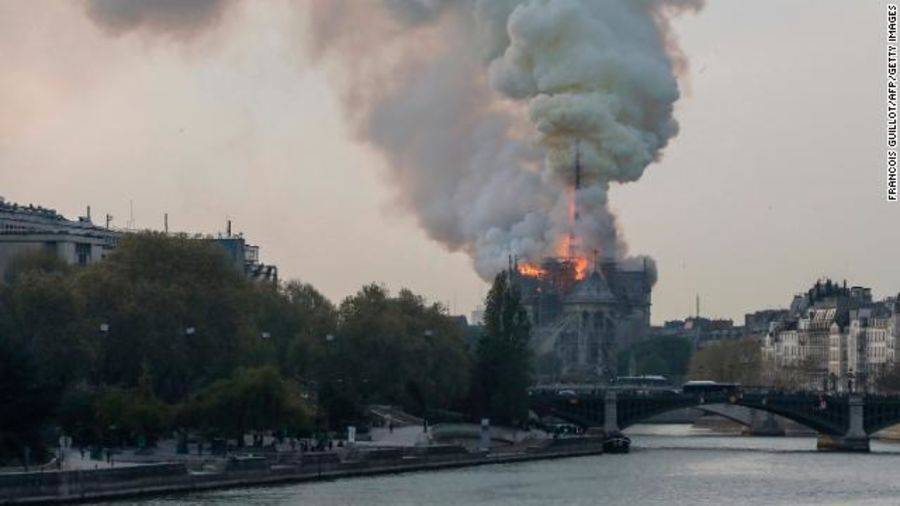
Massive Fire at Notre Dame cathedral

  • Context: News 
  • Thread starter Thread starter Greg Bernhardt
  • Start date Start date
  • Tags Tags
    Fire
Click For Summary

Discussion Overview

The discussion revolves around the massive fire at Notre Dame Cathedral, focusing on the damage to the historic structure, the materials involved in its construction, and the implications for its future. Participants express their emotional responses, share personal experiences, and speculate on the structural integrity of the cathedral following the fire.

Discussion Character

  • Exploratory
  • Debate/contested
  • Technical explanation
  • Conceptual clarification

Main Points Raised

  • Some participants express disbelief at the extent of the fire's damage, noting the cathedral's beauty and historical significance.
  • There is speculation about the flammability of the materials used in the cathedral, with some suggesting that the roof may have been particularly vulnerable.
  • Concerns are raised regarding the extensive use of wood in the interior, especially in the bell tower, which could exacerbate the damage.
  • Participants discuss the potential role of ongoing renovation work, including the use of lead, in contributing to the fire's severity.
  • Some express hope that the main stone structure remains intact, while others question the structural implications of the fire and the collapse of the spire.
  • There are differing views on the effectiveness of the flying buttresses in preventing the cathedral from collapsing, with some arguing that they may not provide sufficient support under the current conditions.
  • Participants share personal anecdotes about their experiences with Notre Dame, reflecting on its cultural and emotional significance.
  • Reports of saved artworks and relics are mentioned, with some participants expressing relief that certain items were removed prior to the fire.

Areas of Agreement / Disagreement

Participants express a range of emotions and opinions regarding the fire and its impact on Notre Dame, with no clear consensus on the structural implications or the extent of the damage. Some agree on the emotional weight of the event, while technical discussions reveal differing interpretations of the cathedral's architecture and its ability to withstand the fire.

Contextual Notes

Discussions include uncertainties about the structural integrity of the cathedral post-fire, the role of various materials in the fire's spread, and the implications for future reconstruction efforts. Participants also highlight the emotional and cultural significance of the cathedral, which may influence their perspectives.

Who May Find This Useful

Individuals interested in architecture, historical preservation, and cultural heritage may find the discussion relevant, as well as those emotionally affected by the loss of significant landmarks.
Messages
19,879
Reaction score
10,886
Wow this is crazy. What a beautiful and historic building. Some images look like it could be a total loss.

https://www.cnn.com/world/live-news/notre-dame-fire/index.html

241920
 
  • Sad
Likes   Reactions: pinball1970
Physics news on Phys.org
I would not have expected it to be very flammable - perhaps just the roof?
 
  • Like
Likes   Reactions: Greg Bernhardt
russ_watters said:
I would not have expected it to be very flammable - perhaps just the roof?

Much of the interior of the cathedral, particularly the bell tower, is full of wood. A lot of it intricate carved and centuries old.

I'm hearbroken watching the news. I've been to Notre Dame a couple of times and it's a beautiful building. All the artwork, carvings, the relics, the tower will all be gone. I hope they're able to limit the fire and save the stain glass, but there have been people on the news just now estimating that there might not be anything more than the stone towers left by the time it is out.

Terrible news.
 
  • Sad
Likes   Reactions: StatGuy2000 and pinball1970
Lead was used extensively in constructing cathedrals due in part to its low melting point.
 
And here's a view from which I remember it best, from the banks of Seine, with lovely surroundings.
 
  • Like
Likes   Reactions: Astronuc, OmCheeto and Klystron
Klystron said:
Lead was used extensively in constructing cathedrals due in part to its low melting point.
According to the Paris Fire Brigade, http://www.pompiersparis.fr/en/news/the-paris-fire-brigade, an ongoing renovation project, involving many tons of lead, may have contributed to the incendiation.

12311676-6925307-image-a-29_1555357197742.jpg


All that scaffolding around the apparent heart of the fire, along with the report of ongoing lead-working, much of which, presumably, involves direct flame application, to me strongly suggests that some activity associated with the renovation project may have incipiated the catastrophe.
 
I passed it countless times when I lived in Paris. Seeing it burn is unbearable. :cry:
 
  • #10
DrClaude said:
I passed it countless times when I lived in Paris. Seeing it burn is unbearable. :cry:
La cathédrale de Notre-Dame ne s'effondrera pas à cause de cette calamité; ses volant-arcs-boutants la soutiendront pour tous nos jours.

The Cathedral of Notre Dame will not collapse due to this calamity; its flying-arch-buttresses will support it for all our days.
 
  • #11
I hope the hunchback made it out OK.

Cheers
 
  • #12
cosmik debris said:
I hope the hunchback made it out OK.

Cheers
Sadly, this story isn't fictional.
 
  • #13
Ryan_m_b said:
Much of the interior of the cathedral, particularly the bell tower, is full of wood. A lot of it intricate carved and centuries old.
Yeah, I guess I had forgotten how much woodwork was in the interior/base. But at the same time, my understanding is that the roof is not structural and it looks to me like the ceiling is entirely masonary. So I wonder if it is possible for the roof to burn and fall off without touching the interior?...though the spire collapsing into it doesn't help, and if it did collapse the ceiling arches it could be structurally catastrophic.

206c952c314736ba929e750ac5ef1907.png
783901-notre-dame-de-paris-interior-ceiling-arches.jpg
 
  • Like
Likes   Reactions: pinball1970 and dlgoff
  • #15
Some views from 1994:

1994-2-26.jpg


1994-2-29.jpg


1994-2-27.jpg


1994-2-32.jpg
 
  • Like
Likes   Reactions: DennisN, Astronuc, OmCheeto and 3 others
  • #16
I've never been there but when seeing TV news video of the fire, tears well up in my eyes. :oldcry:
 
  • Like
Likes   Reactions: OmCheeto
  • #17
  • Like
Likes   Reactions: DennisN, dlgoff and atyy
  • #18
I always wanted to visit it once I could afford it, I guess I never will
 
  • #20
sysprog said:
The Cathedral of Notre Dame will not collapse due to this calamity; its flying-arch-buttresses will support it for all our days.
Support?
The vault was in lateral compression - what is left of the vault still is. The flying arches resist the outwards pressure of the vaults - meaning they meet it with corresponding inwards force.
Had more of the main vault collapsed, would the lateral pressure of the flying buttresses have pushed the side walls over inwards?
 
  • #21
snorkack said:
Support?
The vault was in lateral compression - what is left of the vault still is. The flying arches resist the outwards pressure of the vaults - meaning they meet it with corresponding inwards force.
Had more of the main vault collapsed, would the lateral pressure of the flying buttresses have pushed the side walls over inwards?
The comparatively lightweight arches transmit the outward pressure from the walls to the comparatively heavyweight piers on the ground. The arches lean against the walls, but they don't themselves have such mass as to collapse the walls inward, even when the walls are not pressing outward, the hypothetical absence of outward pressure being due to hypothetical absence of the vault. In vaulted cathedral architecture, buttresses allow the walls to be made less massive, but even buttressed walls are more massive than the flying arches are. The piers support against the pressure transmitted to them by the arches, but the piers don't themselves exert shear force against the walls.
 
Last edited:
  • #22
A lot of good things in this article:


Macron: “We Will Rebuild Notre-Dame”
Already, hundreds of millions of euros have been pledged to the [rebuilding] project

“According to a Notre Dame priest during the fire,” reports the Washington Post, “all of the art work had been removed,” much of it taken for restoration at the Louvre before the fire. “French Minister of Culture Franck Riester later clarified that religious relics had been saved and some of the art work inside had suffered smoke damage and was also being taken to the Louvre.”

Remarkably, says the Post, the famous South Rose stained-glass windows, created more than 750 years ago, appear to have survived undamaged.​

I knew almost nothing about Notre Dame before yesterday.
Things I learned:

It's in Paris [I've never been to France]
It's old: 850th anniversary: 2013
Some of the stained glass windows are bigger than the footprint of my house: 130m2 vs 84 m2
The spire was a very recent addition: installed 1844
The interior probably would have left me speechless:


link
"Ava Maria" is a song:


link
 
  • Like
Likes   Reactions: sysprog, Borg, DrClaude and 2 others
  • #23
sysprog said:
The comparatively lightweight arches transmit the outward pressure from the walls to the comparatively heavyweight piers on the ground. The arches lean against the walls, but they don't themselves have such mass as to collapse the walls inward, even when the walls are not pressing outward, the hypothetical absence of outward pressure being due to hypothetical absence of the vault. In vaulted cathedral architecture, buttresses allow the walls to be made less massive, but even buttressed walls are more massive than the flying arches are. The piers support against the pressure transmitted to them by the arches, but the piers don't themselves exert shear force against the walls.
According to BBC News this morning (Radio 4) the inward pressure of the flying buttresses is a significant concern to the structural engineers and is one of the first aspects of reconstruction that will be considered.
 
  • #24
OmCheeto said:
"Ava Maria" is a song:​
The fact that the prayer was put to music was new to me too, despite having been raised catholic. However, that appears to be quite recent, as the composer was born in 1974:
http://ecclesia-cantic.fr/speaker/frere-jean-baptiste-de-sainte-famille/
 
  • Like
Likes   Reactions: atyy and OmCheeto
  • #25
Ophiolite said:
According to BBC News this morning (Radio 4) the inward pressure of the flying buttresses is a significant concern to the structural engineers and is one of the first aspects of reconstruction that will be considered.
Yes there is some inward pressure inwards, but, my take on it, is that if the wall masonry has been weakened so much over the years either due to neglect, weathering, and/or from the fire that it is in such a condition that it will topple over from the flying buttress, the wall is probably not worth saving, and should be destroyed and rebuilt if that the option of choice, now that national pride and heritage is of interest.

https://www.thisisinsider.com/notre-dame-was-crumbling-behttps://www.telegraph.co.uk/news/2017/06/01/crumbling-notre-dame-cathedral-needs-100m-donors-avert-collapse/fore-fire-works-obstructed-by-french-govt-2019-4
http://time.com/4876087/notre-dame-cathedral-is-crumbling/
I feel for the old lady, and people of Paris/France for this tragedy.
 
  • #26
Here is a NY Times article on the fire, the fire response (including planned removal of artifacts), and the lack of sprinklers and fire walls in the attic (which was called the "forest"), the fire department's awareness of the potential for fire. It also has a nice diagram of the attic structure which makes the spread of the fire very understandable.
242026

Also the building had a lead roof.

They still think it was accidental, but the exact cause is yet to be determined.
Renovation workers had left before the fire was noticed.

I read somewhere else that the building had been laser-scanned about a year ago, which is expected to help in reconstruction.
 
Last edited:
  • Like
Likes   Reactions: 256bits, Klystron, OmCheeto and 3 others
  • #27
DrClaude said:
The fact that the prayer was put to music was new to me too, despite having been raised catholic. However, that appears to be quite recent, as the composer was born in 1974:

For your edification the prayer "Hail, Mary" was put to music long before the 20th Century.

At seminary-college in the 1960's I played a popular version of "Ave Maria" attributed to Johann Sebastian Bach arranged for pipe organ. Legend has it that Bach wrote the tune after being given a penance to recite some number of repetitions of the prayer but preferred to play it on an organ. A more prosaic version notes that Bach wrote many religious songs while selling organs to churches and cathedrals.

Bach's arrangement of "Ave Maria" remains one of my favorite songs to sing in Latin and Spanish (English versions fail to scan IMO). I was taught much older versions of "Ave Maria" arranged for lute and guitar but do not remember sources.
 
  • Like
Likes   Reactions: sysprog
  • #28
Klystron said:
For your edification the prayer "Hail, Mary" was put to music long before the 20th Century.
I didn't know of any French version. I was surprised because it seemed popular enough that people in the street (who I would assume don't all know each other) would start signing it.
 
  • Like
Likes   Reactions: OmCheeto and sysprog
  • #29
Klystron said:
For your edification the prayer "Hail, Mary" was put to music long before the 20th Century.

At seminary-college in the 1960's I played a popular version of "Ave Maria" attributed to Johann Sebastian Bach arranged for pipe organ. Legend has it that Bach wrote the tune after being given a penance to recite some number of repetitions of the prayer but preferred to play it on an organ. A more prosaic version notes that Bach wrote many religious songs while selling organs to churches and cathedrals.

Bach's arrangement of "Ave Maria" remains one of my favorite songs to sing in Latin and Spanish (English versions fail to scan IMO). I was taught much older versions of "Ave Maria" arranged for lute and guitar but do not remember sources.
Franz Schubert's Ellen's Song, which begins with the words "Ave Maria" is the one with the familiar vocal melody.

J.S. Bach's Prelude No. 1 in C Major was arranged as Ave Maria by Charles Gounod.
 
  • Like
Likes   Reactions: Klystron
  • #30
pinball1970 said:
A terrible loss, I hope they can save the main structure, they managed to do it with York Minster in 1984
I visited York a long time ago in the eighties, I guess in 1984 or 1985, I don't remember, but I do think it was after the fire. I remember York as a very nice city with lots of historical sites, and I remember the York Minster very well. Here's a photo of mine from the visit:

33770663998_64eae3a261_c.jpg
 
  • Like
Likes   Reactions: OmCheeto, pinball1970, atyy and 1 other person

Similar threads

  • · Replies 42 ·
2
Replies
42
Views
4K
  • · Replies 37 ·
2
Replies
37
Views
10K
Replies
5
Views
2K
Replies
3
Views
1K
  • · Replies 2 ·
Replies
2
Views
2K
  • · Replies 28 ·
Replies
28
Views
4K
  • · Replies 15 ·
Replies
15
Views
3K
  • · Replies 2 ·
Replies
2
Views
2K
  • · Replies 4 ·
Replies
4
Views
2K
Replies
2
Views
1K