Math Help Forum: Find the limit if it exists

  • Thread starter Thread starter calculus123
  • Start date Start date
  • Tags Tags
    Forum Limit
Click For Summary
Understanding limits from graphs can be challenging, especially when determining if a limit exists. The discussion highlights confusion around interpreting limits as x approaches specific values, particularly -2 and 2. Participants emphasize focusing on the behavior of the graph from either the left or right side of these points to ascertain the limit. Clarifications on notation and resolution of graphs are also requested to aid comprehension. Overall, the conversation centers on improving understanding of limits through graphical analysis and specific examples.
calculus123
Messages
4
Reaction score
0
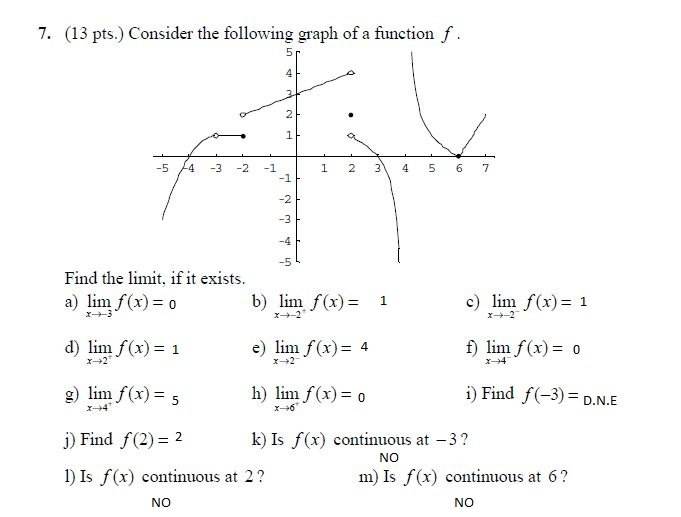
I'm having a really difficult time understanding limits from the graph. I don't completely understand how to find if the limit exists or not. I tried to do these for my homework but I don't know if they are right. Could someone please help me understand limits?
152hn36.jpg
 
Physics news on Phys.org
I'm having trouble reading the little + and - symbols in your limits. Is there any way you can display this at a higher resolution?

[edit] just noticed that in b and c, the limits are as x approaches -2, whereas in d and e, x approaches 2.

The first one that looks wrong is b. Is that the limit as x approaches -2 from the positive side? If so, the answer is not 1. To answer this question, ignore everything to the left of x = -2, and ignore what happens at x = -2 itself. Focus only on what the graph is doing as x approaches -2 from the right side. What number is the graph approaching?
 
B and C are -2, whereas D and E are +2. Going blind looking at it.
 
The limits appear to be:
\begin{align*}
\lim_{x \to -3} f(x) \\
\lim_{x \to -2^+} f(x) \\
\lim_{x \to -2^-} f(x) \\
\lim_{x \to 2^+} f(x) \\
\lim_{x \to 2^-} f(x) \\
\lim_{x \to 4^-} f(x) \\
\lim_{x \to 4^+} f(x) \\
\lim_{x \to 6^+} f(x)
\end{align*}
 
calculus123 said:
I'm having a really difficult time understanding limits from the graph. I don't completely understand how to find if the limit exists or not. I tried to do these for my homework but I don't know if they are right. Could someone please help me understand limits?
Explain how you arrived at your answers, so we can see where you're going wrong.
 
Question: A clock's minute hand has length 4 and its hour hand has length 3. What is the distance between the tips at the moment when it is increasing most rapidly?(Putnam Exam Question) Answer: Making assumption that both the hands moves at constant angular velocities, the answer is ## \sqrt{7} .## But don't you think this assumption is somewhat doubtful and wrong?

Similar threads

  • · Replies 10 ·
Replies
10
Views
2K
  • · Replies 7 ·
Replies
7
Views
1K
  • · Replies 16 ·
Replies
16
Views
3K
  • · Replies 8 ·
Replies
8
Views
2K
  • · Replies 7 ·
Replies
7
Views
2K
  • · Replies 9 ·
Replies
9
Views
2K
  • · Replies 5 ·
Replies
5
Views
2K
Replies
5
Views
2K
Replies
11
Views
2K
Replies
19
Views
2K