Runei
- 193
- 17
Hi there,
Once again I find myself twiddling around with some quantum mechanics, and I bumped into something I find strange. I can't see what the error of my thinking is, so I hope someone could be able to point it out.
I'm looking at solutions to the infinite square well, and arrive at the simple differential equation
\frac{d^2\Psi}{dx^2} = -k^2 \Psi
The solution to this can be written in terms of complex exponentials or sines and cosines. I bumped into the weird stuff when I use complex exponentials.
So the general solution in that case would be
##\Psi(x) = Ae^{ikx}+Be^{-ikx}##
Now, what I then started thinking was: "Hmmm... This could be viewed mathematically as a sum of two vectors, and solution is simply another vector."
So I drew this picture to illustrate the idea:
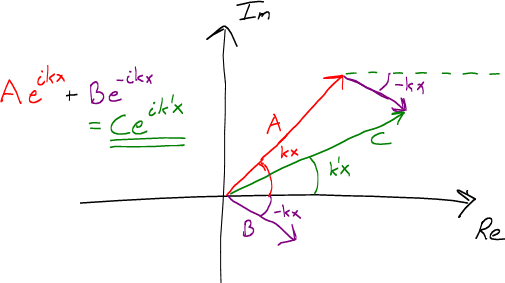
So from that perspective it seems that the solution could also be written as
##\Psi(x) = Ce^{ik'x}##
However, using the simple constraints of the infinite square well quickly leads to problems - namely:
##|\Psi(0)|^2 = 0##
##C = 0##
So... Now really what I had hoped for. Where am I going taking a wrong turn? Has it to do with the x? That x should be x' also?
Thanks in advance :)
Once again I find myself twiddling around with some quantum mechanics, and I bumped into something I find strange. I can't see what the error of my thinking is, so I hope someone could be able to point it out.
I'm looking at solutions to the infinite square well, and arrive at the simple differential equation
\frac{d^2\Psi}{dx^2} = -k^2 \Psi
The solution to this can be written in terms of complex exponentials or sines and cosines. I bumped into the weird stuff when I use complex exponentials.
So the general solution in that case would be
##\Psi(x) = Ae^{ikx}+Be^{-ikx}##
Now, what I then started thinking was: "Hmmm... This could be viewed mathematically as a sum of two vectors, and solution is simply another vector."
So I drew this picture to illustrate the idea:
##\Psi(x) = Ce^{ik'x}##
However, using the simple constraints of the infinite square well quickly leads to problems - namely:
##|\Psi(0)|^2 = 0##
##C = 0##
So... Now really what I had hoped for. Where am I going taking a wrong turn? Has it to do with the x? That x should be x' also?
Thanks in advance :)
