Mathematical problem about Buffon's Needle

  • Context: Graduate 
  • Thread starter Thread starter frostysh
  • Start date Start date
  • Tags Tags
    Mathematical Needle
Click For Summary

Discussion Overview

The discussion revolves around Buffon's Needle problem, which involves calculating the probability that a needle of length L, dropped onto a floor ruled with parallel lines spaced D apart, will intersect one of the lines. Participants explore various approaches to solving the problem, express frustrations with their own solutions, and seek clarification on specific aspects of the mathematics involved.

Discussion Character

  • Exploratory
  • Technical explanation
  • Debate/contested
  • Mathematical reasoning

Main Points Raised

  • One participant, frostysh, describes their attempts to solve the problem and expresses dissatisfaction with their results, noting that their solution approximates the correct probability for small values of D and L but diverges for larger values.
  • Another participant, Buzz, suggests a different approach involving two variables: the position of the needle's center and the angle of the needle, both of which have uniform distributions. They propose calculating the range of values for these variables that correspond to the needle crossing a line.
  • A third participant critiques frostysh's diagram, pointing out that while some line segments intersect the vertical lines, others do as well, indicating a need for clarity in the representation of the problem.
  • Frostysh acknowledges the complexity of the problem and mentions a book solution that involves integrals, expressing a desire to understand this approach better.
  • Frostysh also reflects on their use of informal language and slang, considering how it may affect the perception of their contributions in the forum.

Areas of Agreement / Disagreement

Participants express varying levels of understanding and approaches to the problem, with no consensus reached on a definitive solution or method. Disagreements exist regarding the interpretation of the diagram and the conditions under which the needle intersects the lines.

Contextual Notes

Frostysh's solution appears to be based on geometric reasoning but lacks clarity in certain areas, particularly regarding the conditions for intersection. The discussion includes references to integrals and probability calculations that remain unresolved.

Who May Find This Useful

This discussion may be of interest to those studying probability theory, geometric probability, or anyone looking to understand the complexities of Buffon's Needle problem and the various methods of approaching it.

frostysh
Messages
63
Reaction score
3
Buffon's Needle

A floor is ruled with equally spaced parallel lines a distance
D apart. A needle of length L is dropped at random on the floor. It is assumed that L no more than D. What is the probability that the needle will intersect
one of the lines? This problem is known as Buffon’s needle problem.


In summary, I think I spent on this problem a few month, trying to solve it, but suddenly without much of success. For now I have no sleep at night, and I have found some solution, unfortunately this solution is seems to be wrong, I have checked it with a book solution, and me is very sad and crying about that :sad:

So I need hint with this cursed problem, to be more preciously with my solution, why my solution sux. My solution can give a good approximation with small numbers of D, and L

Actually solution:

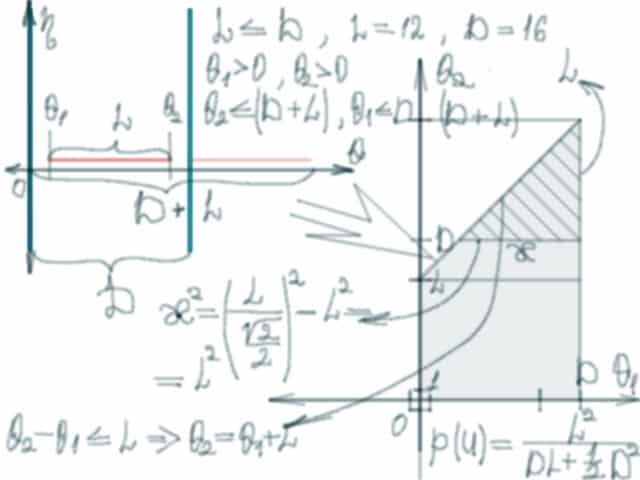
I have draw a few coordinate Axis, Theta is perpendicular to lines on the floor, Eta is parallel to them. The endpoints of a Needle, have its own coordinates.
Buffon_stick.jpg


Then I have represented all possible values of coordinates of this endpoints as side of the rectangle. This coordinates of endpoints must be no more than L. From this stuff I have build the equation for the line in the Cartesian Coords. Then I have calculate the total area of my shape, and then I have calculated the area of triangle in which the endpoints in the different "sides" of the line, which is mean the line must be crossed.

Then I have divide this triangle are by the total area, and multiplied by factor two, because there is a two line that can be crossed, and I have obtain the probability that the frigging needle will cross the frigging line. p(U). In case of D = 16, and L = 12, my formula gives probability approx. 0,45, and formula which has been discovered by this mr Buffon, gives to us 0,477.
Perhaps I need little bit correct my stuff, and then it will sux no more? :( .

Thanx for the answers.

P.S. My solution is actually on the images so I hope, this forum will show ma' images, if not - https://s25.postimg.org/bcx5x9ifj/Buffon_stick.jpg, this is a direct link. And sorry for ma' english level.
 
Physics news on Phys.org
Hi frostysh:
I apologize for not referring to your diagram, but I am unable to understand how the diagram represents your work towards a solution.

I offer a suggestion about an approach to the problem. There are two variables related to whether the needle will cross a line.
1. P = the position of the center of the needle with respect to the lines. This variable has a uniform distribution between 0 and L/2.
2. A = the angle of the needle with respect to the lines. This variable has a uniform distribution between 0 and π/2.
You need to calculate the range of values of P and A corresponding to the needle crossing a line.

Regards,
Buzz
 
frostysh said:
why my solution sux.

In your diagram it is true that all line segments of length L with one endpoint (x,y) that lies in the triangle (D-L, D),(D,D),(D,D+L) is a line that intersects the vertical lines. However, there are also some line segments of length L with one endpoint (x,y) in the figure bounded by (0,0),(D,0),(D,D)(D-L,D)(0,L) that intersect the vertical lines.
And sorry for ma' english level.

Your English would be better if you used ordinary words like "my" instead of slang like "ma". The general impression that slang like "sux", "friggin", "thanx" gives on a USA English speaking forum is that the writer is a teenager or pre-teenager. Of course, that might be correct in your case, but you will taken more seriously if you don't use such slang.
 
Last edited:
First off - thanks to all, this forum is useful for me indeed.

@Buzz Bloom

Well, it's ok - often even frostysh can't understand the nonsense that frostysh draws on the diagrams ;) . I have spent few month (of course with a long pauses) in my attempts to solve this ... problem. Then I have found the solution that we can see on the diagram, but after I have checked my numeric answer with the "book's" formula, I have realized that my solution little bit s... not so good as it need to be, wel in the small numbers it very close to the right answer, when numeric values of D, and L is increasing, the abyss between my solution and normal is increasing too :/, I am was very sad, so I have look into a books solution, which is including some crazy Integral stuff (that based on the position of the center, and angle - right what you saying), etc, I have understand almost nothin - so I decided to "update my solution" to obtain same answer like in the book :) . But I will think about those integralic stuff too.

@Stephen Tashi

I have no realized why our bloody stick will intersect those lines, on the floor, when values of it's coords will be in the next figure (0,0),(D,0),(D,D)(D-L,D)(0,L), coz' boz of endpoints will be inside of our "belt", perhaps you did mentioned second line, but to count it I have multiplied ## p(U) ## by factor two, and that because I have obtain ## p(U) \sim L^{2} ##, but not ## p(U) \sim \frac{1}{2} L^{2} ##. I need to think... *thinking*

P.S. About a language - Or, my intellect just not "evolve", and it in the same state as when I was a kiddo, lol... This is bad coz' it's my favorite words: "nonsense", "sux", "frigging", etc. It will be hard to rid from this habits to suse them, but I will try...
 

Similar threads

  • · Replies 2 ·
Replies
2
Views
2K
  • · Replies 7 ·
Replies
7
Views
2K
Replies
3
Views
2K
Replies
37
Views
6K
  • · Replies 12 ·
Replies
12
Views
3K
  • · Replies 2 ·
Replies
2
Views
2K
  • · Replies 6 ·
Replies
6
Views
2K
  • · Replies 2 ·
Replies
2
Views
2K
  • · Replies 24 ·
Replies
24
Views
7K
  • · Replies 25 ·
Replies
25
Views
3K